Leviosa AI aims to set the standard for online sales automation
Online sales now sprawl across countless social platforms… Sellers struggle to create videos and materials for every product
Fusing content production with operations management through automation… Founded by KAIST- and Seoul National University-educated brothers
Tracking consumer responses to each piece of content… “We will become an AI company that discovers superior sales methods”
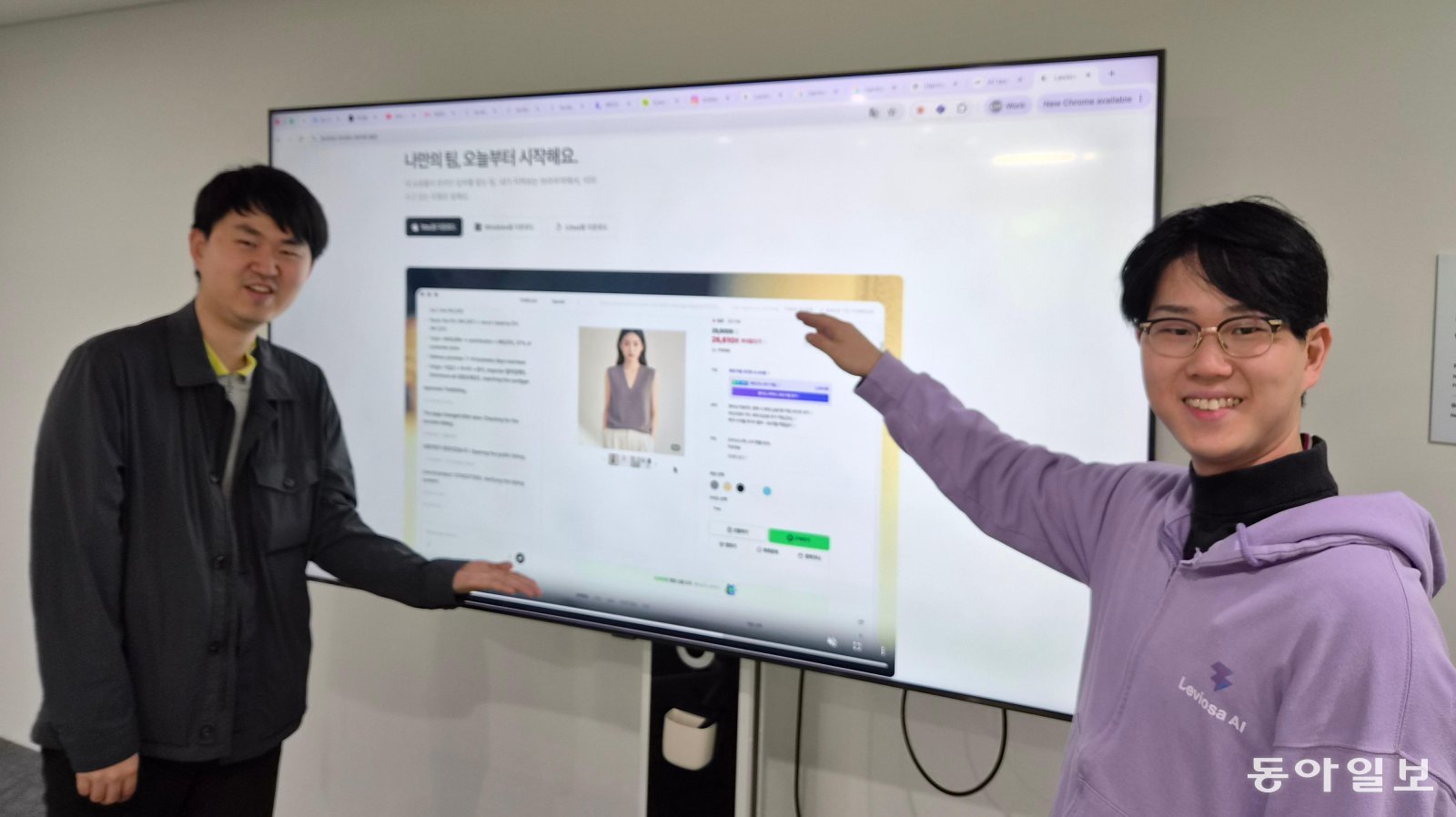
Leviosa AI CEO Ju Haram (left) and co-founder and Chief Operating Officer (COO) Ju Hadam explain their service, an automation tool for online sellers, at the company’s office in Mapo District, Seoul, on the 15th of last month. Photo by reporter Heo Jin-seok, jameshur@donga.com
The challenges facing online sellers never end. They must take product photos, hire models, retouch images, and create product detail pages. On top of this, they have to produce photos and videos for social networking services (SNS) and upload them to dozens of domestic and overseas platforms. Even after creating this content, the work is not over. They must check which channels to upload to, which copy generates engagement, and whether this actually leads to orders. Leviosa AI aims to establish a new standard for online sales by integrating content production for product promotion with product sales management.
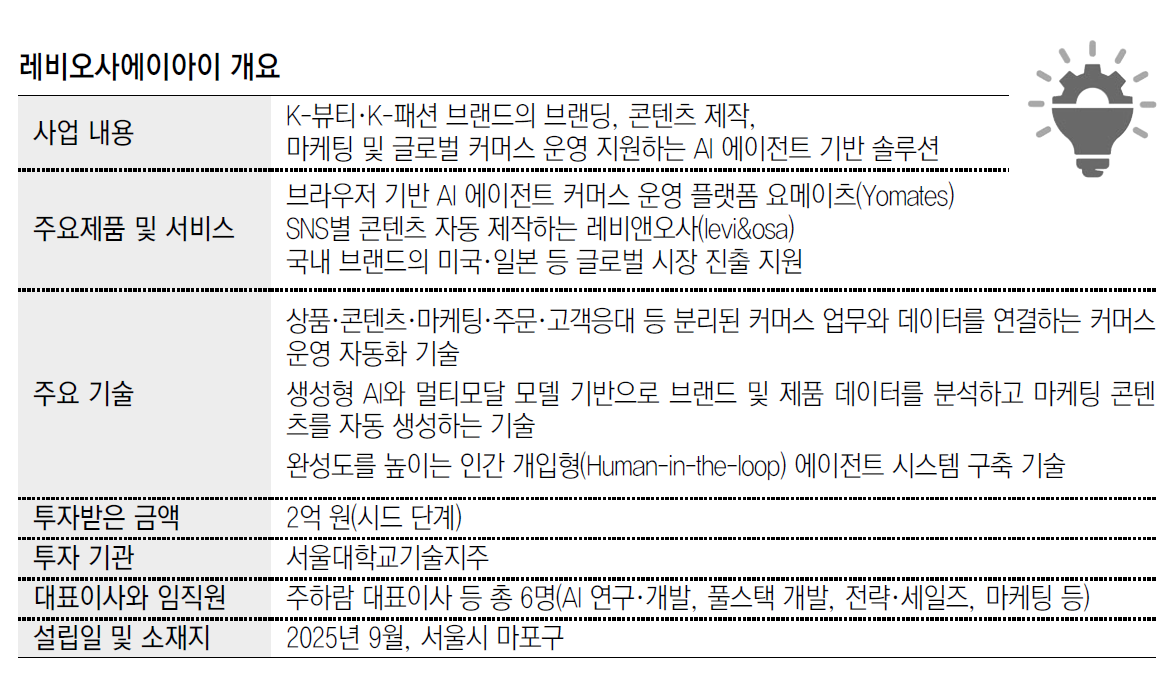
At Leviosa AI’s office in D.CAMP in the Front1 Building in Mapo District, Seoul, on the 15th of last month, CEO Ju Haram (31) said, “The two biggest concerns for sellers are increasing sales and preventing workload from increasing when sales rise,” adding, “We are building an ‘AI commerce network’ that helps ensure content production leads to sales conversion and enables operations with minimal burden even when the company grows and more new products come in.”
● Creating sales content for each medium from a single photo
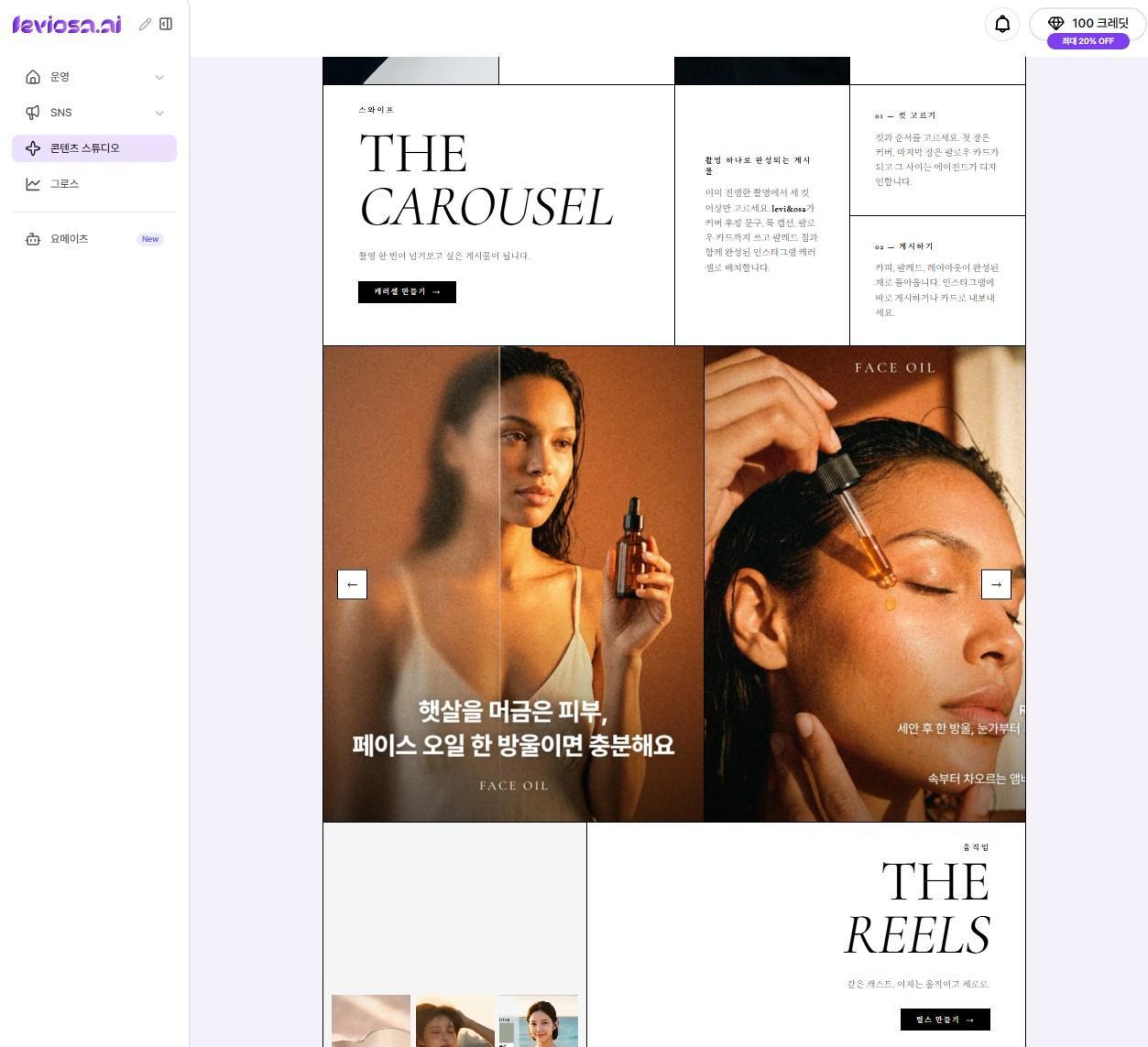
Leviosa AI’s service includes an artificial intelligence (AI) content studio called “levi&osa.” Users upload a single product photo and then select whether to use a model, plus lighting, mood, and style. The system then generates eight editorial-style images. The process does not end there. Based on the generated images, it also creates Instagram card news, Reels videos, and even shopping mall product detail pages. The company explains that this entire series of outputs can be completed in about 30 minutes per product.
The problem with existing generative AI is “prompt labor.” To obtain the desired output, users must repeat inputs 10 to 15 times. The company says it has virtually eliminated this process.
The key lies in “harness engineering,” which imposes sophisticated rules and constraints to consistently generate high-quality outputs. On top of this, Leviosa AI has added a separately developed evaluation model to further enhance completeness. COO and co-founder Ju Hadam (27) said, “AI initially filters out candidate outputs with defects, then the user reviews them, and the system regenerates or corrects them.”
The company is focusing its technology on categories where human models are crucial, such as beauty and apparel. COO Ju said, “We are confident that we can produce high-quality human modeling outputs in a single pass,” adding, “Existing generative AI tools will find it difficult to replicate this sophisticated workflow and sensibility.”
● ‘Yomates’ that works like a human through the browser
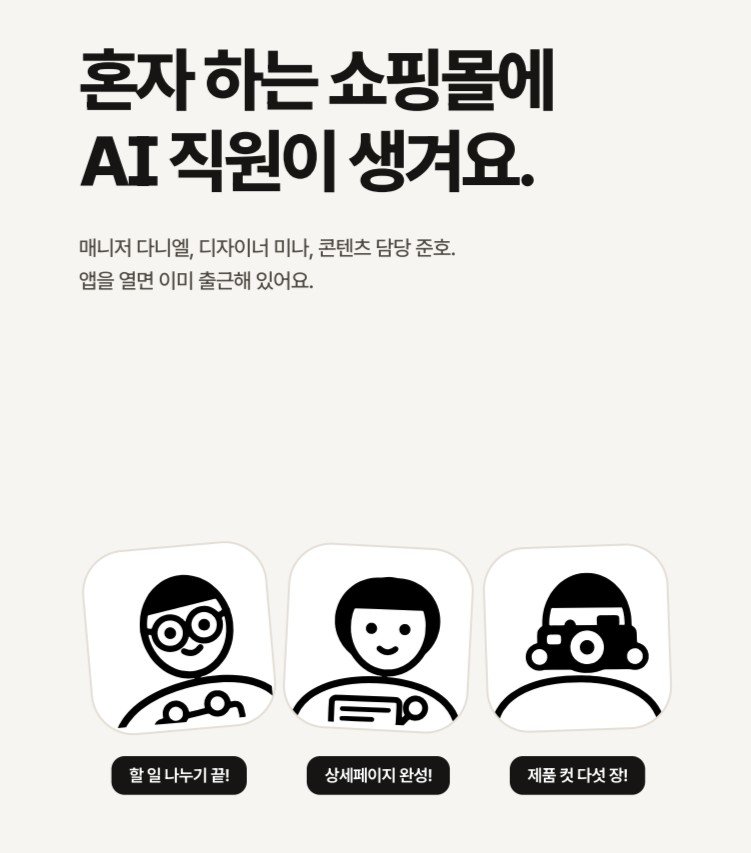
An image symbolizing the Yomates service. Provided by Leviosa AI
Once content is created, it then has to be sold. Leviosa AI’s core service under intensive development for the global market is “Yomates,” a browser-based AI agent platform. The company is currently operating a beta service and plans to switch to a paid service in November.
Yomates is not a simple operations automation tool. It is a service that enables users to operate online stores directly just by conversing with AI.
Most existing online sales automation tools operate based on application programming interfaces (APIs). However, according to Leviosa AI, sellers suffer considerable difficulties due to API blocking by sales platforms, expired authentication, and errors after updates. Instead of an API integration approach, Leviosa AI built its service using browser automation technology that functions as if a human were opening a Chrome browser and clicking through it.
COO Ju said, “If a user types in the chat window, ‘Find an ear cleanser with a margin and list it on Smart Store,’ the product listing is completed.” The AI agents’ workflow operates as follows, for example: the manager agent “Daniel” analyzes demand and calculates margins, then the designer agent “Mina” creates the product detail page and launches the browser to register the product on the platform. COO Ju said, “Compared with the conventional API method, we have significantly reduced errors.”
Yomates’ target market is not confined to Korea. It aims to be a global service encompassing diverse domestic and overseas platforms such as Amazon, Shopify, TikTok Shop, Naver Smart Store, and Cafe24. The goal is to avoid dependence on any specific shopping mall and instead unify multiple sales channels into a single conversational workspace.
● Partnership of a Seoul National University leave-of-absence student and a KAIST AI PhD
CEO Ju and COO Ju are brothers. The company’s direction and technology grew out of their combined experiences. Younger brother COO Ju entered the Department of Electrical and Computer Engineering at Seoul National University in 2017 and is currently on leave. To fulfill military service duties and build his skills as a developer, he worked as a programmer at Class101 and Dunamu before founding the startup. While working at a company, he separately operated a K-pop album Smart Store as a side project and alone generated annual sales of KRW 500 million and net profit of KRW 90 million. As a programmer, he automated ordering and shipping, reducing labor costs to KRW 0, which enabled profitability. However, he said he came to realize that the key to success in online sales lies in “content and marketing.” COO Ju explained his reason for founding the company in this field, saying, “I am good at development, but I did not have specialized knowledge in the entertainment sector needed to sell albums. So I thought I should build a platform as a developer.”
Older brother CEO Ju is an AI scholar with a PhD in artificial intelligence from KAIST and a former national representative in the Informatics Olympiad. He had planned to pursue an academic career until his younger brother persuaded him, saying, “Let’s do this together.” He now leads AI modeling and evaluation model development.
● “Data capturing consumer responses by content type is the key competitive edge”
A portion of the content studio screen. All photos that look like real models were generated by AI. Website screen capture
In the past, it took one to two weeks and tens of millions of KRW for multiple people—from planners and studio staff to models and retouchers—to create a single piece of content. Now AI tools have dramatically reduced this cost and time. However, the two brothers do not see mere reduction in content production costs as the solution. They note that many more brands are at a loss about where and how to distribute even well-made content. This is because consumers now discover and purchase products not through search boxes but through Instagram Reels, YouTube Shopping, and TikTok Shop feeds, in an era when the feed itself is the display shelf.
The company’s long-term goal is to build an AI-native commerce network that goes beyond simply providing tools. COO Ju said, “As AI advances, the costs of content generation and operations automation can drop significantly,” adding, “Even in such a future, we will retain competitiveness if we possess integrated sales data across multiple platforms on ‘which brand sold how much on which platform with what kind of content.’”
Toward the end of the year, Leviosa AI plans to establish a subsidiary in Singapore to link with global payment networks such as Stripe. This is because payment infrastructure is essential to support K-brands’ expansion into overseas markets such as the United States and Japan.
There are, of course, risk factors. If large corporations or platforms themselves start offering similar AI tools as default features, Leviosa AI’s position could be weakened. However, the company plans to overcome this with independent agents that are not tied to any specific platform and with unique data that spans multiple platforms.
Leviosa AI’s vision is a world where anyone can operate a global brand and online store simply by conversing with AI, without specialized e-commerce knowledge. levi&osa is the content production service designed to realize this vision, and Yomates is the central platform that links content production with actual commerce operations. CEO Ju said, “We aim to become the infrastructure of global commerce that enables Korean brands to enter the world market without heavy burden.”
ⓒ dongA.com. All rights reserved. Reproduction, redistribution, or use for AI training prohibited.
Popular News