Advancing aseptic processing and packaging technologies
Producing 700 million units annually and exporting to 60 countries including the U.S.
“A future growth engine that embodies Chairman Lee Jae-hyun’s philosophy
Targeting KRW 1.5 trillion in annual sales by 2028”
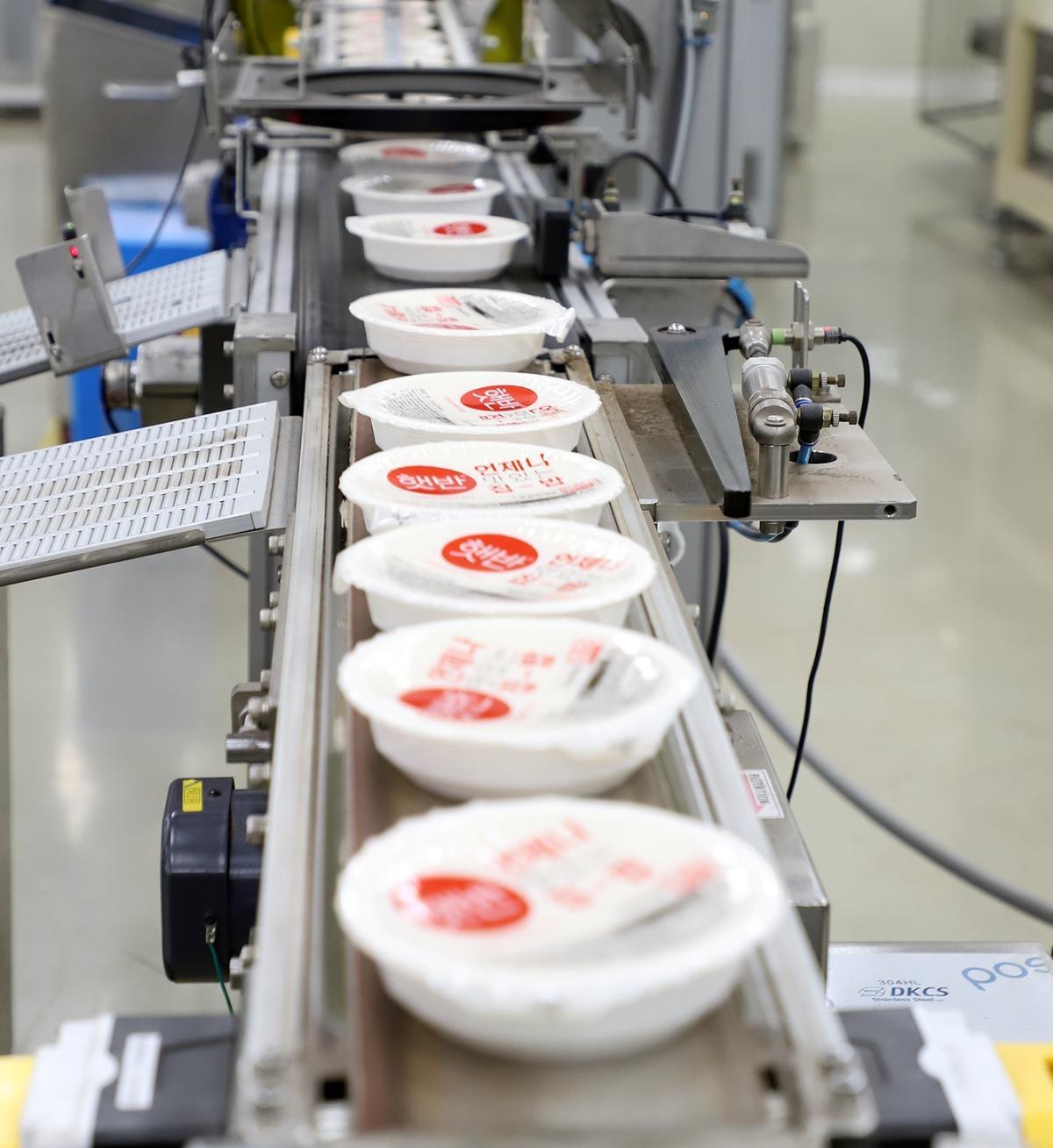
At the Hetbahn production line at CJ Blossom Campus in Jincheon, North Chungcheong Province, on the 21st, Hetbahn products are being manufactured. Marking the 30th anniversary of its launch this year, Hetbahn’s cumulative sales are expected to reach KRW 10 trillion by the end of the year. Provided by CJ CheilJedang
“Who would pay money to eat plain rice?”
In December 1996, “Hetbahn,” which broke the fixed notion that “rice is something that must be cooked at home with care,” made its debut and marks the 30th anniversary of its launch this year. At that time, Korean food culture was dominated by strong prejudice that instant rice meant “tasteless rice,” and that people who bought it were “lazy housewives.” However, as sociocultural changes such as the increase in single-person households and dual-income couples continued, Hetbahn has now become part of Korea’s everyday rice culture.
Sales, which were around KRW 7.0 billion in the first year of launch, grew to KRW 1.18 trillion on an annual basis last year. During the same period, Hetbahn’s domestic market share stood at about 66%. Cumulative sales volume reached 6.8 billion units; if all Hetbahn packs were lined up in a row, they would circle the Earth about 24 times. CJ CheilJedang stated, “Hetbahn is a product that symbolizes Chairman Lee Jay-hyun’s philosophy and determination to ‘create future food products with a 10- or 20-year horizon.’”
● Producing 700 million units a year with unrivaled technology To mark the 30th anniversary of Hetbahn’s launch, the Hetbahn production line at CJ Blossom Campus in Jincheon, North Chungcheong Province, visited on the 21st, proved to be an enormous facility the size of 70 soccer fields (about 490,000 m²). On six production lines, white Hetbahn containers were passing in rows along conveyor belts. Rice polished less than a day earlier was poured into empty containers, then sterilized with hot steam and high pressure. The containers were then transferred to a cooker acting as an oversized rice pot, and after about 30 minutes, freshly cooked Hetbahn appeared along with a savory rice aroma. From this site and the production facility in Busan, 700 million units of Hetbahn are produced annually and exported not only to Korea but also to more than 60 countries including the United States, Germany, and Vietnam.
CJ CheilJedang said, “Under Chairman Lee’s ‘Only One’ philosophy, Hetbahn has consistently emphasized ‘super-gap R&D (research and development),’” adding, “From the selection of rice varieties and raw materials through polishing, aseptic processing, packaging, and nutritional design, the company has developed unrivaled technological capabilities, including aseptic technology.” The number of brand-related patents filed at home and abroad totals 267.
Oh Ye-jin, principal researcher at CJ CheilJedang Food Research Institute, said, “These technological capabilities have formed the foundation for product diversification beyond white rice to multigrain rice, Sotban (pot-cooked-style rice), and global white rice products.” As the domestic food market has been reorganizing around health-oriented products, the share of multigrain rice in Hetbahn’s domestic sales has risen from the 10% range in 2019 to nearly 30% last year. In December, the company also plans to launch “Protein Multigrain Rice,” which mixes rice made from plant-based protein and contains protein equivalent to more than three egg whites.
● Hetbahn riding the K-boom into global markets
As the domestic instant rice market enters a mature phase, CJ CheilJedang is also focusing on expanding overseas markets. Just as CJ CheilJedang redefined dumplings overseas from “dumpling (Chinese-style dumplings)” to “mandu (Korean-style dumplings)” through its “bibigo” brand, the company aspires to nurture Hetbahn as the flagship “next K-wave” product following dumplings.
Hetbahn’s overseas sales have grown by about 30% annually on average over the past five years. This has been aided by the global popularity of wellness trends and the surge of “gluten-free” diets in the US market, which have spotlighted rice as a healthier food than bread.
The growing curiosity among overseas consumers about Korea’s unique “chewy, sticky rice” through K-dramas and K-pop stars has also been a positive factor. Generally, foreigners are familiar with long-grain rice from Southeast Asia, where the grains are long and separate easily, but due to the rising popularity of K-food, Hetbahn’s share in the US instant rice market has climbed to 11.9%.
Kim Sook-jin, head of Food Marketing at CJ CheilJedang, said, “Hetbahn, which has evolved from an ‘emergency food’ eaten in a pinch to an ‘everyday meal’ that replaces home-cooked rice, will now be grown into a ‘health food’ that provides healthy carbohydrates,” adding, “We aim to grow Hetbahn into a brand with KRW 1.5 trillion in annual domestic and overseas sales by 2028 and to increase the share of overseas sales from 15% to as high as 25%.”
ⓒ dongA.com. All rights reserved. Reproduction, redistribution, or use for AI training prohibited.
Popular News