Next Challenge for Nuriho After 5th Successful Launch
Proving multiple separation with deployment of five satellites… Expanding fairings to address limited payload space
Raising launch success rate from 80% to over 90%… Tackling high launch costs and increasing frequency beyond once a year
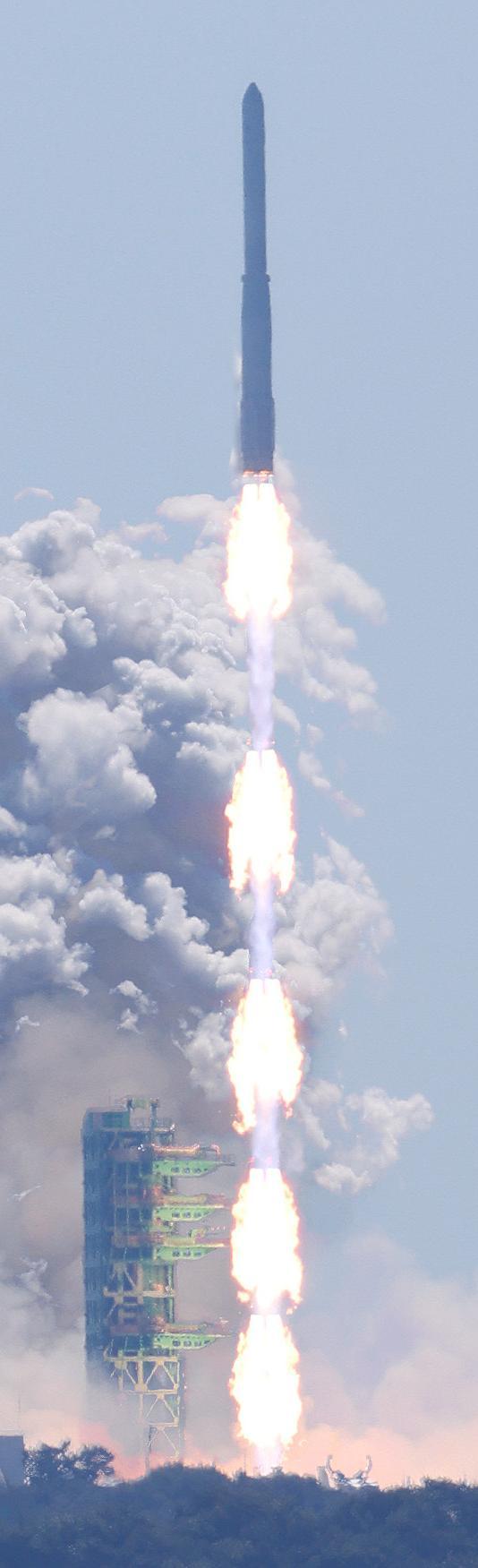
The Korean launch vehicle Nuri lifts off from the Naro Space Center in Goheung-gun, Gwangju, Jeollanam-do, on the afternoon of the 7th. With the success of its fifth launch, Nuri has achieved an 80% launch success rate. The Korea AeroSpace Administration announced that it will raise the success rate to 90% through repeated launches. News1
On the 7th of this month, during its fifth space flight, the Korean launch vehicle Nuri was launched at the scheduled time for the first time and precisely placed five primary payload satellites into their target orbits. It reached the target altitude of 575 km and a speed of 7.5 km per second, and successfully deployed the ultra-small satellite constellation NEONSAT No. 2 to No. 6, achieving two-way communication with all of them. Nine out of ten CubeSats, which were secondary payload satellites, were also successfully separated.
Having succeeded in its fifth launch, Nuri now faces the task of enhancing its value as a launch vehicle. The next step is to upgrade its commercial viability based on space transportation capacity and reliability. This involves improving satellite payload performance and launch success reliability, while establishing a private sector-led system for launch vehicle production and operation to move toward commercialization.
● “More space needed for satellites… Launch vehicle upgrades required”The key technical achievement of the fifth launch was the demonstrated capability to precisely separate multiple primary payload satellites in different directions. During flight, Nuri changed its attitude and angle to sequentially separate the five NEONSAT satellites. To prevent collisions between satellites, it adjusted the separation direction and timing, and newly applied devices that reduce shocks occurring during the separation process. Koh Jung-hwan, former Director of the Korean Launch Vehicle Development Program at the Korea Aerospace Research Institute (KARI), evaluated that “by increasing the number of primary payload satellites, it has been proven that all the changes made for the fourth launch are working well.”
The next task is to secure more space to carry satellites and maximize transportation capacity. As the capability for precise multi-satellite separation has been demonstrated through the fifth launch, experts say Nuri needs to be upgraded so that it can carry as much as possible within its payload capacity.
Gong Cheol-won, Head of Launch Vehicle System Research Division 1 at KARI, explained, “Currently, Nuri lacks actual space to load satellites relative to the mass it can transport.” This means that even if there is design margin in payload mass, the volume, number, or structure of satellites can limit what can be loaded. Gong said, “In cooperation with Hanwha Aerospace, the system integrator, we are planning to increase the diameter and length of the fairing, which is the cover that protects the satellites, in order to secure more space.”
● Using reliability to offset limits in price competitivenessWith the success of Nuri’s fifth launch, its cumulative launch success rate stands at 80%. Oh Tae-seok, Administrator of the Korea AeroSpace Administration (KASA), has set a goal of raising the launch success rate to over 90%. Hyun Seong-yoon, Director of the Korean Launch Vehicle Program at KASA, explained, “There is no internationally established standard for launch success rates, but the idea behind the goal is that it likely needs to be at least 90% for a launch vehicle to be recognized in the global market as one that customers can trust and use.”
In the commercial launch market, however, not only cumulative success rates but also a record of consecutive successful launches and the ability to meet customer schedules are crucial. Launch vehicle reliability affects both satellite launch insurance premiums and customers’ choice of launch services. Hyun noted, “It is true that the launch price is higher than that of overseas launch vehicles,” and expressed the view that Nuri should leverage reliability as a competitive factor to compensate for its limited price competitiveness. He also assessed that adhering precisely to the scheduled launch time in this mission demonstrates improved launch operations capability.
To translate these technical achievements into actual commercial launch services, Hanwha Aerospace, the private company participating as Nuri’s system integrator, must independently manufacture and operate the launch vehicle while seeking ways to enhance price competitiveness. Former Director Koh pointed out, “Nuri’s technical achievements and its commercial competitiveness should be evaluated separately,” adding, “Nuri is the outcome of a research and development project, and separate upgrades and efforts are required for commercialization.”
A transition in the production and operation system is also needed to support repeated launches. Gong said, “The current launch pad and launch preparation process are designed on the basis of one launch per year,” explaining that facilities and operating procedures must be improved to enable two or more launches annually. An increase in launch vehicle production volume is also expected to help lower unit production costs.
To secure sufficient launch demand, KASA is also pursuing plans to expand launch services from primarily public and defense satellites to include private satellites. A space industry official predicted, “Nuri’s future commercialization will depend on its ability to build reliability through repeated launches, enhance transportation capacity and cost-effectiveness, and establish a system under which private companies can independently provide launch services.”
ⓒ dongA.com. All rights reserved. Reproduction, redistribution, or use for AI training prohibited.
Popular News