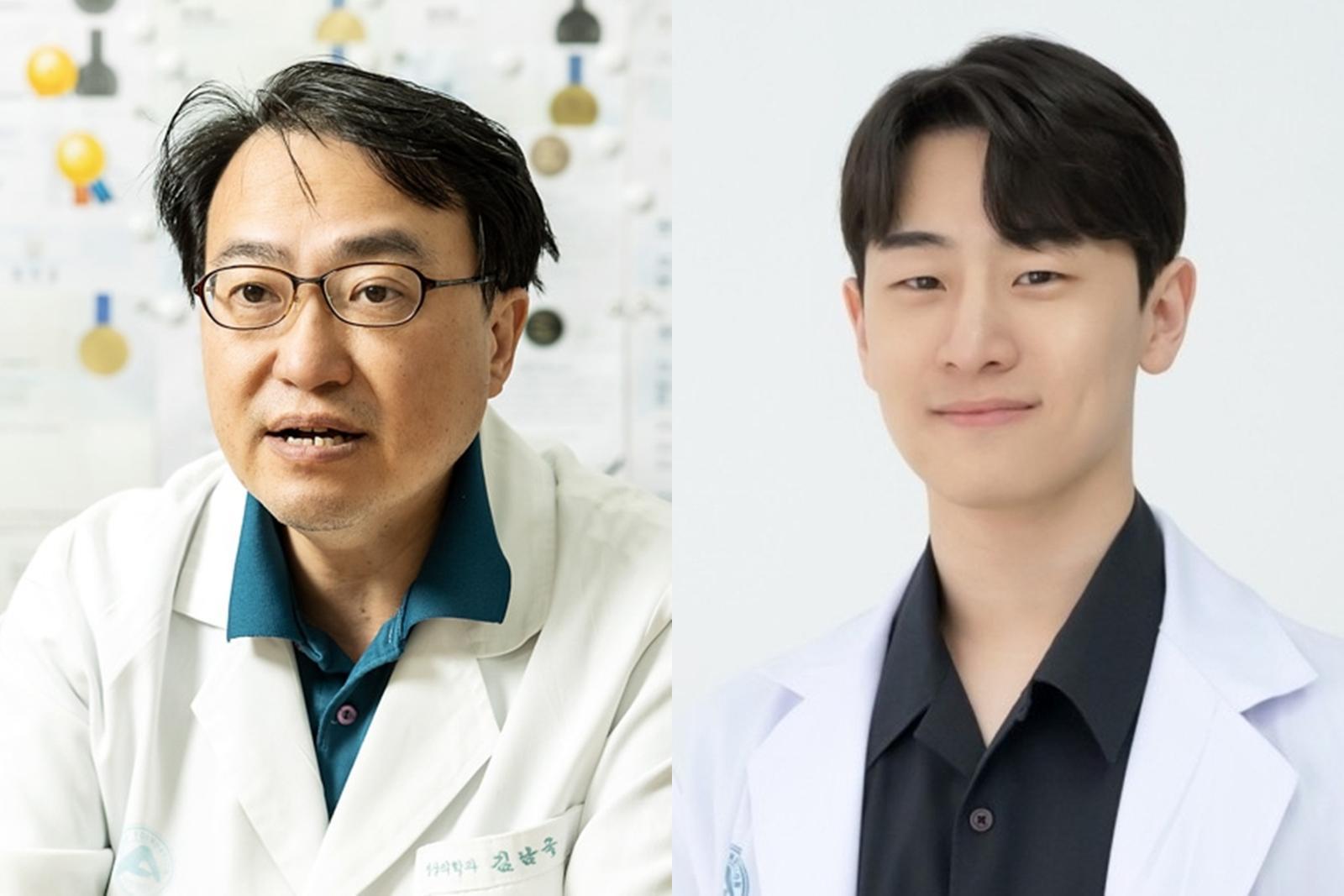
Professor Kim Nam-kuk of the Department of Convergence Medicine at Asan Medical Center in Seoul (left) and Dermatology Resident Kim Kyung-hoon.
Artificial intelligence (AI) that diagnoses skin diseases can show different levels of accuracy depending on the skin color of the patients used for training. Because existing training data are concentrated on light skin, diagnostic performance can decline for patients with darker skin. A Korean research team has developed a technology that uses AI to darken only the skin tone in images while preserving lesions on light skin as they are.
A research team led by Professor Kim Nam-kuk of the Department of Convergence Medicine at Asan Medical Center in Seoul, Dermatology Resident Kim Kyung-hoon, and Dermatologist Moon Ik-jun announced that they have developed a “Skin Type Transfer Network (STTN)” to reduce AI diagnostic performance gaps caused by skin color.
The diagnostic accuracy of AI is affected by the volume and composition of training data. However, clinical photographs used for AI-based skin disease diagnosis are mainly focused on light skin. In particular, it is relatively difficult to obtain images of darker-skinned patients whose diseases have been definitively diagnosed through biopsy. As a result, concerns have been raised that AI may fail to deliver sufficient diagnostic performance for patients with certain skin tones.
STTN, developed by the research team, is a technology that darkens only the skin tone while preserving the shape of the lesion as much as possible, based on photographs of actual patients’ skin lesions. Unlike general generative AI, which creates new lesions, this system is designed to convert existing images to supplement insufficient training data.
The team trained STTN using 16,707 clinical data points and then evaluated how similar the generated images were to real photographs. A total of 42 individuals—including 19 dermatologists, 12 physicians from other specialties, and 11 non-medical professionals—were asked to distinguish between real photographs and AI-generated images.
The results showed an average accuracy rate of 49.7%, similar to random guessing. This indicates that evaluators, including medical professionals, found it difficult to distinguish real photographs from AI-generated ones. However, dermatologists with extensive clinical experience tended to detect subtle differences in the generated images.
The research team then examined whether AI-generated images actually improved diagnostic performance. They compared an existing AI model trained only on light-skin images with a model additionally trained on dark-skin images generated by STTN.
As a result, the area under the curve (AUC), which represents the performance of distinguishing benign from malignant skin tumors, increased from 0.56 to 0.66. An AUC closer to 1 indicates better discrimination performance. Sensitivity, which measures how accurately patients with disease are identified, and specificity, which measures how accurately those without disease are distinguished, also improved. Diagnostic performance for light skin was maintained.
This study is significant in that it demonstrates the potential to mitigate diagnostic performance disparities by skin color by using AI to supplement data for patient groups with limited real-world clinical data. However, additional verification is needed to determine whether the same results are reproduced in actual clinical practice.
Professor Kim Nam-kuk stated, “In medicine, performance at the level of the individual patient is more important than average AI performance,” adding, “We will work to develop fair AI whose accuracy does not vary depending on race, skin color, gender, or age.”
The findings of this study, conducted in collaboration with a research team in Ethiopia, were published in the international journal Journal of Investigative Dermatology.
ⓒ dongA.com. All rights reserved. Reproduction, redistribution, or use for AI training prohibited.
Popular News