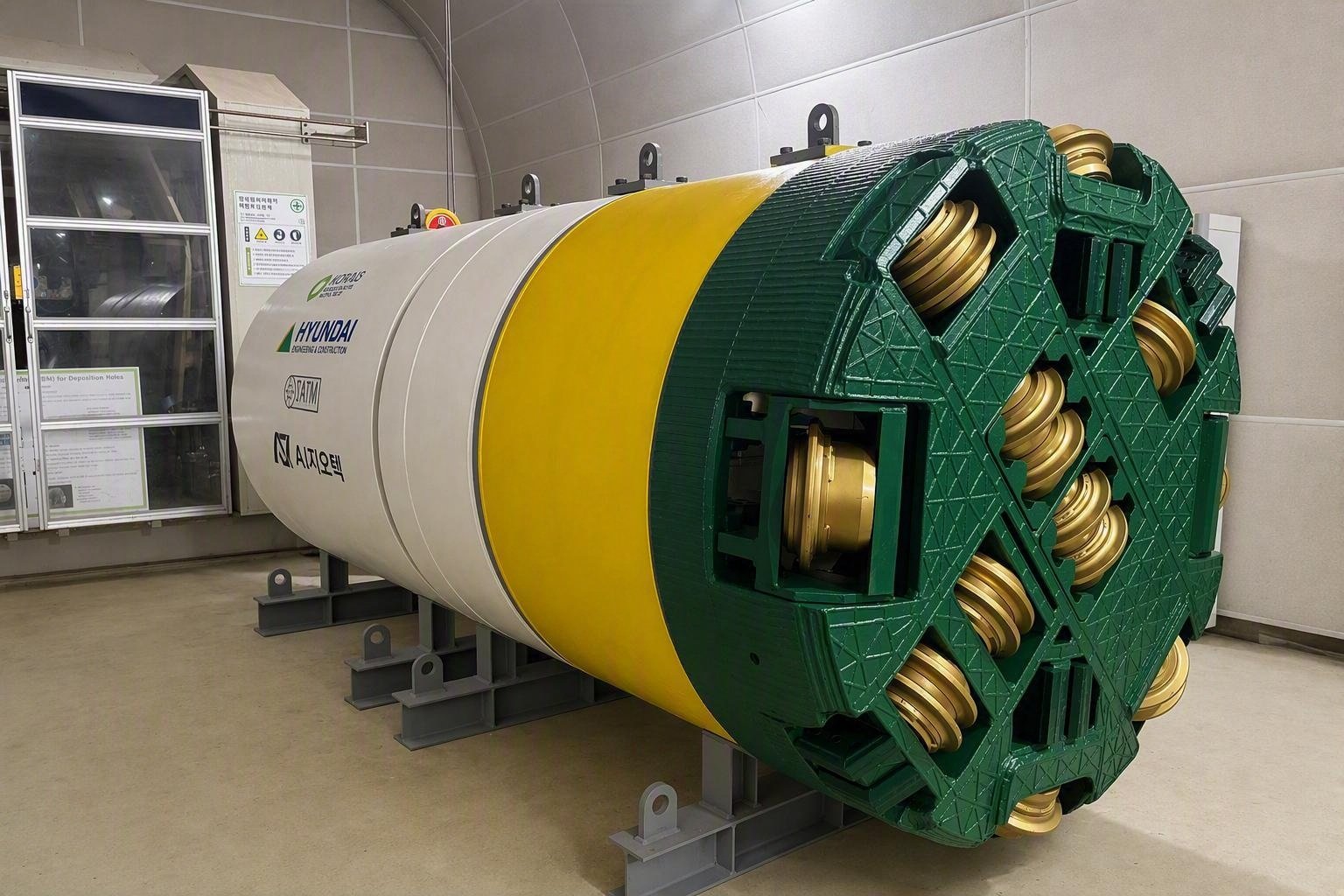
Excavation equipment exclusively for spent nuclear fuel disposal holes developed by Hyundai Engineering & Construction. Provided by Hyundai E&C.
Hyundai Engineering & Construction has secured a core excavation technology designed to safely isolate and dispose of spent nuclear fuel from nuclear power plants in deep underground rock formations.
Hyundai E&C announced on the 2nd that it has become the first Korean construction company to develop excavation equipment dedicated to spent nuclear fuel disposal facilities and has completed excavation in underground bedrock at a research demonstration site on the same scale as an actual disposal facility.
Spent nuclear fuel refers to nuclear fuel that has been used for power generation in a nuclear power plant and then removed from the reactor. Even after use, it continues for a long period to emit high levels of radioactivity and heat, and therefore must be safely managed in isolation from the external environment.
One of the methods for long-term management of spent nuclear fuel is to construct disposal facilities in deep underground bedrock to isolate it. The holes drilled in the bedrock to emplace the disposal canisters containing sealed spent nuclear fuel are called “disposal holes.”
The equipment developed by Hyundai E&C this time is a dedicated excavator that drills these disposal holes with high precision. If cracks or damage occur in the surrounding rock mass during the creation of disposal holes, pathways for groundwater flow may form, making it crucial to excavate accurately while minimizing rock damage.
The equipment developed by Hyundai E&C has a diameter of 1.75 m and a length of 5.7 m, and reflects the specifications and construction conditions for disposal holes required by the Korean Deep Geological Disposal System (KORADIS). A “foldable cutterhead” has also been applied so that the equipment can be retrieved and reused after excavation, enabling repeated construction of multiple disposal holes.
Hyundai E&C verified the performance and constructability of the equipment by excavating bedrock in an underground research tunnel at the same scale as actual disposal holes. During excavation, artificial intelligence (AI) was used to analyze drilling data in real time and assess ground conditions. After excavation, LiDAR-based digital mapping was used to check the construction status and the suitability of the disposal holes.
This technology development was carried out through a national R&D project on spent nuclear fuel management technologies led by the Korea Radioactive Waste Agency. Hyundai E&C is the only construction company participating in the research. Related technologies are being developed under the leadership of HMG Construction Technology Research Institute, the integrated R&D organization of Hyundai E&C and Hyundai Engineering.
Hyundai E&C plans to expand the scope of research beyond disposal hole excavation to include concrete and grout for controlling groundwater inflow, a rock mass classification system reflecting domestic geological characteristics, and digital-based rock mass evaluation and monitoring technologies.
A representative of HMG Construction Technology Research Institute said, “We are the first Korean construction company to develop excavation equipment dedicated to disposal holes and to verify its performance and constructability through actual rock excavation,” adding, “We will continue to strengthen our technological capabilities across the entire lifecycle from nuclear power plant construction and decommissioning to spent nuclear fuel disposal.”
ⓒ dongA.com. All rights reserved. Reproduction, redistribution, or use for AI training prohibited.
Popular News