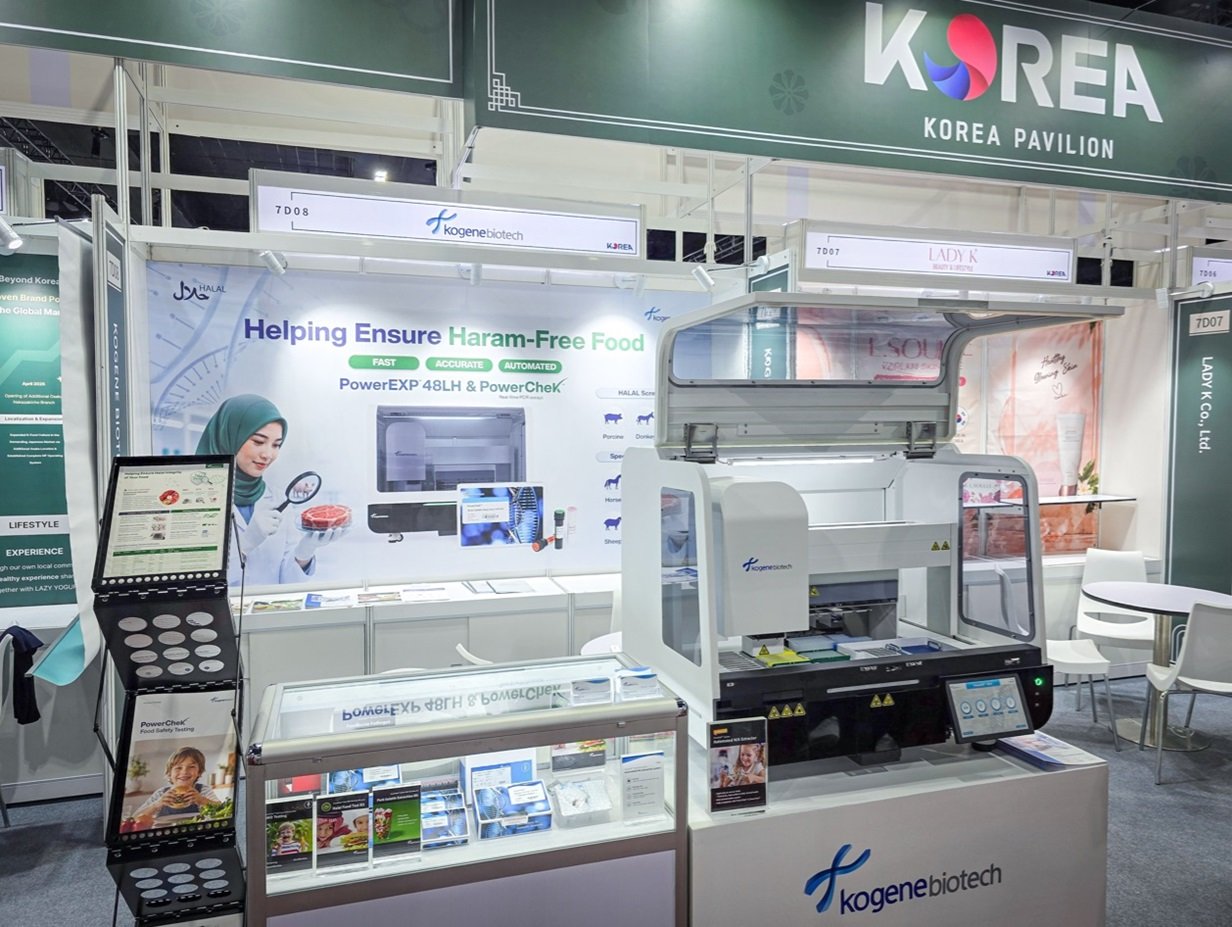
View of the KogeneBiotech booth at the ‘22nd Malaysia International Halal Showcase (MIHAS 2026)’
Automation technology is being applied to halal verification processes that test for pig-derived DNA contained in jellies, pharmaceuticals, and cosmetics. KogeneBiotech has unveiled in Malaysia a testing system that connects everything from DNA extraction to preparation for PCR reactions to detect pig-specific genes.
Molecular diagnostics company KogeneBiotech announced on the 28th that it participated in the ‘22nd Malaysia International Halal Showcase (MIHAS 2026)’, held from the 23rd to the 26th at the Malaysia International Trade and Exhibition Centre (MITEC) in Kuala Lumpur, and presented a testing system that links DNA-based halal testing products with automation equipment.
Halal testing is used not only for food but also to verify whether prohibited ingredients are contained in raw materials, pharmaceuticals, and cosmetics. For products such as gelatin, where it is difficult to visually distinguish the animal species of the raw material after processing, DNA analysis can be used.
The Department of Chemistry Malaysia has been operating a testing method that analyzes pig-derived DNA in food, gelatin, and other products. The pig DNA detection method ‘MS 2627:2017’ has also been established as a Malaysian national standard. The Malaysian government has pursued efforts to expand this method into a standard testing method that can be used by member states of the Organisation of Islamic Cooperation (OIC).
● Automation from DNA extraction to PCR preparation
The ‘PowerPrep Halal DNA Extraction Kit EXP’ introduced by KogeneBiotech is a product that extracts DNA from various samples such as food and raw materials. The ‘PowerChek Pork Gelatin Real-time PCR Kit’ detects pig-specific genes in gelatin and related processed products using a real-time PCR method.
The company connected these to its proprietary automated liquid handler ‘PowerEXP 48LH’. It is designed to automatically carry out processes from DNA extraction to PCR reaction preparation after sample pre-processing. KogeneBiotech has also developed an automated protocol that processes multiple processed food samples—such as jelly, marshmallows, and gelatin—under the same conditions.
KogeneBiotech has been developing halal testing kits since 2013. It has worked with Indonesia’s halal certification body LPPOM MUI to optimize DNA extraction methods and PCR testing methods for each sample type, and has carried out technology transfer and training for local researchers.
At this exhibition, the company also showcased products for testing genetically modified organisms (GMOs) and foodborne pathogens, as well as a lyophilized reagent system. These are molecular diagnostic product lines that can be applied not only to halal testing but also to raw material identification and food safety in the food sector.
● Expanding halal market from food to pharmaceuticals and cosmetics
MIHAS is a halal industry B2B exhibition hosted by the Ministry of Investment, Trade and Industry (MITI) of Malaysia and organized by the Malaysia External Trade Development Corporation (MATRADE). Now in its 22nd year, it covers 14 industry sectors including food and beverages, pharmaceuticals, personal care, and technology and services. The organizers estimate the size of the global halal economy at around USD 3.5 trillion.
Baek Myo-ah, Executive Vice President of KogeneBiotech, said, “We aim to build an integrated halal testing platform that goes beyond supplying single PCR reagents to connect sample pre-processing, nucleic acid extraction, PCR testing, and automation equipment,” adding, “We plan to expand cooperation with major testing and certification bodies in Asia and the Middle East.”
ⓒ dongA.com. All rights reserved. Reproduction, redistribution, or use for AI training prohibited.
Popular News