Participation from 11 experts including AI Computing professors “Data centers alone cannot sustain AI progress” Over KRW 60 billion invested in fundamental technology research
KAIST has established the first dedicated Artificial General Intelligence (AGI) research institute in Korea. The goal is to develop fundamental technologies that go beyond current artificial intelligence (AI), which handles only the tasks it has been trained on, to enable AI to independently judge and adapt even to completely new problems and environments. The institute aims to move away from competition focused on scaling up data and computing resources, and instead concentrate on creating AI that can respond to unfamiliar situations with limited resources.
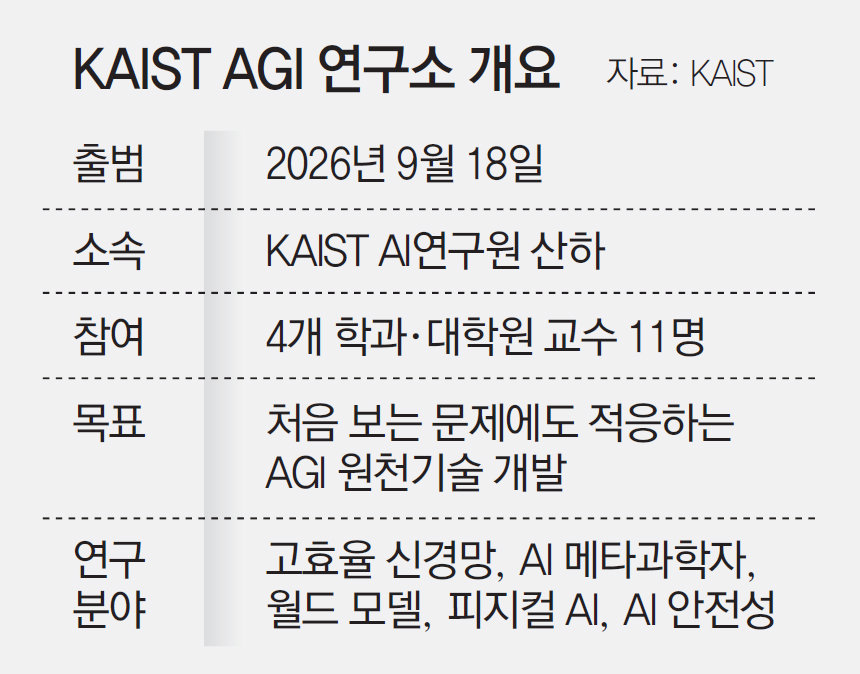
According to KAIST on the 21st, the AGI Research Institute was officially launched on the 18th as a research center under the KAIST AI Institute. Eleven professors from the School of Computing, the Department of AI Computing, the Kim Jae-chul Graduate School of AI, and the School of Electrical Engineering are participating, with Professor Tae-Kyun Kim of the School of Computing serving as the inaugural director. KAIST stated that, although there have been laboratories and organizations in Korea that study AGI-related technologies, this is the first time that a dedicated research institute has been established with AGI itself as a joint research objective.
AGI is AI that, like a human, broadly understands and solves problems across multiple domains. It must be able to handle heterogeneous tasks and unfamiliar situations, going beyond mere proficiency in a specific area such as Go or translation. The institute has set AI’s “generalization” ability—the capacity to apply what it has learned to entirely new problems—as its core objective. This is because current AI systems are strong on problems similar to those they were trained on, but often show degraded performance when conditions or environments change.
Director Kim said, “There is a limit to AI advancement if the approach is only to keep expanding AI data centers,” adding, “In next-generation AI competition, it is crucial to steadily develop fundamental AI technologies that can adapt to new problems even in resource-constrained environments.” The institute plans to redesign how AI processes information and learns, and to research technologies that enable AI to respond to first-encountered problems with limited resources.
The research areas are fivefold: △ “high-efficiency neural networks” that deliver performance with low computation; △ “AI meta-scientists” that autonomously formulate hypotheses and seek knowledge; △ “world models” that predict changes in the real world; △ “physical AI” that perceives and moves in real space like a robot; and △ “AI safety” to ensure AI does not deviate from human intent. Since these capabilities must operate together for AGI to make decisions and act in unfamiliar situations, the institute will conduct research by interlinking the domains. For example, it would enable a robot to predict the movement of obstacles and the outcome of its own actions in a space it is visiting for the first time, and to move accordingly.
The institute will begin with areas supported by the Ministry of Science and ICT. It will receive KRW 10 billion over five years for the development of next-generation neural networks and KRW 18.75 billion for the development of AI meta-scientists. It will also participate in a KRW 34 billion, two-year project led by LG Electronics on world models and robot-based physical AI.
Overseas, there is also a growing trend to address AGI as a distinct agenda. On the 17th of this month, researchers at Google DeepMind launched the “DeepMind Institute” to begin research on the safe development of AGI and its social and economic impacts.
Jeon Hye-jin 기자 sunrise@donga.com
AI-translated with ChatGPT. Provided as is; original Korean text prevails.
ⓒ dongA.com. All rights reserved. Reproduction, redistribution, or use for AI training prohibited.