World’s first collaborative demonstration with Samsung Medical Center’s “robotic surgery team”
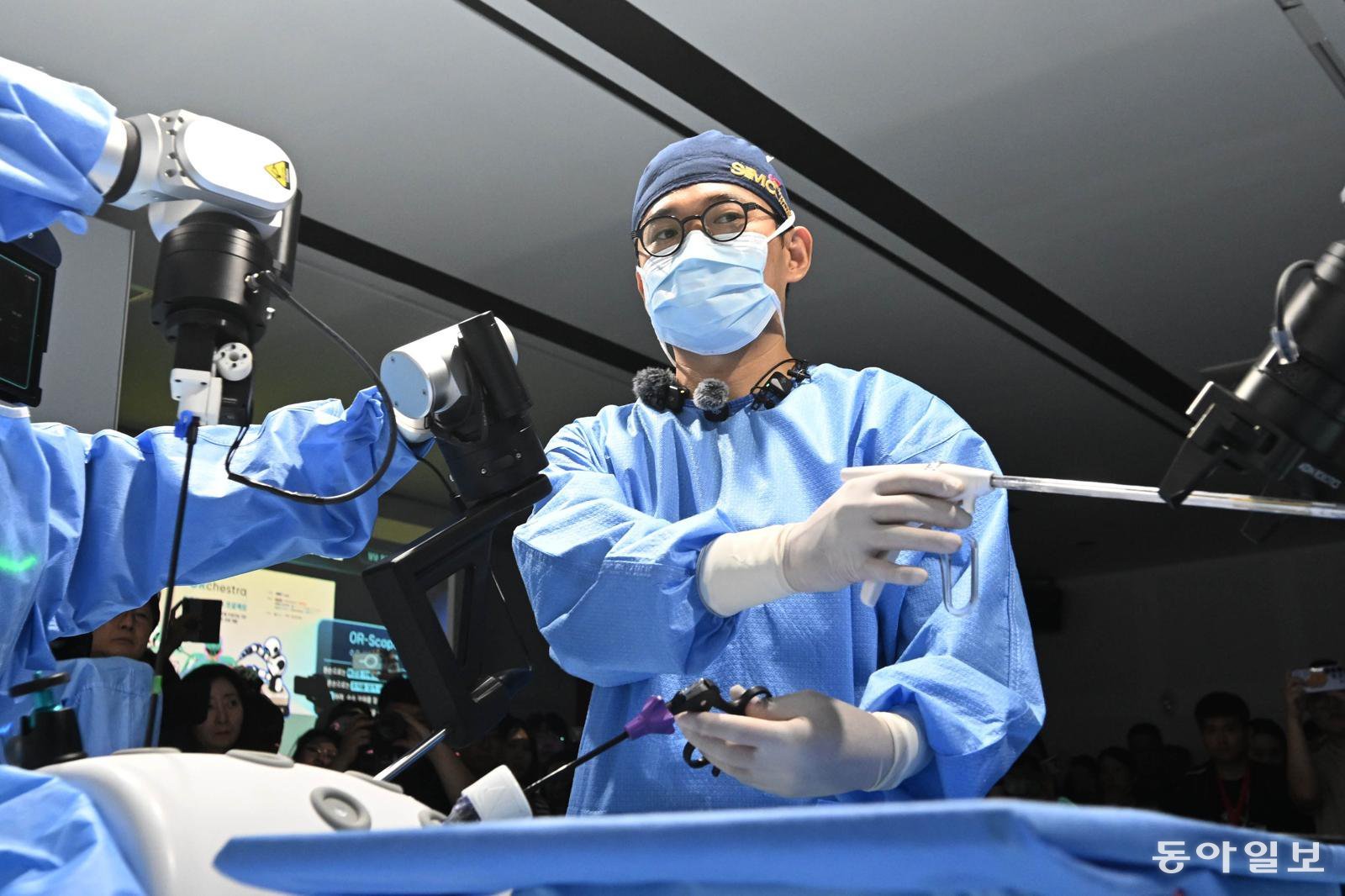
On 16 September at the Samsung Life Insurance Irwon Station Building in Irwon-dong, Gangnam-gu, Seoul, Professor Oh Nam-gi of the Division of Transplantation Surgery at Samsung Medical Center, who served as operating surgeon during a humanoid surgical-assistant robot demonstration hosted by Samsung Medical Center, receives a grasper (medical forceps) from a humanoid robot. Pool photo.
“Grasper (medical forceps), please.”
When the operating surgeon extended his hand in a lecture room near Samsung Medical Center in Gangnam-gu, Seoul, on 16 September, a humanoid robot acting in the role of a nurse picked up a surgical instrument and handed it over. When the surgeon then said “Follow me,” another robot holding an endoscopic camera adjusted the camera angle and held the incision site according to the direction in which the surgical instruments moved.
On this day, the research team at Samsung Medical Center conducted a demonstration surgery to remove the gallbladder from a goat liver together with the humanoid robot “Orchestra,” which has been under development since July last year. It was the world’s first demonstration of a human operating surgeon performing a collaborative surgery with multiple surgical-assistant robots.
● Development of ‘intelligent surgical-assistant robots’ to replace medical staff
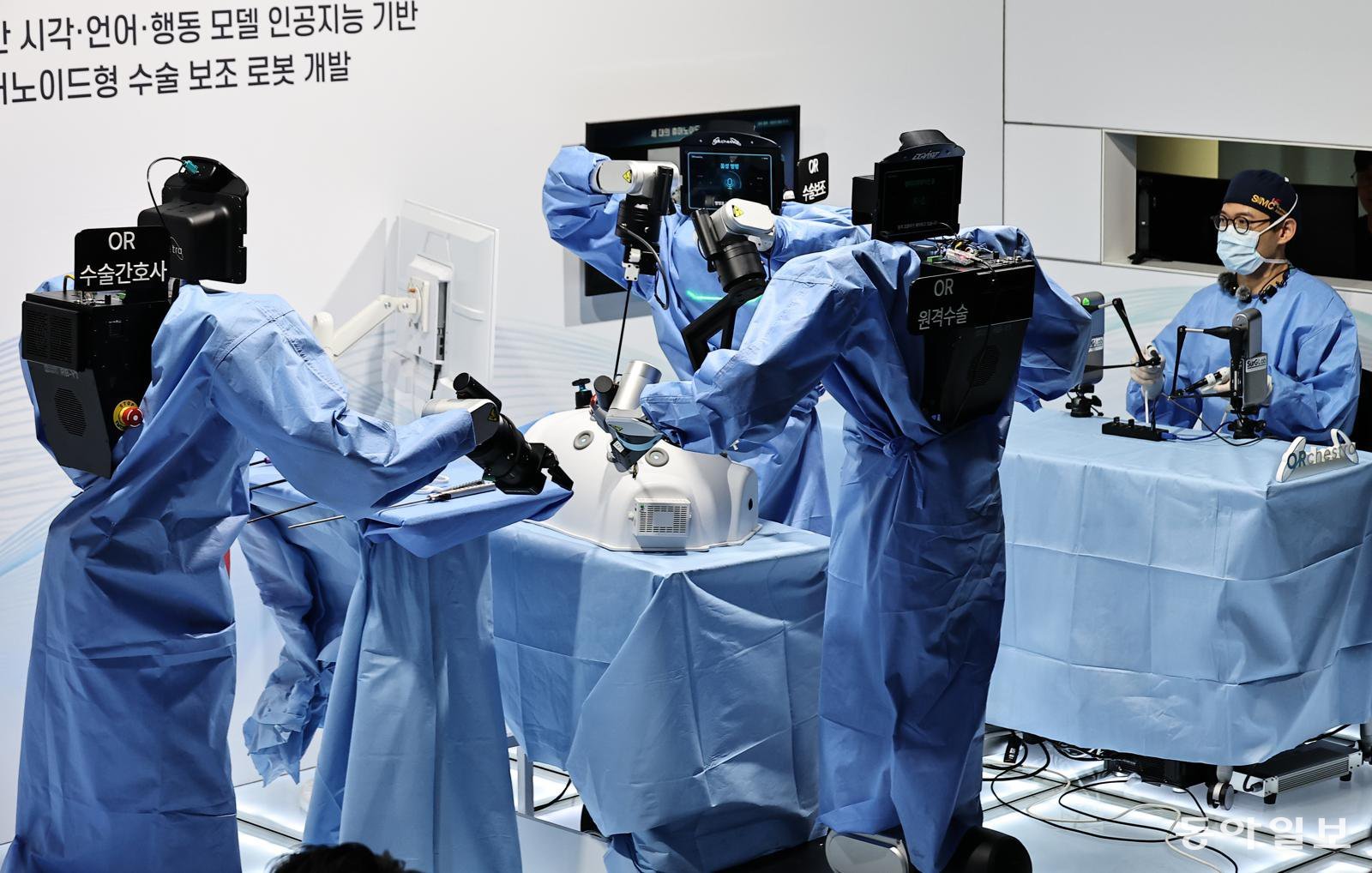
On 16 September at the Samsung Life Insurance Irwon Station Building in Gangnam-gu, Seoul, Professor Oh Nam-gi of the Department of Transplantation Surgery at Samsung Medical Center (far right) performs a demonstration surgery to remove a gallbladder from a goat liver in collaboration with three humanoid surgical-assistant robots. The robot in the center performed the surgery under Professor Oh’s control, while the robot on the left acted as a nurse and the robot on the right as an assistant surgeon. Photo by Yang Hoi-seong, yohan@donga.com
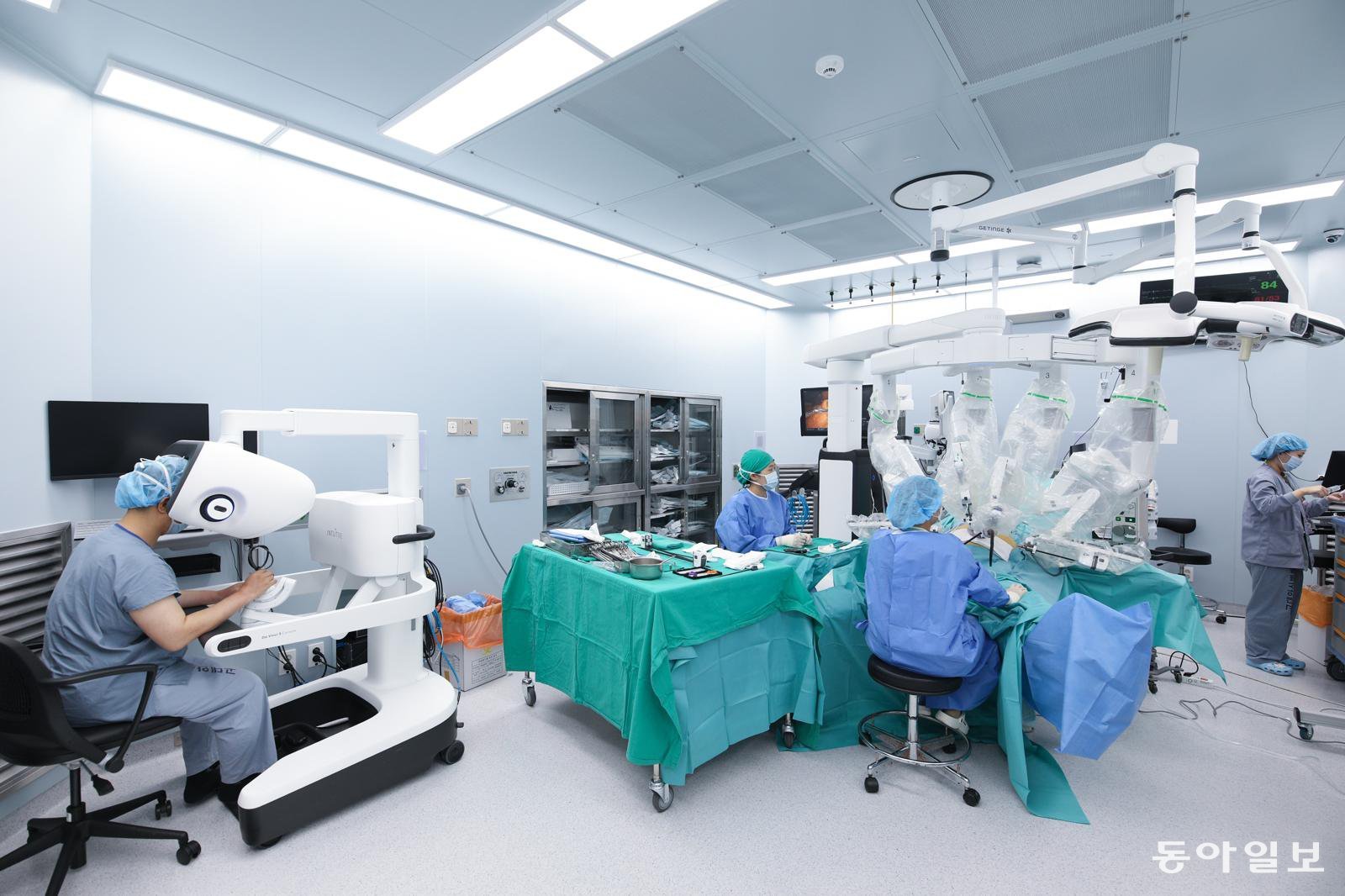
Currently, the surgical robots most commonly used in medical settings in Korea and overseas move based on a physician’s remote control. With the representative surgical robot “da Vinci,” the operating surgeon manipulates robotic arms to perform precise dissection or suturing at the surgical site.
In contrast, the humanoid robots unveiled this time are “intelligent surgical-assistant robots” capable of substituting for medical staff. They have functions to assist physicians by handing over five types of surgical instruments in response to voice commands and moving endoscopic cameras as instructed. In the demonstration, one robot assumed the role of a nurse and another that of an assistant surgeon to support the operating surgeon.
Like existing medical robots, remote surgery is also possible. In the demonstration, Professor Oh, the transplant surgeon in charge, first remotely controlled a surgical-assistant robot to dissect the cystic duct, then moved to the operating surgeon’s position and, together with the two robots, completely removed the remaining portions to finish the surgery. The procedure took only about 10 minutes.
A surgical robot currently used in operating rooms. A physician remotely controls the robotic arms to perform surgery. Photo by Hong Eun-sim, hongeunsim@donga.com
The new system also overcomes the limited mobility of existing operating-room robots. Conventional robots are bulky and heavy, making them difficult to move and requiring dedicated operating rooms. In contrast, Orchestra has a height (160 cm) similar to that of a human and wheels attached to its body, minimizing inconvenience.
● Korea leads in human–robot collaboration in surgeryGlobally, competition to develop humanoid surgical-assistant robots is intensifying. Development is largely proceeding in two directions: robots that handle logistics and preparatory tasks before and after surgery, and robots that participate in surgery by manipulating surgical instruments. Earlier this year, Foxconn, the world’s largest electronics manufacturing services company, introduced “NURABOT,” which can deliver medications and supplies around hospital wards and perform operating-room nursing duties. Development is also underway on humanoid surgical-assistant robots that move via remote control. In the United States, a remote surgery on a live pig using a humanoid robot has been successfully performed.
Although Korea started later than other countries in developing medical humanoids, experts assess that its technology for collaboration between humans and humanoids in the operating room is at an advanced level. Jung Kyu-hwan, head of the Intelligent Medical Robot Research Center at the Future Medicine Research Institute, said, “In the field where medical staff and humanoids collaborate, Korea is ahead, and we are confident in further development going forward.” In Korea, three institutions—Samsung Medical Center, Seoul National University Hospital, and Pusan National University Hospital—are currently developing such collaborative assistant robots.
Medical professionals expect that once surgical-assistant robots are commercialized, they will help alleviate workforce shortages in essential medical fields. Professor Jung Yong-gi of the Department of Otorhinolaryngology at Samsung Medical Center, who is leading the research, said, “Small hospitals in regional areas find it difficult to secure skilled surgical-assistant staff,” adding, “Once robots are commercialized, they will enable surgeries to be performed stably with limited personnel, helping to fill gaps in essential medical staffing.”
However, many challenges remain before robots that assist medical staff can be deployed in actual human surgery. Safety and accuracy must be verified to a level suitable for human operations, and institutional standards must be established on issues such as who—among medical staff, hospitals, or developers—bears responsibility if a medical accident occurs due to a robot’s judgment or movements.
The research team aims to conduct its first clinical trial in 2029 and plans during the remaining development period to further advance the technology and verify whether it can be applied in real-world medical settings.
ⓒ dongA.com. All rights reserved. Reproduction, redistribution, or use for AI training prohibited.
Popular News