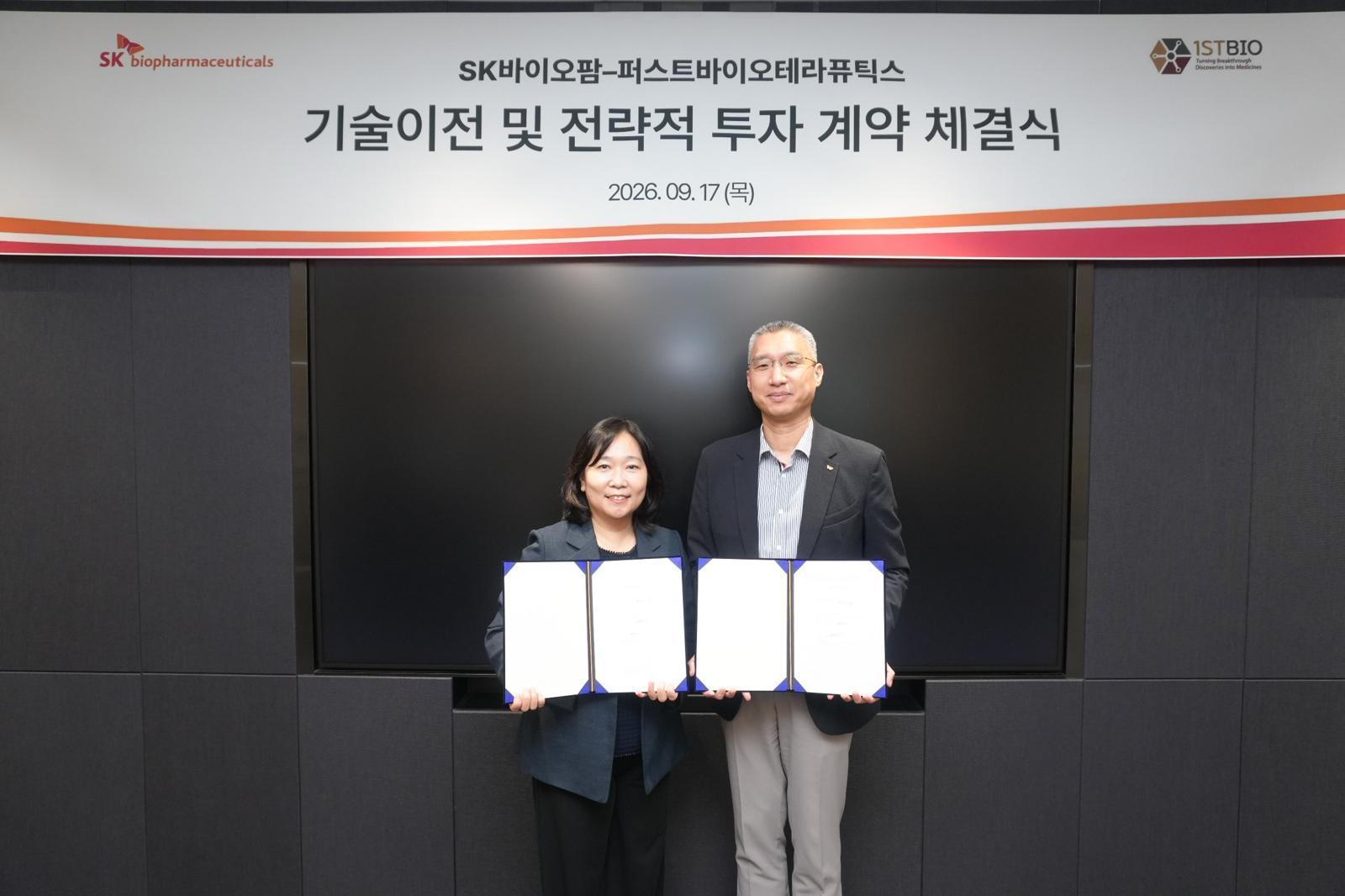
On the 17th at SK Biopharmaceuticals’ Pangyo headquarters, First Biotherapeutics CEO Kim Jae-eun (left) and SK Biopharmaceuticals Head of Strategy Yoo Chang-ho pose for a commemorative photo at the signing ceremony for an in-licensing agreement for a new drug candidate for Parkinson’s disease. Courtesy of SK Biopharmaceuticals
SK Biopharmaceuticals announced on the 17th that it has signed a license agreement and a strategic equity investment agreement with First Biotherapeutics to secure the global exclusive development and commercialization rights for a new drug candidate for the treatment of Parkinson’s disease.
The license agreement is worth up to approximately KRW 430.8 billion, consisting of an upfront payment of KRW 2.5 billion, development and commercialization milestone payments of up to KRW 72.5 billion, and sales-based milestone payments of up to USD 260 million (about KRW 355.8 billion) tied to net sales. After commercialization, running royalties based on net sales will be paid separately.
Separately, SK Biopharmaceuticals also signed a strategic equity investment agreement worth KRW 3 billion.
The agreement covers a small-molecule, orally administered Parkinson’s disease treatment candidate that simultaneously inhibits Type 2 LRRK2 (Leucine-rich Repeat Kinase 2) and c-Abl (Cellular Abelson Tyrosine Kinase).
Parkinson’s disease is a degenerative brain disorder in which nerve cells that produce dopamine gradually degenerate, leading to impaired motor function and other symptoms. Most currently used therapies focus on symptom relief, so there is significant demand for disease-modifying therapies (DMTs) that can slow or alter the course of the disease itself.
The candidate has been designed to act in a multifaceted manner on endolysosomal dysfunction and alpha-synuclein accumulation, which are known as key pathological mechanisms of Parkinson’s disease. Based on its dual-inhibition mechanism targeting both LRRK2 and c-Abl, the goal is to develop a first-in-class therapy.
First Biotherapeutics is currently conducting research to select a preclinical candidate. SK Biopharmaceuticals plans to review subsequent development, including studies for an Investigational New Drug (IND) application, based on the progress and results of this research.
This agreement represents the first candidate in-licensed under the leadership of SK Biopharmaceuticals’ Open Innovation Center (OIC). SK Biopharmaceuticals plans to expand its central nervous system (CNS) pipeline through an open innovation strategy that links externally sourced candidates with its in-house development and commercialization capabilities.
In particular, the company will fully pursue its “East-West Bridge” strategy, which connects candidates discovered in Asia, including Korea, to global markets.
East-West Bridge is an open R&D model in which candidates discovered in Asia are validated at the preclinical or early clinical stages and then advanced using SK Biopharmaceuticals’ clinical development and commercialization capabilities, together with its global partnerships. Depending on the characteristics and development stage of each candidate and market conditions, the company will consider direct development or collaboration with external partners.
SK Biopharmaceuticals has been expanding collaboration with external research institutions and companies this year, including operating an open innovation program with Seoul Bio Hub and conducting joint research with Insilico Medicine on AI-based new drug discovery.
First Biotherapeutics CEO Kim Jae-eun stated, “This collaboration is highly meaningful in that it combines First Biotherapeutics’ early-stage drug discovery capabilities with SK Biopharmaceuticals’ global development and commercialization capabilities,” adding, “We will focus the strengths of both companies to ensure that subsequent development proceeds successfully.”
SK Biopharmaceuticals CEO Lee Dong-hoon said, “This agreement is a concrete example of expanding our central nervous system portfolio through open innovation and of materializing our East-West Bridge strategy to connect promising Asian candidates to global markets,” adding, “We plan to explore the potential for developing next-generation DMTs that intervene in disease progression itself.”
ⓒ dongA.com. All rights reserved. Reproduction, redistribution, or use for AI training prohibited.
Popular News