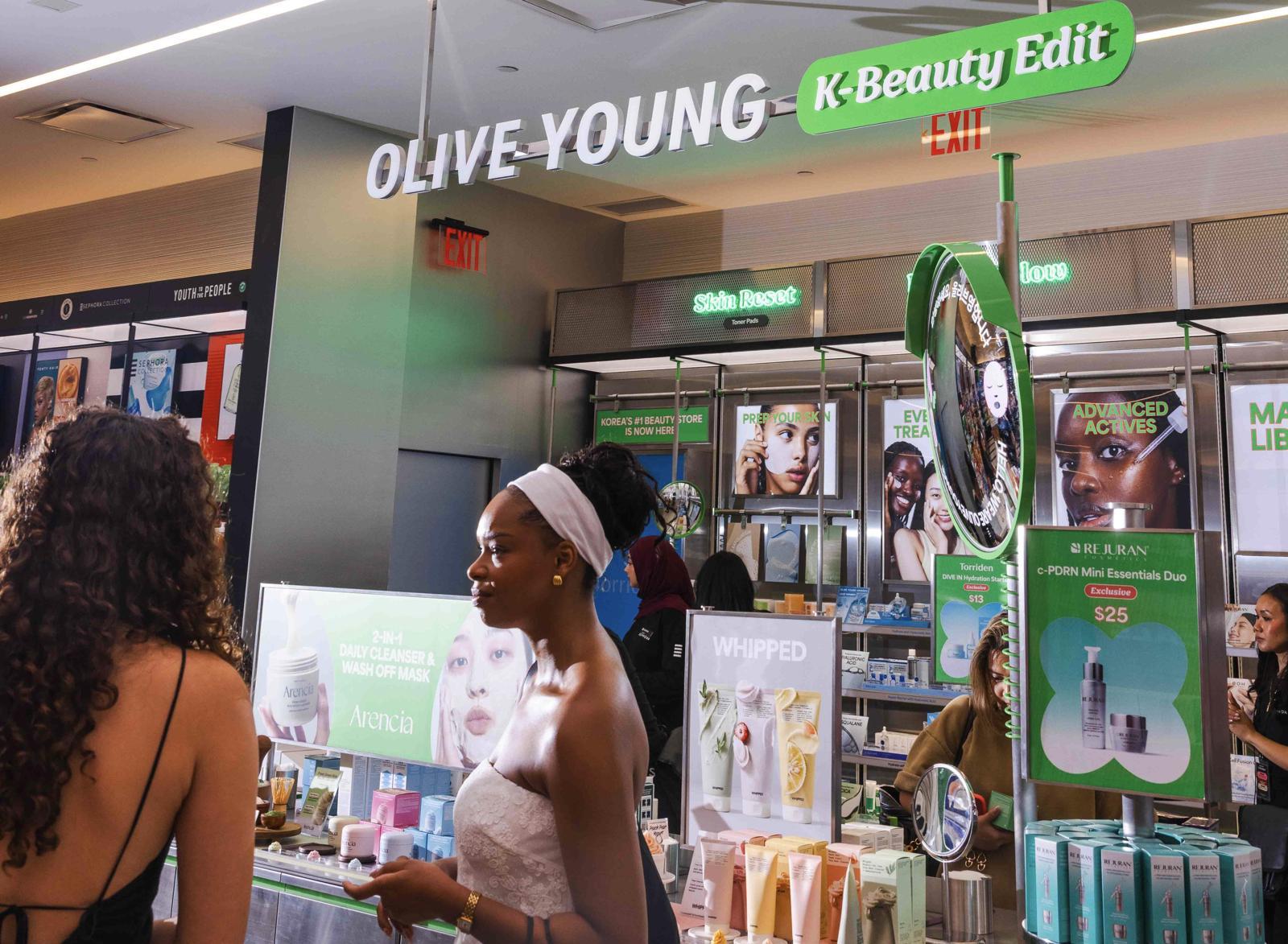
‘Olive Young K-Beauty Edit’, showcasing products representative of K-beauty inside the Sephora store in Times Square, New York, USA. Provided by CJ Olive Young
CJ Olive Young is accelerating the transplantation of the K-beauty ecosystem in the United States by establishing offline stores, an online mall, and logistics centers, while expanding collaboration with major local distributors. Its strategy is to apply at once its brand curation capabilities and experiential store operation know-how accumulated in Korea to the US market and to serve as a platform that supports local market entry for Korean small and mid-sized beauty brands.
On the 20th of last month, CJ Olive Young opened the “Olive Young K-Beauty Edit” at a global beauty specialty Sephora store located in Times Square, New York, to showcase leading K-beauty products. Olive Young is directly selecting Korean cosmetics and displaying them in a store in the heart of New York so that local consumers can experience them firsthand.
● Simultaneous on–offline expansion in the USOlive Young is also accelerating collaboration with large local distribution networks. It plans to continuously run K-beauty curation in more than 580 Sephora stores across the United States. This is a “two-track” strategy of expanding its own stores while partnering with powerful operators that already have nationwide distribution networks in the US to broaden consumer touchpoints.
It is also rapidly expanding its own on–offline channels. On 21 May this year, it opened its first local offline store, “Olive Young Pasadena,” in Pasadena, California, and launched a US-dedicated online mall on the same day. It plans to increase the number of stores in California to five by the first half of next year and then expand openings into the Midwest and East Coast regions.
According to Olive Young, more than 1,500 visitors per day on average are coming to the Pasadena store, which is equipped with a skin diagnosis device called “SkinScan.” Rather than merely selling Korean cosmetics, the store emphasizes experiential elements so that consumers can check their skin condition and then choose suitable products themselves. This serves as a testbed to assess whether the health & beauty (H&B) experiential store model developed in Korea will also work with US consumers.
Before expanding stores, the company also established a logistics base. In March this year, Olive Young set up a West Coast integrated logistics center in Bloomington, California. It is an automated logistics center that can be expanded up to approximately 18,200 square meters (equivalent to 5,000 pyeong) in response to growing cargo volume. It is expected to handle both inventory supply for offline stores and shipping of online orders within the United States going forward.
What is notable is that Olive Young has built offline stores, e-commerce, and logistics infrastructure together from the early stage of its US expansion. Rather than simply increasing the number of stores, the strategy is interpreted as an attempt to establish a K-beauty distribution ecosystem in the US market by linking product selection, consumer experience, sales, and delivery into a single structure locally.
● The “curation–experience–education” trioThe differentiation strategy Olive Young is putting forward in the US market is “curation” and “experience.” The company judges that although interest in K-beauty products has grown, there are relatively few channels that comprehensively explain which products are popular in Korea, in what order products should be used, and how to use them. In response, it is targeting local consumers by enabling them to compare products from multiple brands in a single store and by providing guidance on how to use products and on skincare routines.
Large-scale experiential events are also being used as a tool to raise brand recognition locally. At “Olive Young Festa” held in Los Angeles (LA) on the 14th of last month, an event hall of about 4,701 square meters (approximately 1,422 pyeong) was set up. According to the company, some 100,000 visitors came to the venue over three days. The focus of the event was to promote the category of “K-beauty” itself, beyond individual brands, by allowing visitors to experience numerous K-beauty brands in one place.
The role Olive Young is aiming for in the US is not limited to that of a simple “K-beauty product retailer.” It seeks to function as a distribution platform that selects and introduces various Korean brands and enables consumers to compare and experience them directly. Collaboration with Sephora also follows this approach: instead of individual brands independently breaking into large local distribution networks, they expand their contact with local consumers through Olive Young’s curation.
● Gateway for small brands’ K-beauty expansion
Another reason Olive Young’s US expansion is drawing attention is that it coincides with efforts to broaden overseas distribution channels for Korean small and indie beauty brands. For small-scale brands to enter overseas markets directly, they must bear multiple burdens including regulations and certifications, customs clearance, local marketing costs, and negotiations with distributors. In contrast, leveraging a platform that already has local stores, logistics networks, and points of contact with major distributors can partially lower these entry barriers.
Joint expansion with a specialized platform can open new pathways for overseas expansion by small brands. Yang Jeong-ho, CEO of At Home, which operates the private aesthetic brand “THOME,” said, “To enter global markets independently, there remain challenges such as responding to tariffs and regulations, as well as localization marketing and building brand trust after entry,” adding, “This is why joint expansion with a proven specialized platform is important.”
The key issue is whether initial interest can be converted into repeat purchases. Even if K-beauty succeeds in attracting the attention of US consumers, stable supply chains and localized marketing must support it to drive repeat purchases and raise the recognition of individual brands. Converting visitors to experiential events and foot traffic at new stores into actual sales and loyal customers is also a challenge.
Olive Young’s US business is now entering a full-fledged expansion phase. As it expands its stores into the Midwest and East Coast, its success or failure is expected to depend on whether it can continuously secure local demand and translate this into tangible sales and brand growth for the Korean small and mid-sized brands that have entered its platform. A CJ Olive Young official said, “We will work to firmly establish a ‘K-beauty forward base’ that can maintain ongoing engagement with US consumers.”
ⓒ dongA.com. All rights reserved. Reproduction, redistribution, or use for AI training prohibited.
Popular News