SKT: Real-time risk analysis of in-vehicle video to pinpoint communication disruption risks in heavy equipment, etc.
KT: Predicting outages through analysis of traffic and other data
LG U+: Robots conducting constant inspections of telecom equipment
Network management shifting from ‘post-incident response’ to ‘preemptive detection’
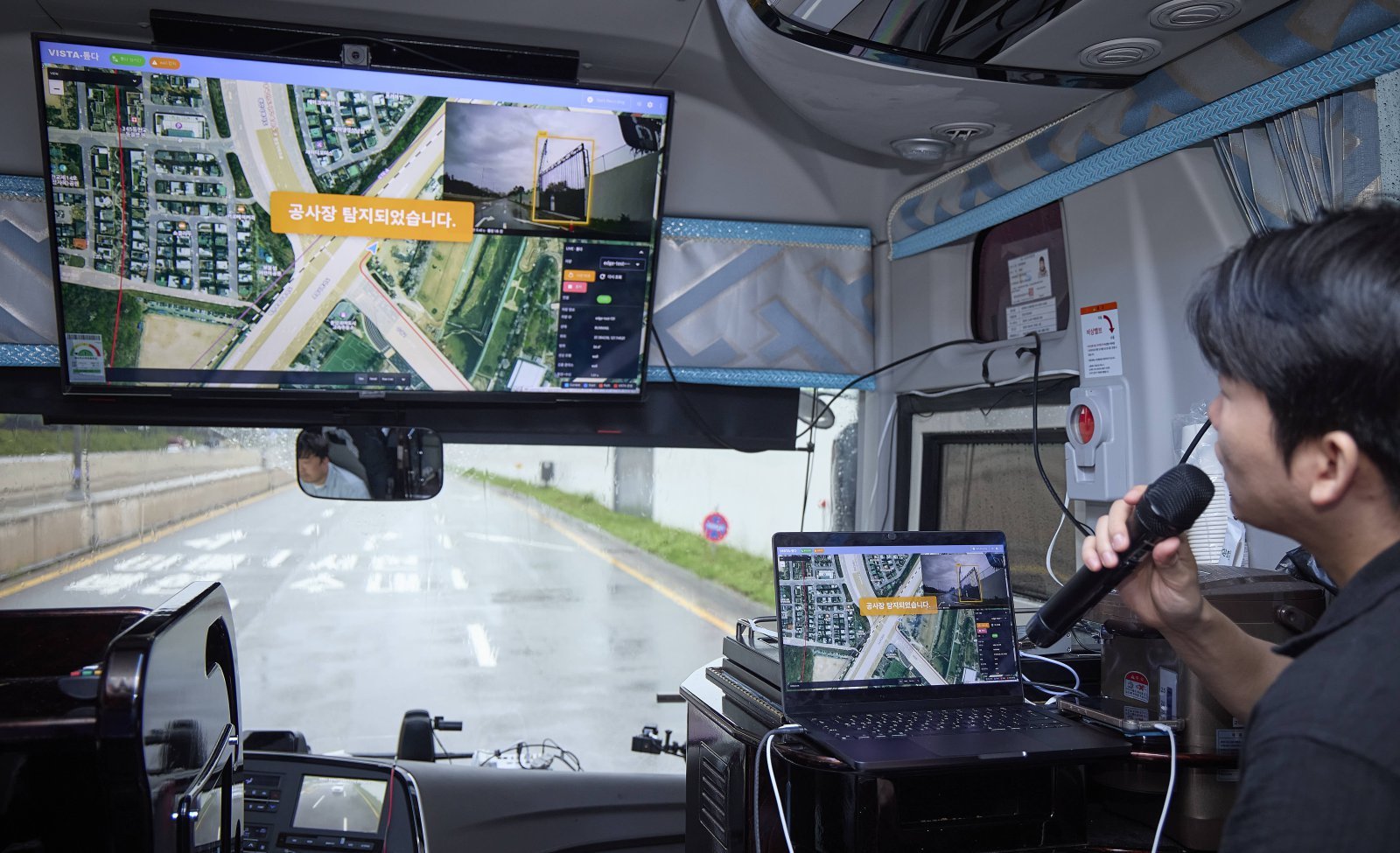
On the 1st in Bundang-gu, Seongnam, Gyeonggi Province, SK Telecom’s artificial intelligence (AI) communications infrastructure inspection solution “TOPDA” detected a construction site in video footage taken while driving and displayed it on the screen. TOPDA is a system that analyzes video recorded by company vehicles using AI to identify risk factors around communications facilities, such as construction sites, heavy equipment, and abnormal facilities. Provided by SK Telecom
“Construction site detected.”
When a bus that departed from SK Telecom’s headquarters in Bundang-gu, Seongnam, Gyeonggi Province, began to drive on the road on the 1st, a notification message appeared on the large screen at the front. The screen showed a map with the vehicle’s current location and real-time road footage from the front camera. Shortly afterward, as the bus passed an excavator on the roadside, a new message appeared: “Excavator detected.” AI had pre-identified major risk factors that could cause communications disruptions by striking underground communications cables or overhead power lines during construction.
● AI replaces manual inspection of communications facilities
On this day, SK Telecom unveiled its AI-based communications infrastructure inspection solution “TOPDA.” TOPDA is a pure Korean word meaning “to search thoroughly.” When cameras and location information devices are installed on company vehicles that are routinely used for business trips and other purposes, AI analyzes the video recorded while driving to identify risk factors around communications facilities, such as construction sites, heavy equipment, and abnormal facilities. No additional inspection vehicles or personnel are deployed.
In fact, no one on the bus that day was closely watching the scenery outside the window. Instead, a camera mounted at the front of the vehicle captured the road, and AI selected elements in the footage—such as communications cables and utility poles—that could pose a risk to communications facilities. While the bus traveled 3 km over approximately 10 minutes, the AI analyzed 1,820 images and detected 28 objects including construction sites and excavators.
AI detects construction sites and excavators because they are major risk factors that can cause communications failures. If underground communications cables are severed during excavation, nearby base stations or internet networks can be disrupted, affecting users’ voice calls and data usage. An SK Telecom official said, “When a disconnection accident occurs, communications in the surrounding area are paralyzed, causing significant damage,” adding, “Aging facilities, such as exposed cables sagging or leaning utility poles, can also lead to safety accidents.”
SK Telecom alone manages 200,000 km of optical fiber nationwide, equivalent to about five times the Earth’s circumference, and 2.35 million utility poles. Despite this vast scale, until now two employees had to ride in a vehicle, drive slowly along the cable routes, visually inspect facilities, and get out of the vehicle for direct checks when necessary, which limited the scope of inspections. TOPDA first identifies construction sites, heavy equipment, and abnormal facilities that humans could miss in this process. It goes further than simply detecting an excavator: it also determines whether actual work is in progress and how close it is to the communications cables, and then singles out only the locations that require dispatch.
In practice, the excavator that AI detected that day was near communications facilities but was parked, so it was determined that an immediate dispatch was unnecessary. Conversely, if an excavator working near a communications conduit is detected, AI analyzes the risk level, sends a site inspection alert to field staff, and staff are dispatched to the location. SK Telecom trained the AI with 22,000 on-site photographs over the past five years, and the current detection accuracy rate is 88%. The company aims to raise accuracy to 95% next year.
● AI also used for fault detection and equipment inspection
Other telecommunications companies are also adopting methods in which AI, rather than humans, first detects issues related to communications facilities. KT uses its self-developed autonomous operations platform “AIONet” to analyze, in real time, traffic, alarms, and system logs generated from base stations and communications equipment to identify potential failures in advance.
LG Uplus has deployed AI agents and its autonomous driving robot “U-BOT” in buildings that house communications equipment to constantly monitor equipment status, power supply, and temperature and humidity. An LG Uplus official said, “This reduces repetitive on-site inspections and enables faster human response where it is truly needed.”
ⓒ dongA.com. All rights reserved. Reproduction, redistribution, or use for AI training prohibited.
Popular News