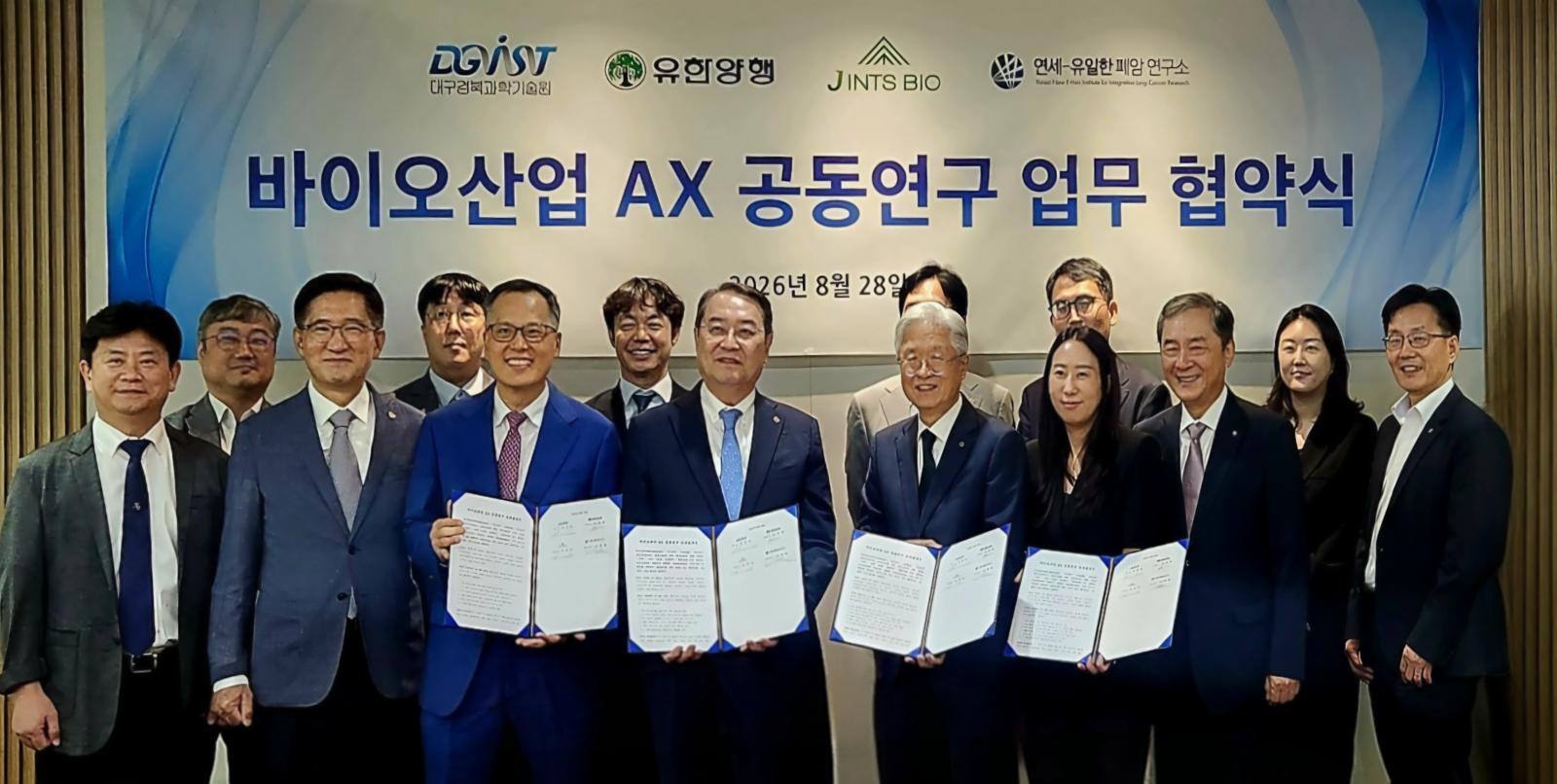
On the 28th of this month at Yuhan Corporation’s headquarters in Dongjak-gu, Seoul, four institutions – JINITSBIO, Daegu Gyeongbuk Institute of Science and Technology (DGIST), Yuhan Corporation, and the Yonsei–Yu Il Han Lung Cancer Institute – signed a memorandum of understanding (MOU) for joint research on the artificial intelligence (AI) transition in the bio industry. From the third person from the left in the front row: Cho Byoung Chul, Director of the Yonsei–Yu Il Han Lung Cancer Institute; Lee Kun Woo, President of DGIST; Cho Wook Je, CEO of Yuhan Corporation; and Joanna Cho, CEO of JINITSBIO. Courtesy of JINITSBIO
JINITSBIO, a biotech company developing anti-cancer drugs and treatments for rare diseases, is joining forces with Yuhan Corporation, Daegu Gyeongbuk Institute of Science and Technology (DGIST), and the Yonsei–Yu Il Han Lung Cancer Institute to develop new drugs using artificial intelligence (AI). The company plans to build a drug discovery and development framework in which AI is used to identify drug candidates that are then advanced through actual experiments and subsequent development.
JINITSBIO announced on the 31st that on the 28th of this month it had signed a memorandum of understanding (MOU) for joint research with Yuhan Corporation, DGIST, and the Yonsei–Yu Il Han Lung Cancer Institute to identify and promote collaborative research projects in the field of AI transition in the bio industry.
Under this agreement, each institution will take on a distinct role to link new drug candidate discovery with subsequent development. The Yonsei–Yu Il Han Lung Cancer Institute will propose research directions required in the course of patient treatment. DGIST will participate in research to identify drug targets and candidate compounds. JINITSBIO will design the candidate compounds. It will also carry out experimental validation and follow-up development. Yuhan Corporation will review development and regulatory strategies based on its experience in global new drug development and will also examine commercialization potential. “Through this agreement, a foundation has been established to connect AI-discovered targets and candidate compounds to actual new drug development projects,” said Joanna Cho, CEO of JINITSBIO. “The company will serve as an R&D hub linking the capabilities of each institution.”
● JINITSBIO to utilize AI drug discovery platformIn this joint research, JINITSBIO plans to use its proprietary AI drug discovery platform “JIN-NOVA.” JIN-NOVA is a platform that analyzes various biological information such as patients’ genes and proteins, as well as clinical data, using AI and applies the results to drug development. It identifies drug targets that have a high correlation with diseases and narrows down candidate compounds that are likely to act on those targets.
DGIST’s supercomputer will also be used. A large number of compounds will be compared in silico to select those with high potential, and the likelihood that a candidate compound will act on its target protein will be analyzed. Based on these results, priorities will be set for which candidate compounds to test first in experiments. The team will also examine the likelihood of efficacy in specific patient groups and the potential for combination use with other therapies. “We aim to present an industry–academia–research–hospital collaboration model in the bio field that connects AI and supercomputing capabilities to actual drug development needs and feeds validation results back into technology advancement,” said DGIST President Lee Kun Woo.
JINITSBIO is also conducting research to link AI analyses to actual candidate compounds and experiments. According to the company, using JIN-NOVA it has secured 24 new drug candidates targeting various cancer therapy targets. It has also completed initial validation to assess whether these compounds are likely to inhibit the growth of cancer cells. This year, JINITSBIO was selected for the Ministry of SMEs and Startups’ Scale-up TIPS specialized program with a project to advance its JIN-NOVA-based AI drug development technology. JINITSBIO is the lead institution, with DGIST and Yonsei University participating as joint research institutions. Total funding amounts to KRW 4 billion over three years. “Going forward, we plan to expand target and candidate compound hypotheses derived from JIN-NOVA into new drug development projects that can be linked not only to our internal pipeline but also to joint research, co-development, and technology transfer with partners,” Cho said.
● Yonsei–Yu Il Han Lung Cancer Institute to reflect clinical experience in drug research
The Yonsei–Yu Il Han Lung Cancer Institute will present research directions required in patient care. It will also examine the potential for new drug candidates to be used in actual diseases and patient treatment. The institute is led by Professor Cho Byoung Chul of the Division of Medical Oncology at Yonsei University College of Medicine. Professor Cho led the clinical development of lazertinib, the first anticancer drug developed in Korea to receive approval from the U.S. Food and Drug Administration (FDA). Lazertinib is marketed in Korea under the name “Leclaza.”
Collaboration between JINITSBIO and Professor Cho’s research team has continued in the development of JIN-A02, a non-small cell lung cancer treatment candidate. The company is also using patient data and genetic and protein information obtained from JIN-A02 clinical trials in JIN-NOVA research. These data are used to analyze how the drug acts and to identify factors associated with treatment response in individual patients. Combination use with other therapies is also being studied. The results of JIN-A02 research were published this year in the international oncology journal Clinical Cancer Research. “By reflecting treatment needs from the clinical field and the patient perspective from the early stages of research, we aim to enhance the clinical applicability of candidate compounds,” said Cho, Director of the institute. “We will focus our translational and clinical research capabilities on ensuring that this leads to tangible benefits for patients.”
ⓒ dongA.com. All rights reserved. Reproduction, redistribution, or use for AI training prohibited.
Popular News