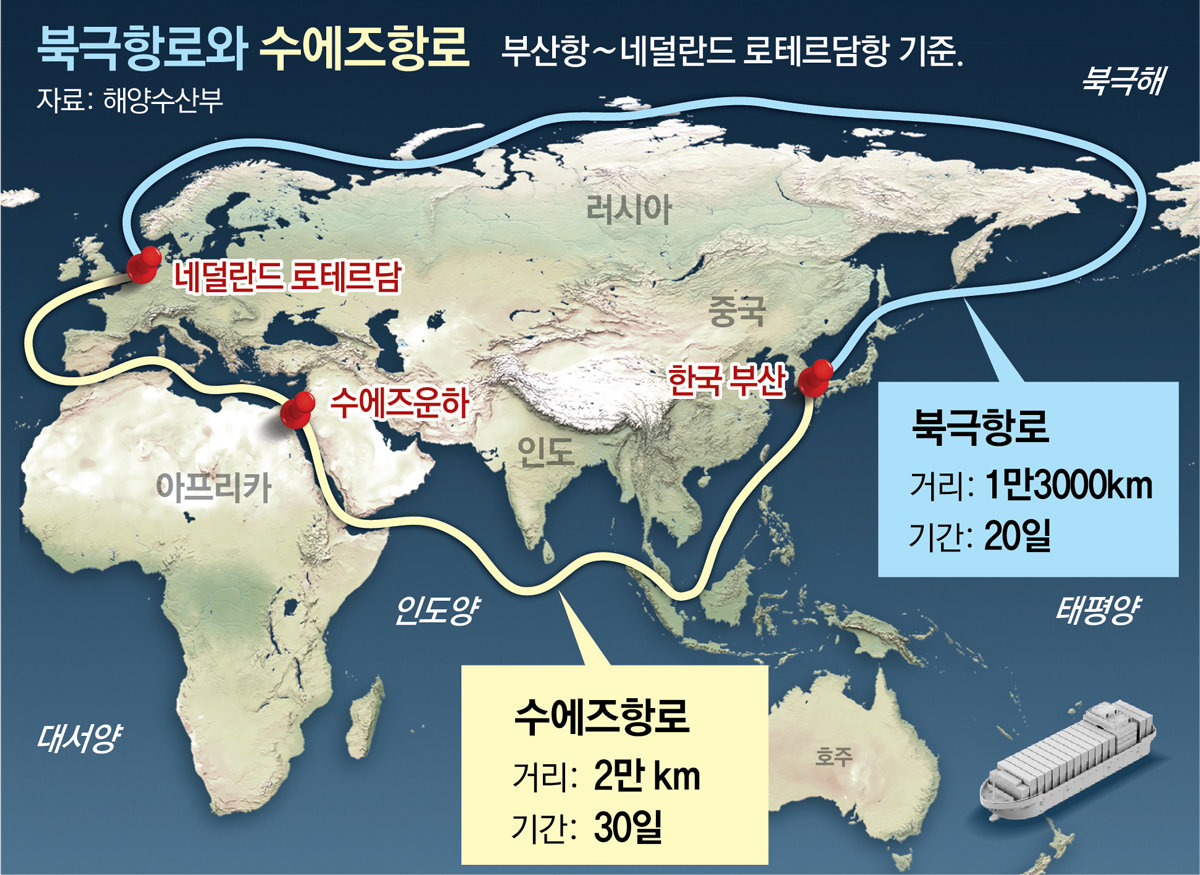
For the first time, a container ship operated by a Korean shipping company will sail along the Arctic route. The Arctic route connects Asia and Europe via the Arctic Ocean. With the need for alternative routes increasing due to recent events such as the blockade of the Strait of Hormuz amid the Iran war, the government plans to use this voyage to verify the economic viability and safety of the Arctic route and thereby lay the groundwork for commercial service. As China has recently begun operating regular container services on this route, Korea is also entering a demonstration phase toward commercialization of the Arctic route through this trial operation.
● One-way distance cut by 7,000 km compared with existing routesThe Ministry of Oceans and Fisheries announced on the 20th that the “Panstar Acro,” a 2,758 TEU-class (1 TEU is one 20-foot container) container vessel operated by Busan-based shipping company Panstar Line.com, will depart Busan New Port on the 22nd and begin a trial round trip to Europe via the Arctic route. The Panstar Acro will depart carrying approximately 737 TEU of export cargo from 85 shippers, including chemical products, used cars, and auto parts, along with 100 empty containers.
The Panstar Acro is scheduled to enter Arctic waters on the 30th and sail about 6,400 km across the Arctic Ocean over roughly eight days. Starting with the Port of Felixstowe in the United Kingdom on the 9th of next month, it will call sequentially at the Port of Rotterdam in the Netherlands and the Port of Gdańsk in Poland, then return via the same route and arrive back in Busan on October 5. The total voyage distance is about 30,000 km and the duration is 45 days, subject to change depending on weather conditions in the Arctic Ocean.
The ministry plans to analyze sailing distance and duration, fuel consumption, and operating costs to specify the conditions needed to establish a regular service. The Korea Ocean Business Corporation and the Korea Shipowners’ Association selected Panstar Line.com as the operating carrier in May through a public call. Up to KRW 4 billion in trial operation support funds and cargo-attraction incentives will be provided from the Shipowners’ Association’s fund. Lee Su-ho, head of the Arctic Route Promotion Headquarters at the Ministry of Oceans and Fisheries, stated, “This is the first step in verifying the potential use of the Arctic route with an actual vessel and cargo.”
Korean companies have previously used the Arctic route, starting with Hyundai Glovis’s trial naphtha shipment in 2013, followed by CJ Logistics in 2015 and Pan Ocean and SLK Kukbo transporting heavy cargo in 2016. However, this is the first time a container ship transporting cargo from various shippers on a set schedule will make a round trip via the Arctic route. It carries significance as a test of its potential as a regular logistics network.
● Emerging as an alternative sea lane to the Suez
The Arctic route is attracting attention mainly because of its shorter sailing distance. From Busan Port to the Port of Rotterdam in the Netherlands, the one-way distance via the Arctic route is 13,000 km. This is about 7,000 km shorter than the 20,000 km route via the Suez Canal. The transit time is also reduced by 10 days, from 30 days to 20 days.
In particular, as instability in the Middle East grows, the Arctic route is emerging as an alternative sea lane that can reduce dependence on the Suez Canal. Not only the Strait of Hormuz but also routes in the Red Sea are within the sphere of influence of the Houthi rebels, a pro-Iran armed group in Yemen. As key maritime routes in the Middle East have come under strain one after another, the need to secure new routes has increased.
Climate change has also brought renewed attention to the Arctic route. In the past, icebreakers were required, but according to the ministry, summer sea ice has decreased due to climate change, making it possible to sail without icebreakers, thereby lowering costs and increasing the feasibility of commercial operations.
However, navigation is not possible in winter when the sea refreezes, and because most of the route lies within waters under Russian jurisdiction, cooperation with Russia is needed for passage permits and other matters. There are also concerns that such cooperation could run afoul of Western sanctions against Russia. Lee said, “We have explained the purpose, necessity, and operational plans of the Arctic route trial voyage to key related countries and completed the necessary consultations to ensure compliance with international norms.”
While Korea, China, and Japan all have an interest in operating on the Arctic route, current assessments suggest that China is ahead. According to the ministry, a Chinese shipping company has completed one container ship voyage along the Arctic route and plans to operate eight sailings this year, with the first already departed recently. The ministry stated, “We are closely monitoring matters related to the (Chinese carrier’s operations)” and added, “We will steadily prepare the groundwork to be ready for the future.”
ⓒ dongA.com. All rights reserved. Reproduction, redistribution, or use for AI training prohibited.
Popular News