“Stolen keys could be cracked by quantum computers” concerns grow
SKT focuses on stabilizing quantum key distribution technology
KT develops its own equipment and upgrades performance… LG U+ standardizes latency management
Google and the U.S. government also accelerate ‘cryptography migration’
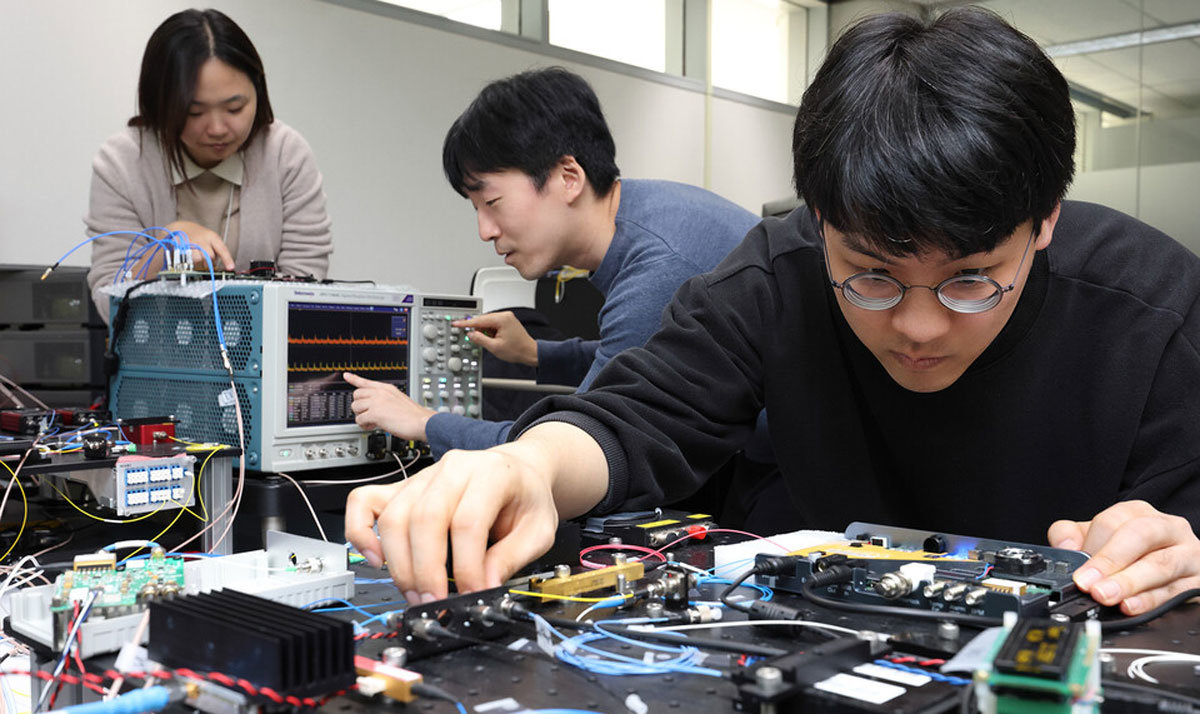
KT researchers test the performance of in-house-developed quantum key distribution (QKD) equipment at the KT R&D Center in Seocho-gu, Seoul. QKD is a technology that securely transmits encryption keys that lock data by using quantum properties. Provided by KT
The three major domestic telecommunications operators are successively moving to develop new security technologies in preparation for the era of quantum computers. Once quantum computers are commercialized, existing cryptographic systems themselves could be rendered ineffective, prompting operators to strengthen the security of their networks in advance by applying quantum technologies.
● Competition for new locks to block ‘quantum computer hacking’According to the telecommunications industry on the 28th, LG Uplus this month began work on international standardization of technology to manage communication delays that may occur when applying quantum security technologies to telecommunications networks. LG Uplus also launched a dedicated enterprise line in 2022 that applies “post-quantum cryptography,” a new type of encryption that cannot be easily broken by quantum computers. Since then, the company has expanded the use of post-quantum cryptography to enterprise security networks, industrial USIMs, and account management services.
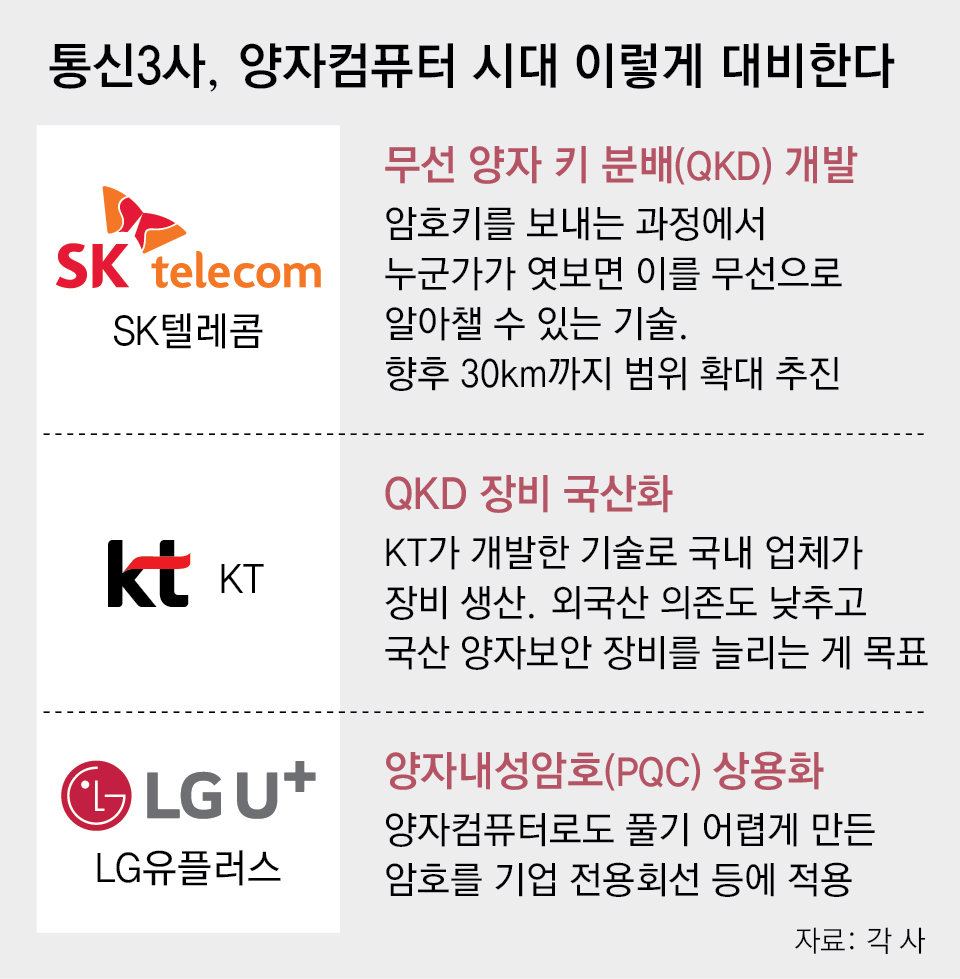
SK Telecom is developing technology to use “quantum key distribution (QKD)” wirelessly in a stable manner. QKD is a technology that uses quantum technology to detect if someone has attempted to intercept the process of transmitting an encryption key. SK Telecom is currently developing QKD that can protect wireless security within a radius of up to 30 km and plans to mount it on satellites thereafter to further expand its coverage.
KT has focused on localizing QKD equipment, which currently depends on foreign products. When KT transfers its in-house-developed QKD technology to domestic equipment manufacturers, these companies produce commercial devices that can be installed in actual communication networks. Related equipment has been on sale since 2020, and KT stated that it has been continuously upgrading its performance.
● “Steal it now and decrypt it later”… accelerating encryption replacementDomestic telecom operators are pushing to strengthen security with quantum technologies in anticipation of quantum computers that are expected in the near future. The “public key” encryption method currently used for internet access and financial transactions has a significant risk of being neutralized with the advent of quantum computers. As a result, there are concerns that “cyberattacks” will occur in which adversaries first steal and store information such as military secrets or advanced technology data that cannot be decrypted now, and then later break it using quantum computers.
In response, moves to change encryption schemes in preparation for quantum computers are accelerating globally. Google has set 2029 as the target year to transition its internal systems to post-quantum cryptography. The U.S. government has also decided to replace the cryptographic technologies used for exchanging encryption keys in major federal systems with post-quantum cryptography by the end of 2030, and those used for electronic signatures by the end of 2031. McKinsey & Company forecasts that the global quantum communications market, estimated at USD 1.3 billion–1.6 billion (approximately KRW 1.9 trillion–KRW 2.3 trillion) in 2025, will grow to USD 11 billion–15 billion (approximately KRW 16.05 trillion–KRW 21.9 trillion) by 2035.
The Korean government also began a pilot transition to post-quantum cryptography this year in five sectors: telecommunications, finance, transportation, defense, and space. In the private sector, some services already use post-quantum cryptography, but a full-scale transition in the public and defense sectors is expected to take more time due to required security certification procedures. Consequently, there are projections that, once the large-scale replacement of encryption begins, telecom operators that have accumulated technology and experience in actual networks will play a larger role. Shin Jeong-hwan, head of KT’s Quantum Tech Research Team, said, “Post-quantum cryptography technologies already exist, and we are now at the stage of applying them to real systems, identifying issues, and establishing certification procedures,” adding, “After 2030, there will be a full-fledged shift to replacing existing public key cryptography.”
ⓒ dongA.com. All rights reserved. Reproduction, redistribution, or use for AI training prohibited.
Popular News