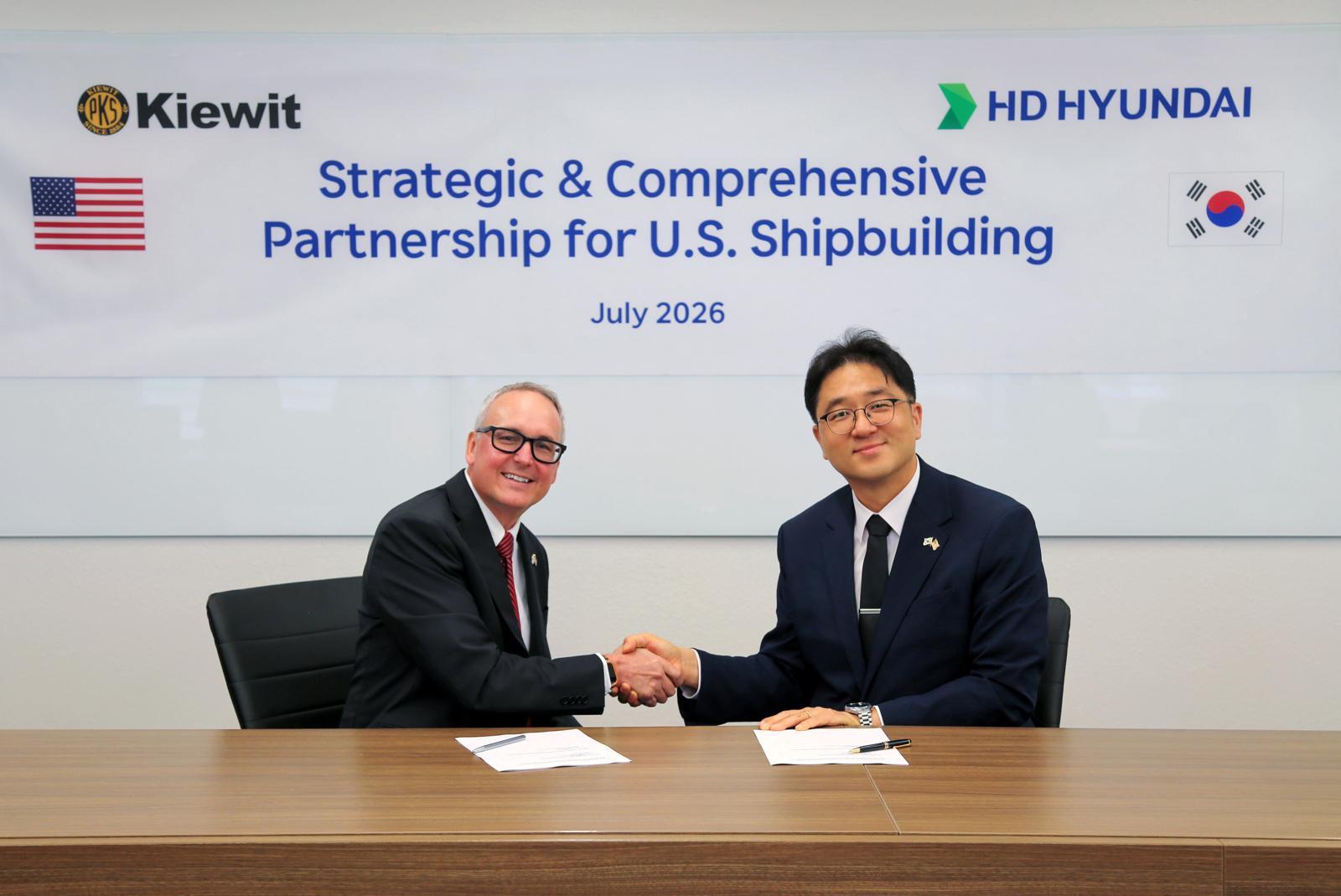
From left, Chad Johnson, Chief Executive Officer of Kiewit Offshore, and Choi Han-nae, Head of Planning at HD Korea Shipbuilding & Offshore Engineering, pose for a commemorative photograph after signing a “strategic partnership for cooperation in shipbuilding.” Courtesy of HD Hyundai
The pace of ship construction and cooperation by Korean shipyards in the United States is accelerating as the U.S. government is expected to commission Korean shipbuilders to construct naval vessels. Hanwha has begun full-scale operation of Philly Shipyard by winning orders for U.S. government vessels, while HD Hyundai is also moving to strengthen joint shipbuilding cooperation between Korea and the United States.
Hanwha announced on the 18th that at Philly Shipyard in Philadelphia, Pennsylvania, the U.S. Maritime Administration on the 17th (local time) officially announced the signing of a construction contract for a Maritime Range Instrumentation Vessel (MRIV) for the U.S. Missile Defense Agency (MDA).
The MRIV tracks trajectories during missile flight tests, collects telemetry data remotely, and supports communications and analysis of test results. It is known to be equipment that will be used in building the “Golden Dome,” a global missile defense system envisioned by the United States.
For the construction of this vessel, Hanwha will collaborate with TOTE Services, a U.S. shipbuilding management company. TOTE Services will oversee overall administrative functions such as schedule and cost management for the construction, while Hanwha will undertake the physical construction of the vessel at Philly Shipyard.
HD Hyundai is also strengthening shipbuilding cooperation with local companies. HD Hyundai announced on the 19th that it recently signed a “strategic partnership for cooperation in shipbuilding” with Kiewit, a U.S. engineering, procurement and construction (EPC) company, at the headquarters of Kiewit Offshore in Corpus Christi, Texas. Kiewit is a company with a track record in the fabrication, installation and commissioning of large offshore structures in North and South America. The two companies agreed to explore options for joint ship construction in the United States.
As signs emerge that the U.S. Department of Defense and Navy are seeking ways for Korea to build U.S. naval vessels—such as sending Requests for Information (RFI) on construction capabilities for combat ships and oilers to domestic shipbuilders including HD Hyundai and Hanwha Ocean—the response from Korean shipbuilders is also speeding up. The size of the U.S. naval shipbuilding market is estimated at a total of USD 1.075 trillion (around KRW 1,600 trillion).
The United States, in principle, prohibits overseas construction of U.S. Navy vessels under the Burns-Tollefson Act, but it is recently seeking ways to lawfully pursue overseas construction. At the Group of Seven (G7) summit held in France last month, former U.S. President Donald Trump asked President Lee Jae-myung, “Can you quickly build 10 U.S. naval vessels for us?” to which President Lee replied, “Of course it is possible, and we will do our utmost.” The United States is reported to be particularly interested in the Chungnam-class frigate (FFG-III), which Korea has recently brought into operational service. The Chungnam-class frigate is a 3,600-ton vessel, and its deployment began in December 2024 when HD Hyundai Heavy Industries delivered the lead ship to the Navy.
ⓒ dongA.com. All rights reserved. Reproduction, redistribution, or use for AI training prohibited.
Popular News