[IT Dong-A x Korea University] Korea University operates the “Crimson Startup Support Group,” a startup incubation and support institution under the direct supervision of the Vice President for Research. Together with the Crimson Startup Support Group, it introduces promising startups affiliated with Korea University that dream of growth, change, and innovation.
The livestock industry holds a large share in the Republic of Korea’s agricultural market. According to data from the Korea Rural Economic Institute, agricultural production in 2025 was estimated at KRW 62.7380 trillion. Of this, livestock production amounted to KRW 25.5305 trillion, accounting for about 41% of the total. However, the negative impacts are as large as the scale. Greenhouse gases and odors emitted from livestock manure cause conflicts in local communities and are cited as a major cause of water pollution.
According to the 2023 Livestock Environment Survey published by the Ministry of Agriculture, Food and Rural Affairs, cattle (Korean native cattle, beef cattle, and dairy cows) account for about 45% of domestic livestock manure generation, with emissions reaching approximately 22 million tons. However, labor shortages and outdated manure treatment methods that depend on heavy machinery further increase environmental burden.
The government has announced livestock environment improvement policies targeting carbon neutrality and odor reduction, and is promoting measures to activate the conversion of livestock manure into solid fuel. A representative example is the Ministry of Agriculture, Food and Rural Affairs’ plan to expand the conversion of livestock manure into solid fuel and to convert a certain volume into solid fuel by 2030. However, from the perspective of farms on the ground, it is difficult to secure the economic feasibility of solid fuel production because they must bear enormous costs for transporting and drying manure.
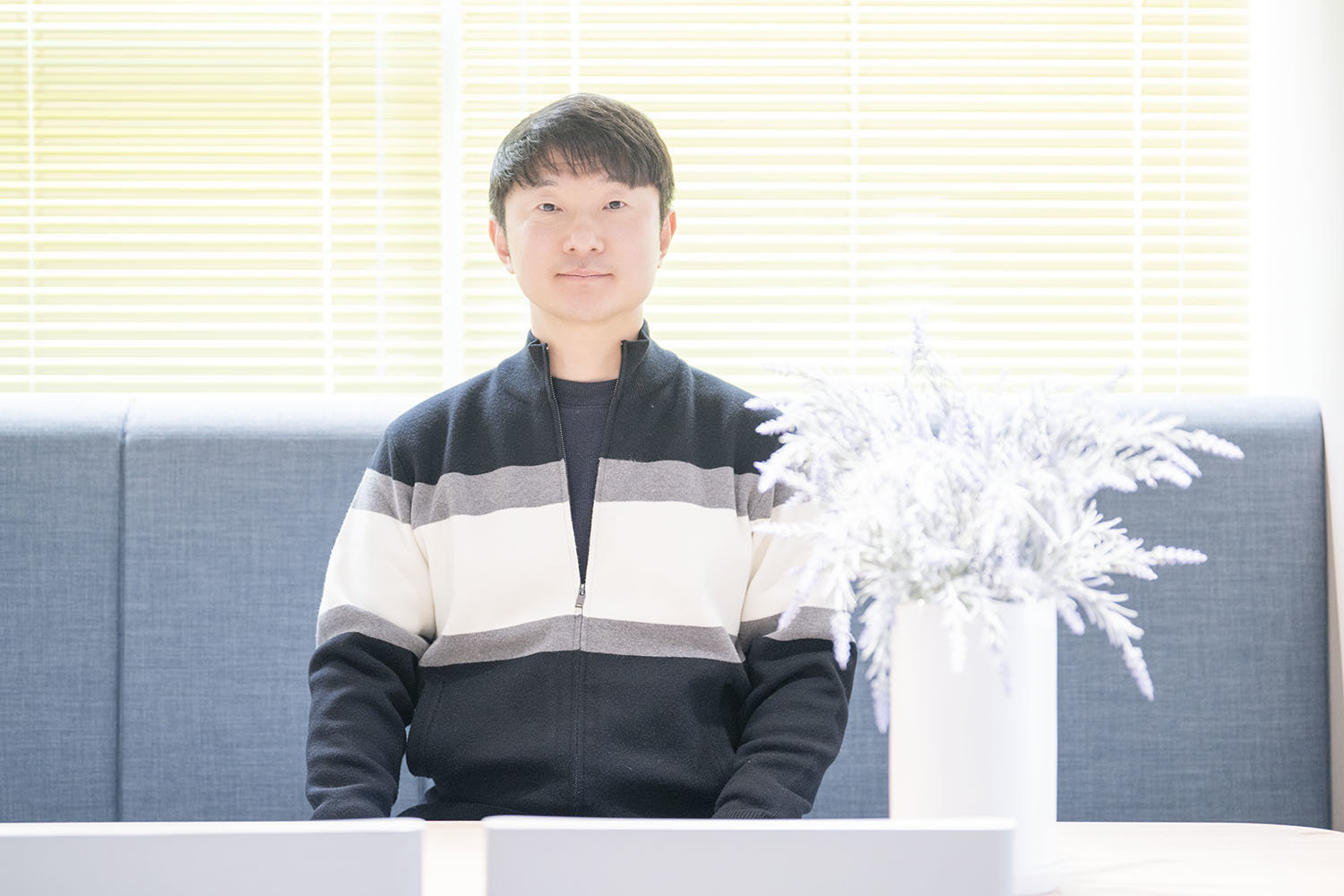
Garambot CEO Lee Moo-bong / Source=IT Dong-A
In this context, a startup has proposed technologies for smart livestock automation and activation of biomass (organic waste resources) fuel production. This deep tech startup, Garambot, aims to solve livestock manure issues by combining AI (artificial intelligence) and autonomous driving robot technologies. How does Garambot envision innovation toward carbon neutrality in the livestock industry? The reporter spoke with Garambot CEO Lee Moo-bong.
From water purification expert to livestock environment improvement specialistCEO Lee Moo-bong was a technology expert who developed autonomous driving software and remote control solutions for water-surface robots used for water purification. One day, while visiting a cattle shed to help a friend who had come to operate a Korean beef farm alone, he encountered an unexpected reality: the issue of handling cow manure. “The biggest headache I found at the farm was manure treatment. The odor was severe, and every time they had to bring in heavy machinery to remove it, which consumed a great deal of labor,” Lee said.
Drying wet bedding (sawdust spread on the floor of the cattle shed) was an almost impossible task, to the point where neighboring farmers lamented that they desperately needed a machine to dry cow manure. However, Lee came up with a new idea on site. He became convinced that if manure discharged that day were immediately mixed and dried before it piled up and turned sludgy, odors and decay could be prevented in advance. He judged that this was a challenge that could sufficiently be overcome with the small autonomous equipment technology he already possessed. Based on this idea, he founded Garambot.
He then recruited his friend who had been running the farm as a team member and began developing robots focused on field operations. The goal was not merely to remove manure once, but to expand into a “smart cattle shed floor management service” that maintains a pleasant environment by managing the shed floor every day.
Garambot shares the philosophy that technology that does not work in the field is meaningless. What its members pursue is not cutting-edge technology confined to the laboratory. They focused their capabilities on building intuitive, robust robots that operate every day on real farms without breakdowns.
There were many trials and errors in the early stages. The first prototype was a cone-shaped robot that resembled horns. Considering that it had to operate among cattle, it was built to be durable, but the cows ended up playing with it like a toy. When a strong cow nudged it, the robot flipped over, which frequently caused malfunctions. Garambot pondered how to manage the bedding while making the robot as inconspicuous as possible to the cows. Eventually, it decided on a low, flat robot design and proceeded with technical refinements.
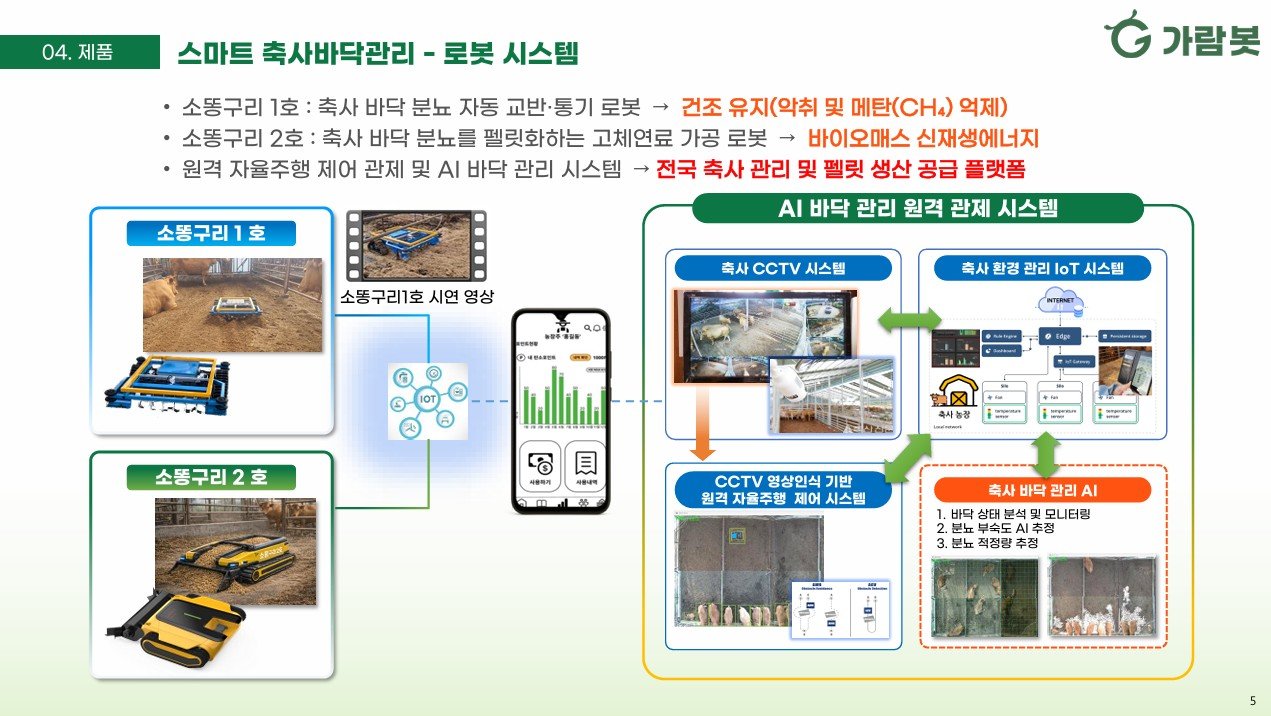
Managing Korean beef sheds by rolling bedding like a dung beetleGarambot developed the Dung Beetle No. 1, a robot that roams the shed floor, automatically mixing and aerating manure and bedding to keep it dry. Management begins from the moment bedding is spread in the shed, making it possible to minimize odors and methane gas that would otherwise arise when wet manure is left unattended.
The differentiating feature of Dung Beetle No. 1 is that it is optimized for compost-bedded pack barns (CBP). Overseas, water-wash-based barn management robots require the construction of liquid manure storage tanks or separate post-treatment facilities, which imposes a substantial burden on farms. In contrast, Garambot’s livestock shed management solution can handle drying and post-treatment of manure inside the shed, so there is no need to build separate treatment facilities.
Garambot has built a smart cattle shed floor management platform by combining vision AI and physical AI technologies / Source=Garambot
The management of the robot and the shed is handled by a closed-circuit television (CCTV) system installed on the ceiling. By combining vision AI (AI-based image analysis) and physical AI (AI for physical interaction), remote autonomous driving is controlled so that stable operation is possible even in the heavily contaminated environment of livestock sheds, according to CEO Lee. A CCTV image-recognition-based remote autonomous driving control system manages the robot, while the AI floor management system analyzes the shed floor conditions in real time to optimize mixing frequency and travel routes. This is because drying speeds differ between sunlit and shaded areas, and between places with good and poor ventilation in the shed.
“Soil dries quickly when you turn it over. In the same way, when we shake and scatter wet sawdust, moisture escapes. If we immediately dry manure that has been discharged and has just accumulated that day, the floor can always be kept in its initial state.”
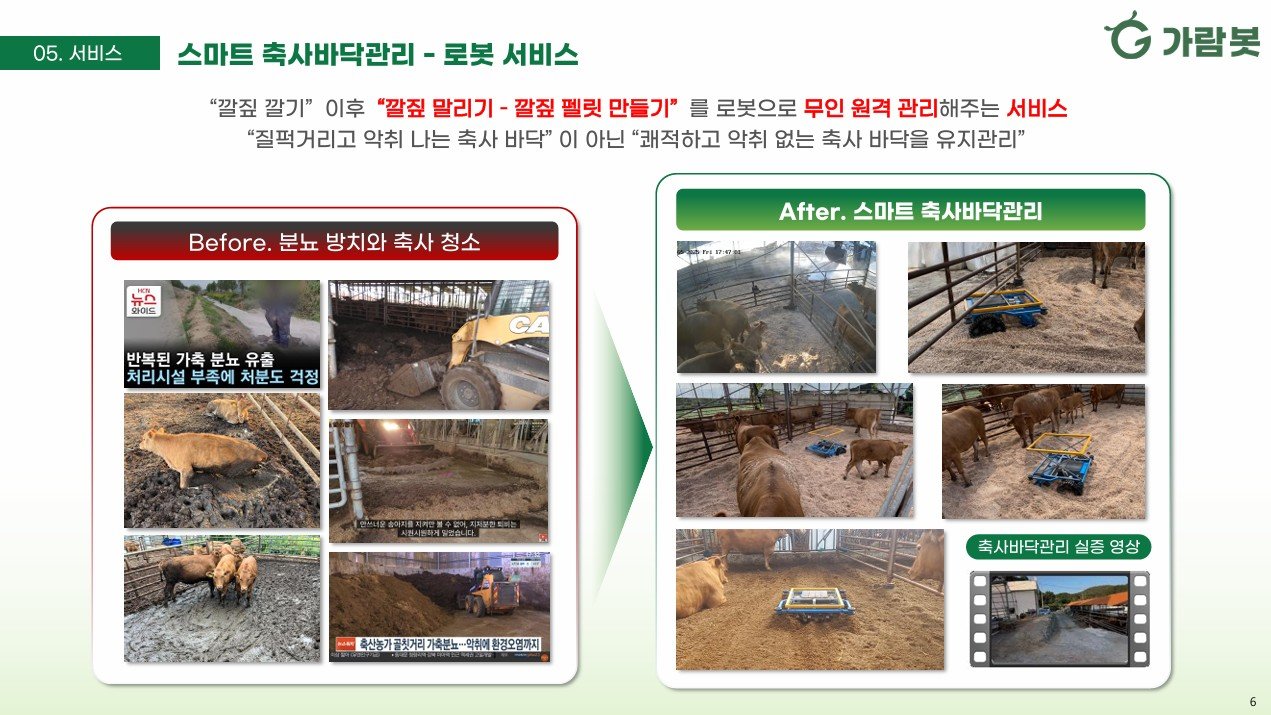
Through a one-month demonstration on an actual cattle shed, Garambot confirmed that the bedding did not clump and that a fine floor material condition was maintained. In effect, the anaerobic conditions under which ammonia and methane—major sources of odor—are generated do not form at all. “It is possible to reduce greenhouse gases generated during manure treatment by more than 90%,” Lee emphasized.
Dung Beetle No. 1 circulates around the shed floor on a set schedule, mixing that day’s discharged manure into the bedding. The moment the moisture trapped in the bedding is mixed, it naturally evaporates, keeping the floor dry. Once the robot’s operating data accumulates, tailored operation becomes possible. It is designed to learn optimal driving patterns based on each farm’s number of Korean beef cattle, type of feed, and shed structure.
Following Dung Beetle No. 1, Garambot is also developing Dung Beetle No. 2. While No. 1’s role is to keep the floor dry, Dung Beetle No. 2’s role is to collect sufficiently dried manure and bedding and process it into biomass (pellets).
Garambot’s goal is to create a sustainable livestock environment / Source=Garambot
The bottleneck in the current process of converting manure into solid fuel is that transport and drying costs account for the majority of production costs. Garambot envisions an ecosystem in which Dung Beetle No. 1 dries the bedding and manure, and Dung Beetle No. 2 then turns it into pellets and collects them. Because there is no separate collection process or drying cost for biomass processing, solid fuel can achieve economic viability. Garambot expects not only to reduce farms’ manure treatment costs by 30% to 50%, but also to alleviate odor complaints and improve the health and productivity of cattle.
Once the smart livestock shed management platform is completed with Dung Beetle No. 1 and Dung Beetle No. 2, the burden on farms will be greatly reduced, Lee explained. Farms can lower the barrier to adopting the smart shed management platform through a subscription-based service, while Garambot will generate revenue by supplying dry cow manure pellets produced in sheds to combined heat and power plants.
Conservative Korean beef farmers’ reluctance is a growth obstacleGarambot, having built a smart livestock shed management platform, faces the challenge of persuading farmers, who have honed their skills by hand over decades, to adopt the unfamiliar approach of AI robots. However, if Korean beef farms are slow to adopt the smart shed management platform, sustainable corporate growth will be impossible, so Garambot is concentrating its efforts on convincing farms.
Garambot has chosen a strategic, phased approach instead of aggressive business expansion. It focuses on accumulating successful demonstration cases to instill confidence that the service works flawlessly. To ease the financial burden on farms associated with initial adoption, it plans to accelerate efforts to register its products as innovative items for public procurement and agricultural machinery. By leveraging government and local government subsidies for livestock odor improvement, it is possible to greatly reduce farms’ investment costs.
Its dissemination strategy is also meticulously planned. Garambot aims to build successful cases around testbeds in Yeongi-myeon, Sejong City, and other key bases, then expand distribution at the regional level through word of mouth. It also plans to accelerate market entry by attracting agriculture-related venture investment and collaborating with major feed manufacturers.
The achievements Garambot has steadily accumulated are also tools to persuade farms and the investment market. In 2025, it filed four domestic patents and one PCT international patent, and registered one patent for a “Livestock Shed Management Robot and Control Method thereof.” In February 2026, it also obtained ISO 9001 (quality management systems) and ISO 14001 (environmental management systems) certifications.
It has also been selected for numerous government support programs. In 2024, it participated in the Ministry of Science and ICT’s K-Global Startup Mentoring program and the Ministry of SMEs and Startups’ Startup Growth Technology Development Project (Didimdol). In 2025, it received support in the deep tech category of the Ministry of SMEs and Startups’ Initial Startup Package and was selected for the “Net-Zero Challenge X” organized by the Carbon Neutrality and Green Growth Commission. In February 2026, it was chosen as an excellent company under the Gyeonggi Startup Booster program by the Gyeonggi Business & Science Accelerator.
Goal: a global agricultural platform companyGarambot’s steady growth has also been strongly supported by Korea University’s Crimson Startup Support Group. Selected for the Initial Startup Package program, Garambot enhanced the completeness of its smart livestock shed management platform by approaching not only technical sophistication but also market fit, revenue generation structure, and global scalability from multiple angles.
Mentoring was also provided for various corporate activities, including investor relations (IR) presentation materials, marketing strategies, and publicity plans. It was able to secure trademark rights and branding as part of the program support process. By participating in global IR, it also had opportunities to validate its business model from the perspective of overseas investors.
“There were aspects of our business that had not been clearly organized. With the help of Korea University’s Crimson Startup Support Group, we were able to build concrete business strategies. It was a turning point that gave Garambot’s members strong confidence that they could move forward without hesitation,” Lee said.
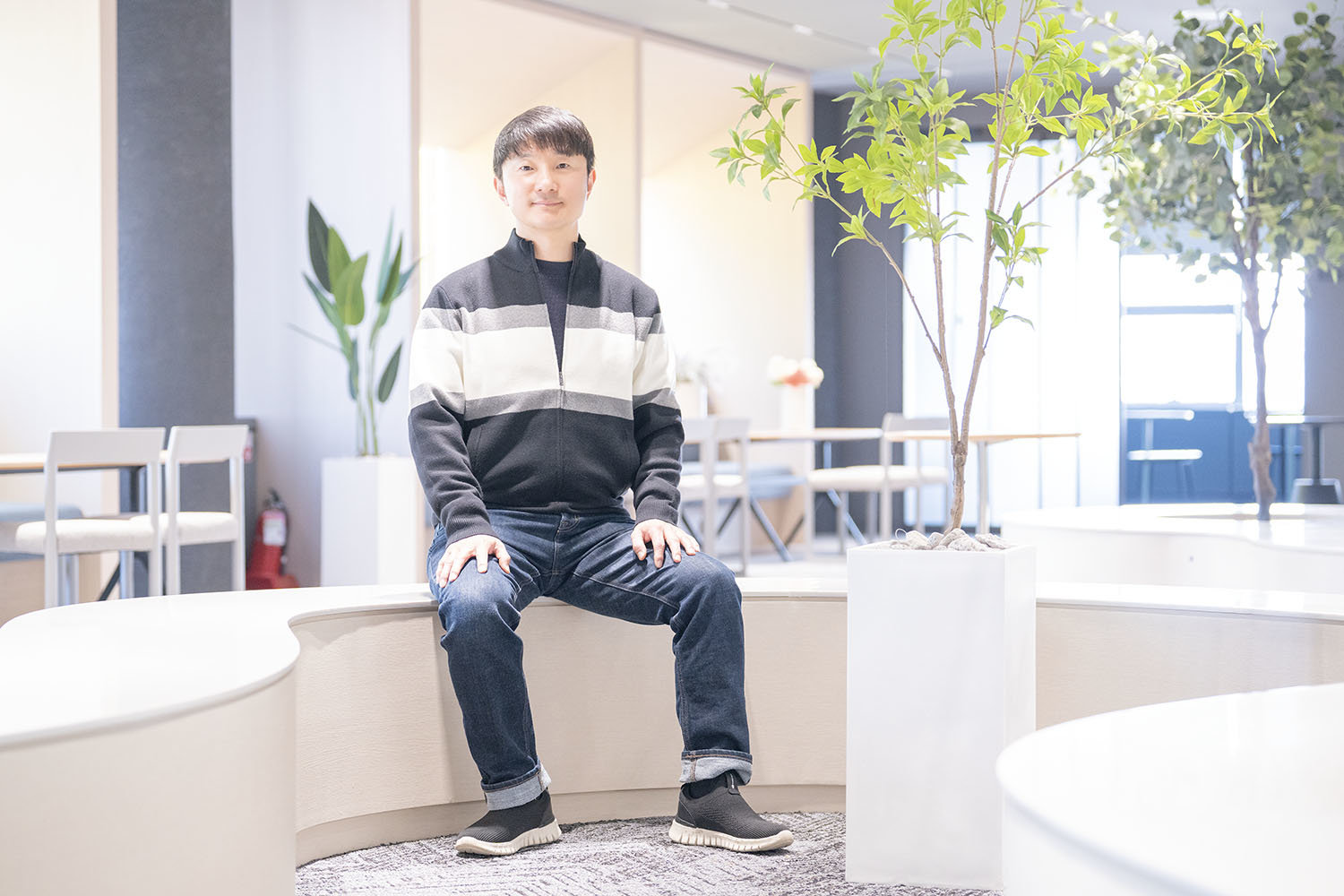
Garambot CEO Lee Moo-bong / Source=IT Dong-A
In 2026, Garambot plans to complete KC certification and innovative product registration for Dung Beetle No. 1 and launch a pilot project with about 30 farms in Yeongi-myeon, Sejong City. Development of Dung Beetle No. 2, the pellet-processing robot, is also scheduled to be completed within 2026. In 2027, the company plans to enter the biomass pellet market, and in 2028, it aims to complete automation of smart shed management AI and solid fuel production, thereby laying the groundwork for global expansion.
Garambot is also eyeing overseas markets. It notes that compost-bedded pack barn (CBP) systems are rapidly spreading, particularly in North America and Europe. This is partly due to their positive effects on animal welfare, lifespan, and productivity, but the strengthening of environmental regulations and the resulting pressure to move away from the traditional reliance on manure storage tanks and liquid manure pits are also cited as drivers of this shift. Lee believes that as the adoption of CBP systems expands overseas, interest in smart shed management platforms will also grow.
Global market entry for the smart livestock shed management platform will proceed in stages. Garambot first plans to build demonstration data in Japan, where livestock conditions—such as an aging farming population, odor regulations, and bedding-based shed structures—are similar to those in Korea. It then plans to expand sequentially into Europe and North America. “We will not cease our challenge to present a new paradigm for sustainable livestock production and to transform troublesome livestock manure into an energy resource,” Lee said.
IT Dong-A reporter Kang Hyeong-seok (redbk@itdonga.com)
ⓒ dongA.com. All rights reserved. Reproduction, redistribution, or use for AI training prohibited.
Popular News