[ITDongA x Korea University] Korea University operates the “Crimson Startup Support Group,” a startup founding and incubation organization under the direct supervision of the Vice President for Research. It introduces promising startups affiliated with Korea University that are growing together with the Crimson Startup Support Group and pursuing change and innovation.
Sound sleep has long been treated as an individual issue. The common response has been that going to bed early or cutting back on coffee is enough when feeling tired. However, sleep deprivation can no longer be regarded merely as a matter of personal condition management. According to statistics compiled by the U.S. Centers for Disease Control and Prevention (CDC) based on the 2022 Behavioral Risk Factor Surveillance System (BRFSS) data, 36.8% of adults were found not to be getting sufficient sleep.
Insomnia is no exception. A survey conducted in May 2024 by the American Academy of Sleep Medicine (AASM) showed that 12% of U.S. adults had been diagnosed with chronic insomnia. AASM added that when temporary insomnia symptoms are included, the figure expands to the 30–35% range.
As more people become trapped in a swamp of stress and insomnia and long for quality sleep, the sleep tech market, which combines information technology (IT) to improve sleep quality, is on the rise. Market research firm Global Market Insights projected that the global sleep tech device market, which was valued at USD 29.3 billion in 2025, will grow to approximately USD 134.7 billion by 2034.
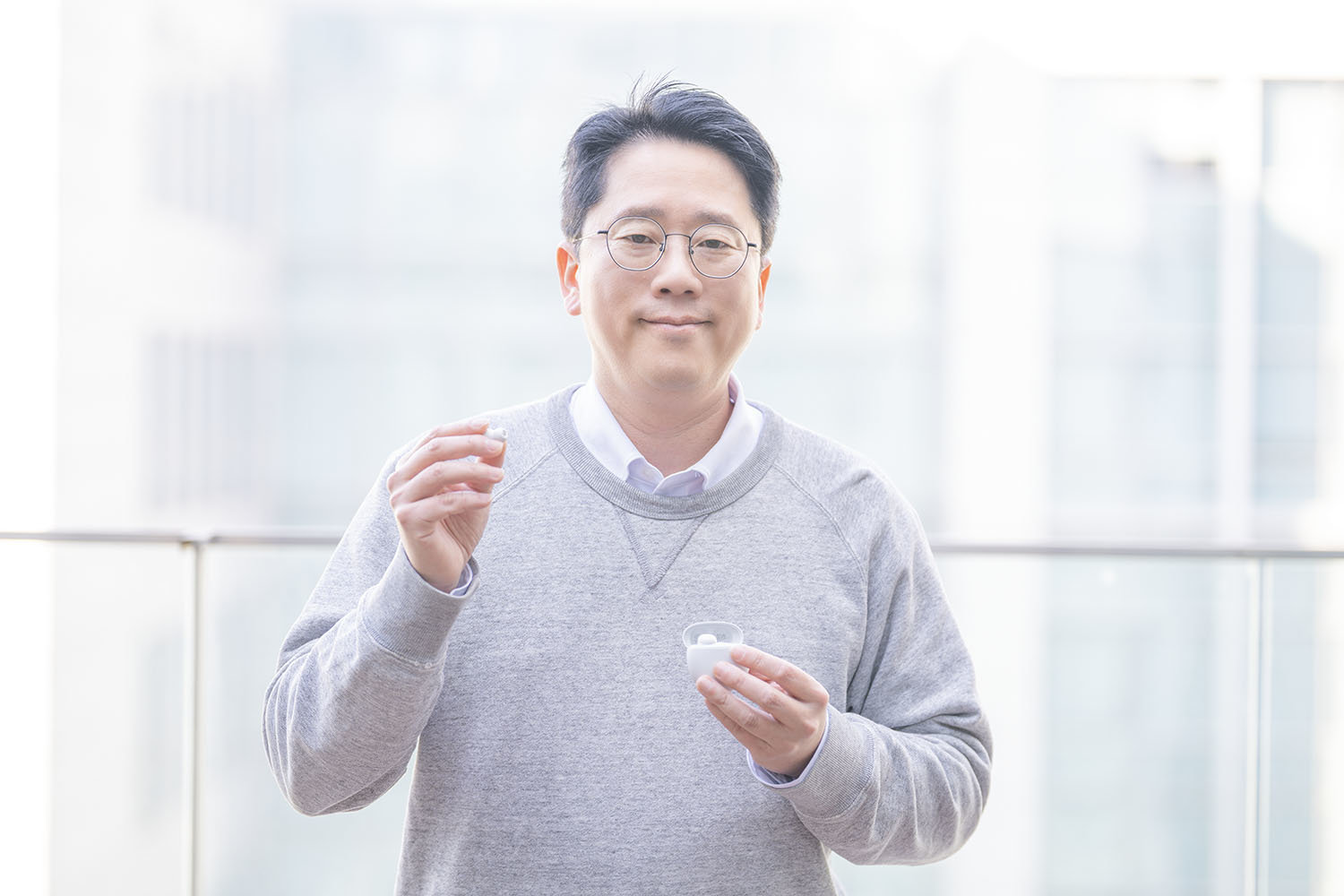
Noh Seung-pyo, CEO of SleepWave / Source = ITDongA
The challenge is that many sleep tech-related products and services remain focused on measuring sleep quality. They indicate how well a person has slept, but leave it up to the user to determine how to utilize that information. SleepWave, however, is driving change in the sleep tech market by proposing a solution that addresses not only measurement but also sleep induction. What technology does it use to create an optimal sleep environment? The following is an interview with SleepWave CEO Noh Seung-pyo.
Thoughts on solving sleep disorders lead to founding a company“Conventional sleep monitoring devices provide only simple feedback such as, ‘You slept poorly last night.’ But what users really need is not a report of results, but immediate deep sleep. We leverage the principle that the brain responds most sensitively to light and sound. SleepWave’s goal is to synchronize brain waves to sleep mode, allowing users to naturally fall into deep sleep.”
Healthcare startup SleepWave began in 2020 within LG Electronics’ in-house venture program. CEO Noh is a former engineer who researched mobile and wearable devices at LG Electronics and founded the company to overcome the limitations of the sleep tech market. Most team members are veteran engineers who worked together at LG Electronics for more than 15 years, giving the startup strong capabilities in both hardware and software development.
Because most of the team consists of highly seasoned technical experts, the company has built a robust infrastructure that allows it to independently carry out everything from hardware design and software algorithm development to app service construction without external reliance. This is SleepWave’s core strength, which provides an implementation capability distinct from startups that have only ideas to offer.
Noh focused on ways to help users achieve comfortable, deep sleep. Most wearable devices meticulously record sleep patterns, but the process ends there. The result is a structure in which data continues to accumulate without addressing users’ questions about their sleep. This led SleepWave to concentrate on developing a solution that would adjust the sleep environment based on measurement data to improve sleep quality.
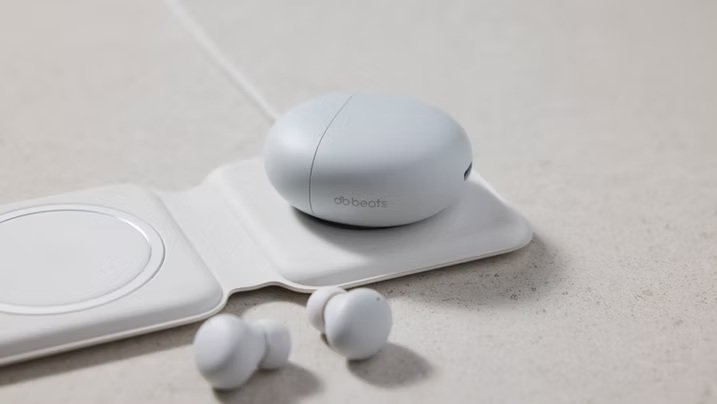
Creating a “pacemaker” for sleep using light and soundSleepWave’s first product is “For me buds,” a pair of fully wireless earbuds. Like ordinary wireless earbuds, the product plays music, but it differentiates itself technologically by incorporating a heart rate measurement sensor. Simply by wearing the earbuds, users can have their heart rate variability (HRV), tension level, and stress index measured in real time.
“For me buds continuously monitor the user’s condition in real time and immediately generate and play special sounds tailored to the data to stabilize brain waves. They do not simply play pre-stored white noise. If a user’s heart rate is elevated, the device performs a ‘pacemaker’ function, gradually lowering the frequency in line with that pace. It is as if the user’s biometric signals and the device are conversing in real time, guiding the way to sleep.”
The principle of stabilizing brain waves through light and sound has been in use for a long time. It is similar in concept to brain wave sound-based products that once enjoyed great popularity in Korea. What sets SleepWave apart is that instead of playing pre-determined audio, it generates customized sounds by reading the user’s real-time biometric signals.
SleepWave sought differentiation by adopting a “closed-loop system.” Most sleep monitoring devices have a one-way structure of measurement followed by reporting. In contrast, SleepWave introduced an organic cycle of measurement, real-time analysis, customized stimulation, and re-measurement. When a user lies down to sleep, if the system detects high brain arousal, it plays lower-frequency sounds, and as the heart rate stabilizes, it gradually lowers the volume or switches to sleep-inducing signals. This dynamic response helps users naturally transition into sleep stages without conscious awareness.
SleepWave’s For me buds earphones, which utilize heart rate sensor technology / Source = SleepWave
Another source of pride for SleepWave is its high level of heart rate measurement accuracy, grounded in its hardware manufacturing capabilities. CEO Noh explained, “We have experience designing and mass-producing tens of millions of mobile devices. Our know-how in filtering out minute biometric signals without noise and converting them into meaningful data is a unique strength that cannot be quickly replicated.”
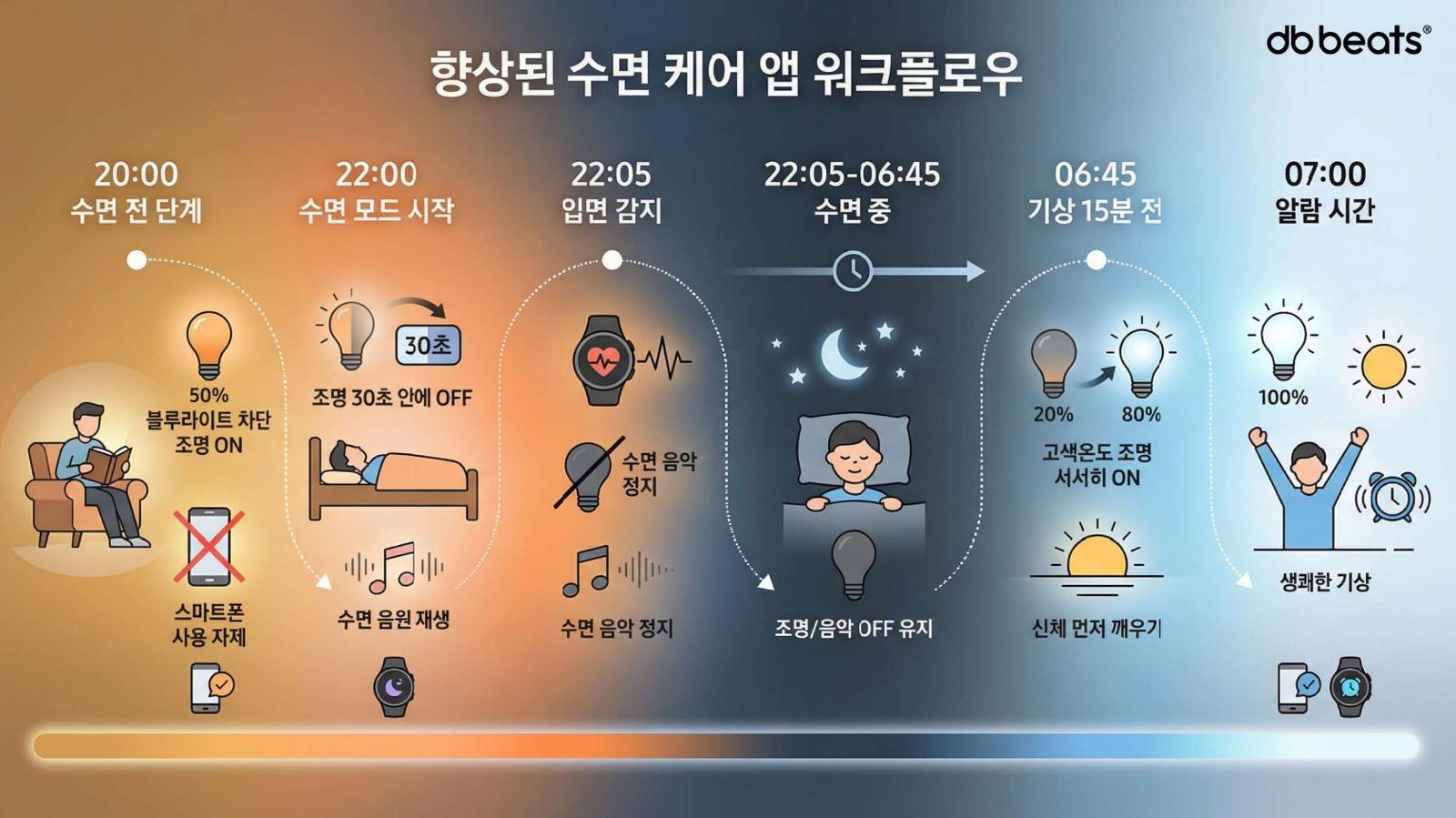
Recently, SleepWave has been expanding this technology beyond the framework of earphones. For users who find it uncomfortable to sleep with earbuds, the company is evolving into a platform that links with smartwatch data to play sounds via smartphone speakers, or controls lighting emitting special wavelengths to establish sleep routines.
Lighting solutions that do not interfere with melatonin secretion are one of SleepWave’s future growth drivers, aimed at transforming entire bedrooms into sleep-friendly spaces. The company is currently conducting proof-of-concept (PoC) work with Hoban Construction to configure sleep-specialized IoT (Internet of Things) spaces. The idea is to apply a platform that integrates the management of lighting, sound, air conditioning, and temperature to hotel and resort sleep rooms.
Sleep care workflow built by SleepWave / Source = SleepWave
Noh is also paying attention to the area of concentration enhancement. He noted that applying brainwave stabilization technology in the opposite direction can lead to improved concentration. SleepWave has completed clinical validation of a concentration enhancement mode and is developing products in collaboration with education company JinHakSa.
Building brand awareness is a practical concern for startupsNo matter how excellent the technology, it is useless if not chosen by the market. Noh cited “building trust” as the greatest challenge after founding the company. As a newly established startup, entering the B2C (business-to-consumer) market to directly build brand recognition among consumers was a formidable challenge.
“Consumers trust large corporate brands but tend to be skeptical about the innovative technologies of startups. To answer the question of whether our product really works, we needed much more data. Sleep is highly individualized, so the process of gaining broad-based trust was extremely arduous.”
To overcome this, Noh chose a straightforward approach. To prove SleepWave’s technological strengths, he focused on building B2B (business-to-business) references through collaborations with large corporations. The company also accumulated objective data through clinical cooperation with medical institutions, including Seoul National University Bundang Hospital. Clinical evaluation results showed that using For me buds shortened sleep onset time by more than 30% compared with existing ASMR users and significantly reduced the number of awakenings during sleep.
Focusing on technology that users can feel directlySleepWave is maintaining steady growth, with sales in 2025 more than doubling those of 2024. The revenue structure is approximately 6:4 between For me buds product sales and software solution revenue. Software solution revenue comes from supplying measurement and sound algorithms to other earphone manufacturers and providing content packages for LG Electronics’ home appliance lineup.
The technological leap and market foothold of SleepWave were strongly supported by Korea University’s Crimson Startup Support Group’s Initial Startup Package program. Through the program, SleepWave received support for patent applications and opportunities for overseas expansion, including participation in an exhibition in Dubai. Influencer marketing support helped compensate for the company’s limited brand exposure and contributed to increased product sales performance.
“For a startup, the process of completing a prototype and then finding actual sales channels is like walking a thorny path. Korea University’s Crimson Startup Support Group provided SleepWave with support in establishing marketing strategies and mentoring on attracting investment. Support for influencer marketing and participation in overseas exhibitions also offered valuable opportunities to grasp global sleep market trends and confirm the export potential of sleep management technologies.”
Noh said, “Rather than ending with one-off support, the program greatly helped us build the ‘survival muscles’ needed for a startup to sustain itself in the market.”
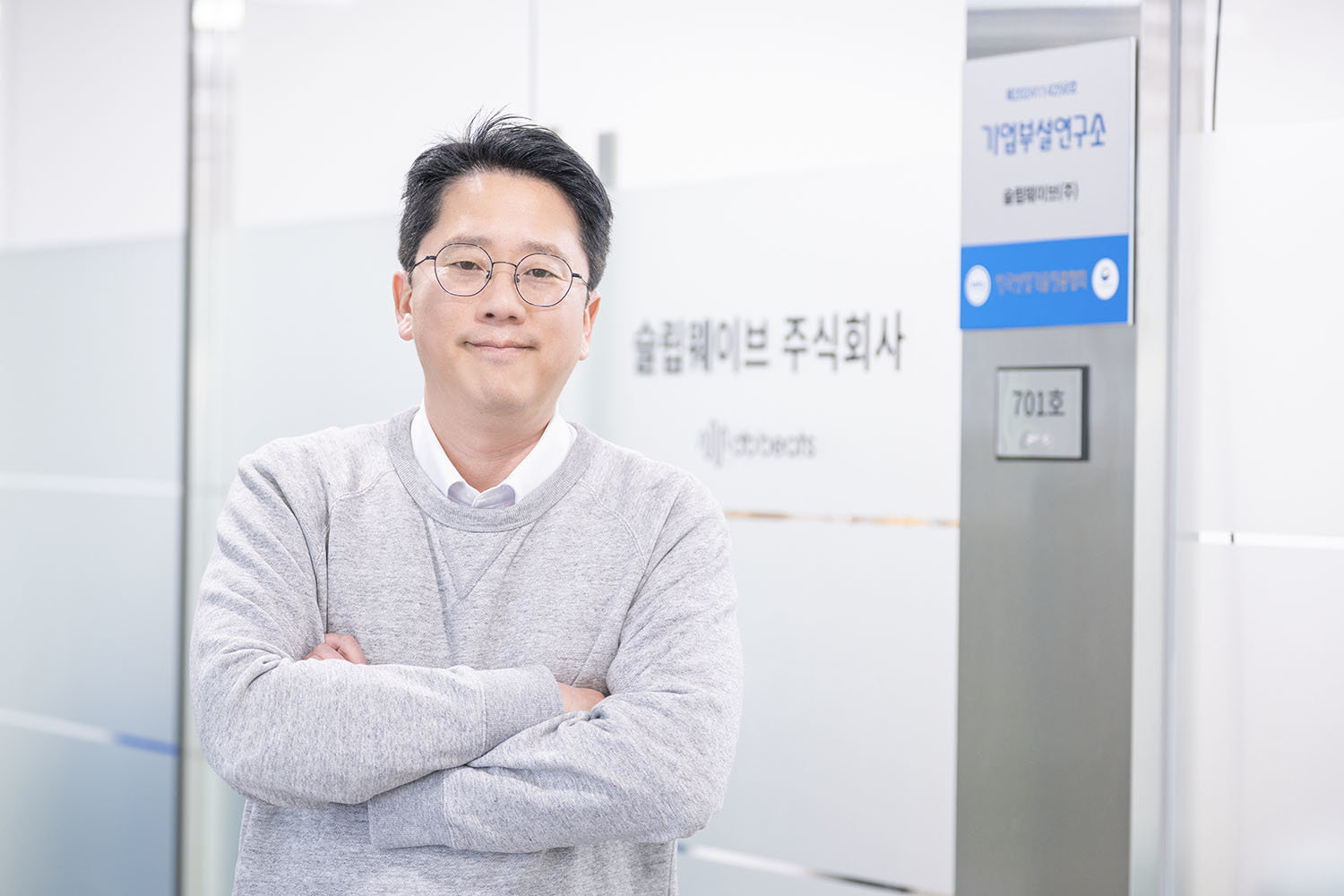
Noh Seung-pyo, CEO of SleepWave / Source = ITDongA
SleepWave plans to expand its business scope from sleep to comprehensive mental care. Examples include sound solutions for improving concentration among students preparing for exams and power nap solutions that provide short but deep rest for office workers. The company aims to evolve into a life care enterprise responsible not only for nighttime peace but also for daytime vitality.
Even so, Noh emphasized that the company does not intend to become one that is fixated solely on technology. “If you immerse yourself in one field for a long time, the technology itself can easily become the goal. If you become preoccupied with how precisely you measure or how much data you analyze, you can lose sight of what users actually want. What SleepWave ultimately creates is something that helps people sleep well. That needs to be truly felt,” he stressed.
ITDongA reporter Kang Hyeong-seok (redbk@itdonga.com)
ⓒ dongA.com. All rights reserved. Reproduction, redistribution, or use for AI training prohibited.
Popular News