※ Seoul National University of Science and Technology supports early-stage startups in the deep-tech (AI·Big Data) sector. Based on Seoul National University of Science and Technology’s tailored growth support program, IT Donga examines promising deep-tech startups that are achieving clear results in the market.
Smartwatches record heart rate and sleep duration. Health management apps calculate calories and count steps. Digital healthcare has become deeply embedded in everyday life to the point where this situation no longer feels unfamiliar.
According to the Korea Biotechnology Industry Organization, the global digital healthcare market was estimated at USD 240.85 billion (approximately KRW 326.7 trillion) in 2023. It is expected to grow by around 21% annually to reach USD 1,635.11 billion (approximately KRW 2,219.5 trillion) by 2033.
The global digital health market is growing explosively, but actual cases where this leads to improvement in users’ health indicators remain rare. A typical example is failing at a diet despite installing a calorie-focused app. Some experts attribute this to a “disconnect between data and behavior,” as there has been no intelligent guide to translate collected data into actionable practice.
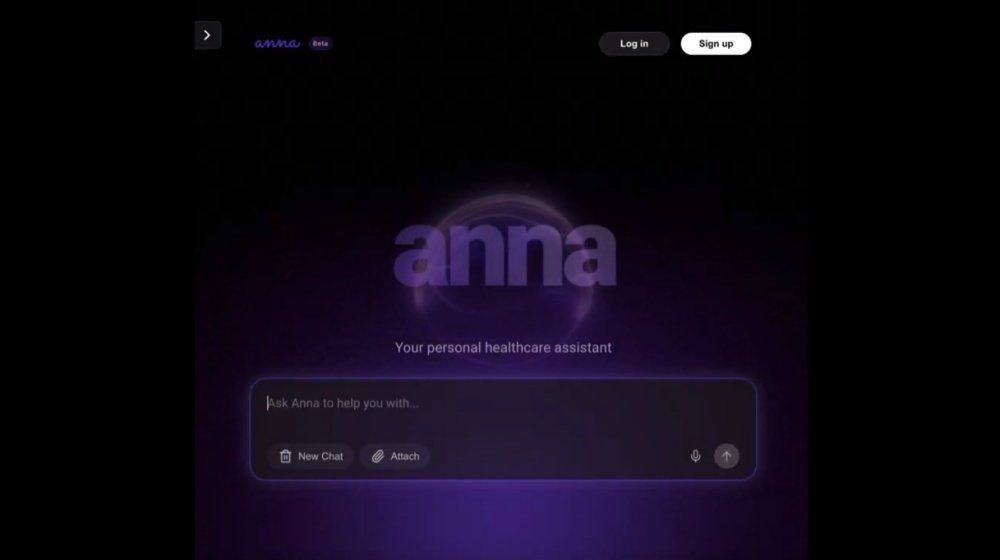
ANNA is Vitalyx’s flagship service, an AI multi-agent collaboration-based behavior-inducing healthcare platform / Source=Vitalyx
It is at this point that startup Vitalyx enters the scene. Vitalyx is developing an AI healthcare platform that drives personalized behavioral change for users based on multi-agent collaboration technology. IT Donga spoke with Vitalyx CEO Kim Min-soo, who founded the company after a decade as a software researcher designing numerous healthcare services, about its technology, growth strategy, and vision.
From recording to action: a new paradigm in healthcareFounded in 2024, Vitalyx’s name combines “Vital,” meaning vitality, “AI,” and “X,” which signifies connection and expansion. The name reflects the company’s intention to move beyond the current limitations of digital healthcare, which is overly focused on recording data.
Before founding Vitalyx, CEO Kim worked for 10 years as a software (SW) researcher designing healthcare services. During that time, he noticed a contradiction: while technology was advancing rapidly, users’ health indicators were not significantly improving. Kim recalled, “I believed the core problem was the absence of an intelligent guide to translate data into practice,” adding, “With my background in computer engineering and a decade of experience in the healthcare domain, I concluded I could solve this problem, which led me to start the company.”
Hyper-personalization and rebalancing: realizing sustainable health managementVitalyx’s flagship service, ANNA, is an AI multi-agent collaboration-based behavior-inducing healthcare platform. Individual AI agents—such as exercise experts, nutrition experts, psychology experts, research paper search agents, and content agents—collaborate in real time for a single user. This differentiates it from existing AI that typically provides only a single, uniform answer.
CEO Kim introduced the specific operating mechanism, stating, “Inside ANNA, specialized agents designed to perform different tasks collaborate in real time.” First, the research paper and content search agents analyze the latest medical papers and verified healthcare content to generate evidence-based guidance. The national health data agent connects with public institutions’ health checkup results and national health guidelines to make judgments based on highly reliable data. The user context agent continuously identifies the user’s current location, weather, activity level, and mood to propose the most feasible actions.
For example, if ANNA detects that a user’s sleep data is poor, the nutrition agent may recommend restricting caffeine intake, while the exercise agent suggests light stretching, creating an organic healthcare response. In other words, whereas conventional healthcare apps tend to impose fixed plans, ANNA immediately reconstructs plans to fit the user’s real-world situation.
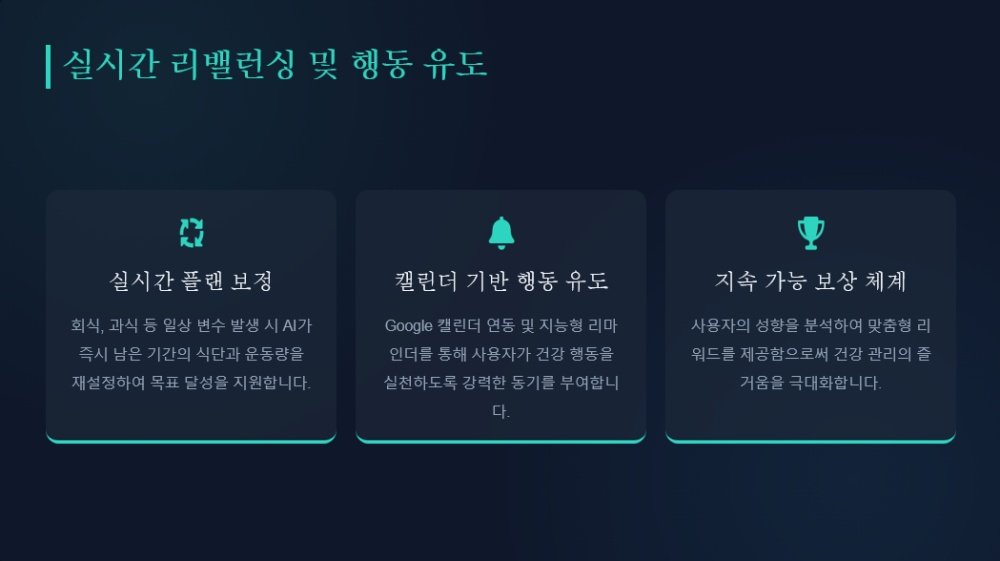
ANNA differentiates itself with its health rebalancing strategy / Source=Vitalyx
A key differentiating factor of ANNA is its health rebalancing strategy. If a user fails to follow a planned diet due to a company dinner, the AI does not reprimand them but instead immediately initiates diet rebalancing. It provides realistic, personalized alternatives in real time—for example, automatically adjusting the nutritional composition of the next meal or suggesting activities that aid digestion. This helps prevent users from abandoning their health management efforts midway.
Kim explained, “Most people do not fail to maintain their health because they lack information. They give up because they do not have actionable guidance tailored to their circumstances,” adding, “When busy work schedules or unexpected social gatherings disrupt a diet plan, ANNA immediately offers flexible alternatives.” He continued, “The core strategy is to create sustainability without mid-course abandonment, rather than pursuing a perfect plan.”
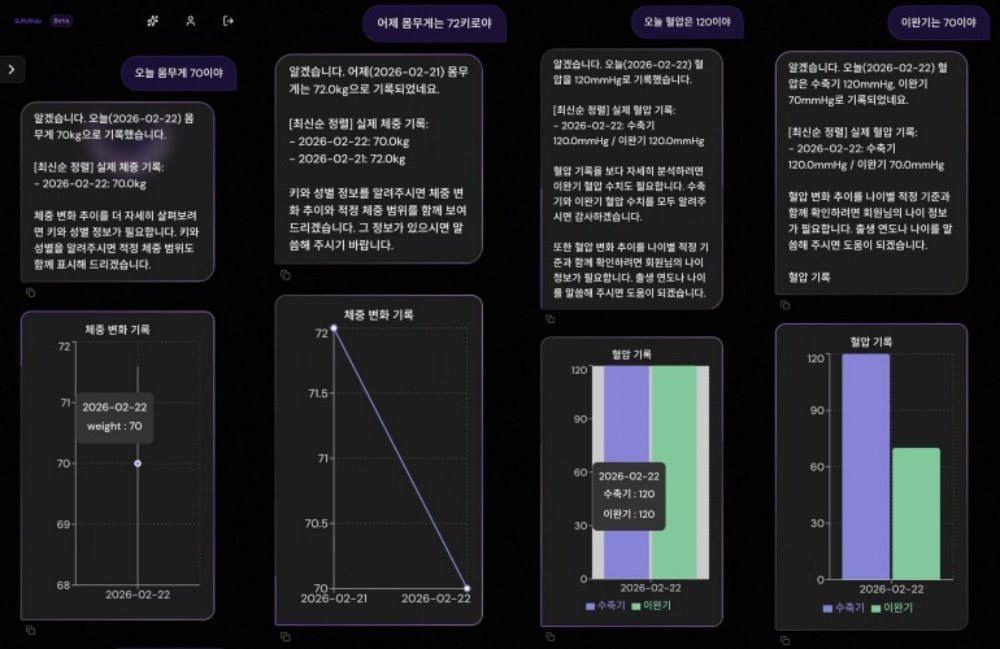
ANNA also becomes smarter the more it is used. This is because it accumulates all time-series data—such as diet logs, sleep patterns, and exercise responses—to build a personalized health profile. Based on this, ANNA goes beyond providing generic health information to deliver hyper-personalized, intensive management, such as recommending alternative menu items when the user’s past experience shows that a particular food led to a decline in their condition.
Overcoming challenges and securing reliability with RAG technology and expert staffVitalyx faced various challenges during the development of ANNA. The biggest obstacles were hallucination—one of the chronic issues of large language models (LLMs)—and the limitations of personalization. Kim recalled, “Accuracy is paramount for health information. It was difficult to gain trust with a general chatbot approach.”
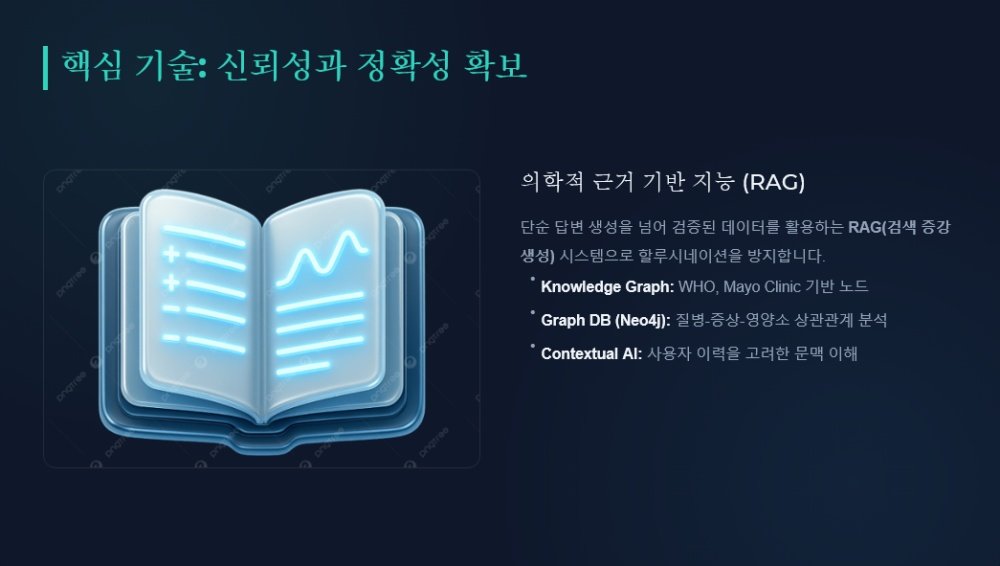
Vitalyx addressed these challenges by combining RAG technology with professional medical knowledge data / Source=Vitalyx
To resolve these issues, Kim combined retrieval-augmented generation (RAG) technology with professional medical knowledge data. The company also focused on vectorizing users’ real-time biometric data. Vectorization is a core technology for processing data efficiently, converting signals such as heart rate, blood pressure, and body temperature into numerical arrays so that patterns can be quickly identified. As a result, the AI was trained to understand users’ current conditions in context, overcoming the previous challenges. Kim explained, “We found a breakthrough by building a guardrail system that ensures the AI provides guidance only within the bounds of verified knowledge, rather than simply generating answers.”
Team composition has also played a crucial role. Vitalyx is an engineer-centric organization structured to respond immediately in-house across planning, development, and public relations. In particular, the head of development is an AI expert who specialized in natural language processing at KAIST, and is responsible for designing the unique architecture that integrates LLMs with real-time health data.
According to Vitalyx, the company plans to further enhance the scientific precision of its behavior-inducing capabilities by hiring behavioral psychology specialists and clinical data scientists. Kim stated, “We will ensure that ANNA’s recommendations are not only medically accurate but also have the psychological power to motivate users to take action.”
Vitalyx also places great importance on the security of health data, as it is among the most sensitive forms of personal information. Accordingly, Vitalyx adheres to the principle of returning data sovereignty to users. The system guarantees the right to be forgotten by allowing users to have their data deleted immediately upon request.
Kim emphasized, “Healthcare data requires a higher level of security than financial data,” adding, “We store all data in a de-identified form and apply strong encryption protocols to communication between servers.” Looking ahead, the company plans to build a cloud environment that complies with medical law and Personal Information Protection Act guidelines to fundamentally block the possibility of data leaks.
Diversifying the business model and planning overseas expansionVitalyx has a concrete business model. While it initially targets a B2C subscription model, it ultimately plans to expand into B2B employee health management for corporations and B2B2C models in partnership with insurers and health checkup centers. Above all, it aims to offer integrated solutions that combine hardware and software through collaboration with manufacturers of smart wearables and fitness equipment.
In the short term, Vitalyx aims to become the domestic standard for behavior-inducing AI healthcare / Source=Vitalyx
In addition, Vitalyx is pursuing partnerships with fitness trainers, nutritionists, and pharmacists to link online and offline services. The company is currently conducting internal tests and plans to carry out a digital wellness challenge proof of concept (PoC) for employees of a specific company in the second half of 2026. Kim expressed confidence, saying, “We will demonstrate meaningful changes in actual health indicators such as blood pressure and body fat using data.”
Vitalyx’s business potential has been recognized, and the company was selected in 2025 for the early-stage startup package in the deep-tech sector under the Startup Support Group at Seoul National University of Science and Technology. Kim said, “This selection was an important milestone that officially recognized Vitalyx’s technological innovativeness,” adding, “With the business commercialization funding, we were able to focus on building the core architecture of our multi-agent system and refining our RAG technology.” He continued, “Deep-tech-focused mentoring has helped us fortify Vitalyx’s unique technological moat. Professional networking has also greatly aided us in validating product-market fit (PMF) and establishing our marketing strategy.”
In the short term, Vitalyx aims to become the domestic standard for behavior-inducing AI healthcare. Its global vision is also clear. By optimizing multilingual LLMs and integrating with APIs of global wearable devices, the company plans to enable people anywhere in the world to experience what it calls an “AI primary care physician in the palm of the hand.” Kim said, “Our solution addresses health management, a universal concern of humanity that transcends language and culture,” adding, “We are planning global expansion, including into the North American market, starting in the second half of 2027.”
Vitalyx has entered the healthcare market with a differentiated behavior-inducing approach that focuses on the practicality of technology. Expectations are rising as to whether it will achieve healthcare innovation through AI multi-agents.
IT Donga reporter Park Gui-im (luckyim@itdonga.com)
ⓒ dongA.com. All rights reserved. Reproduction, redistribution, or use for AI training prohibited.
Popular News