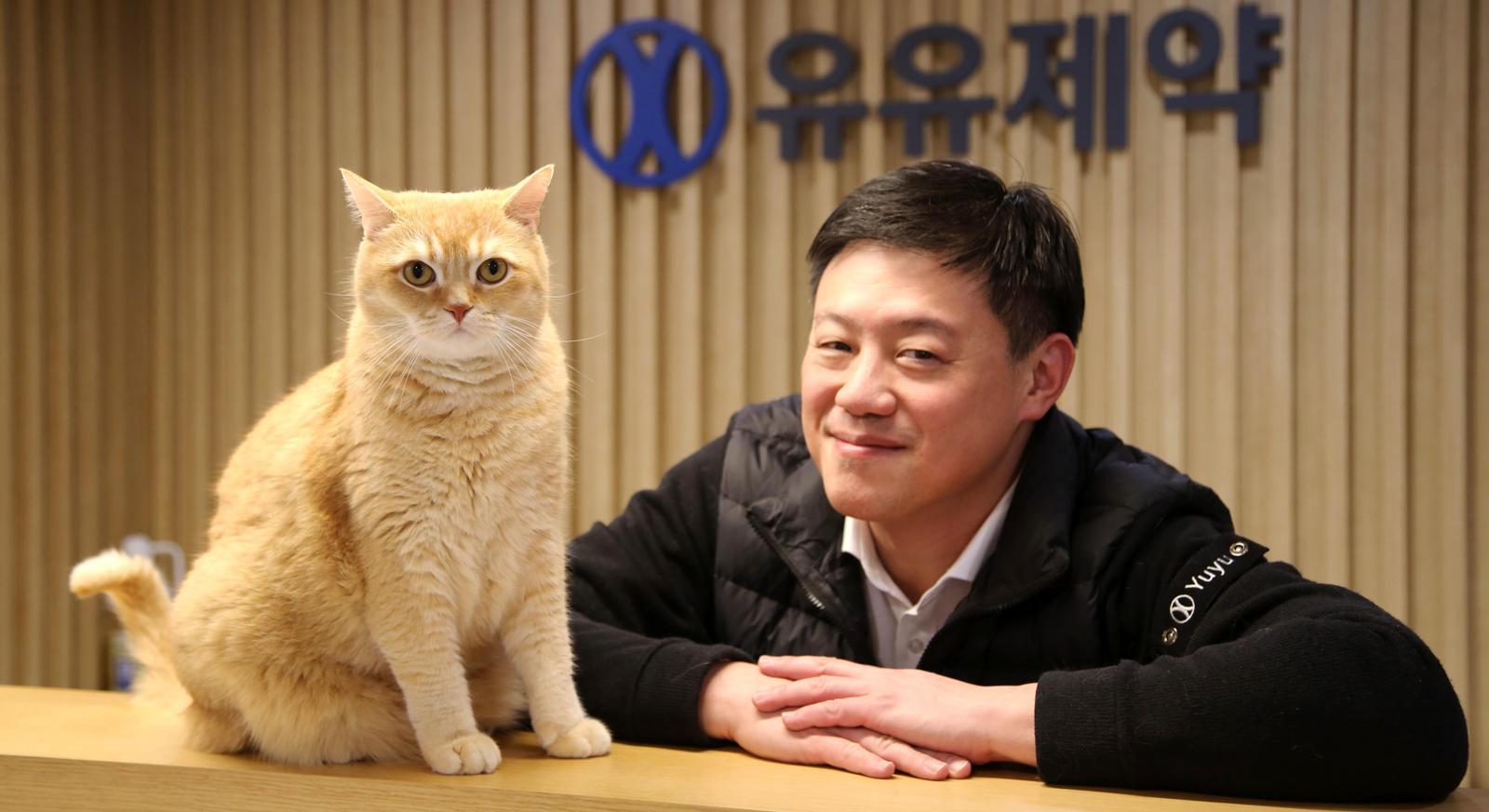
On the 19th, Yoo Won-sang, CEO of YuYu Pharma, poses for a photo with his companion cat “Rang-i” at the company’s headquarters in Jung-gu, Seoul. YuYu Pharma plans to secure a new growth engine by focusing on the animal pharmaceuticals market, such as cat atopic dermatitis, where drug supply lags behind market potential. Provided by YuYu Pharma
“KRW 1,440 trillion.” This is the estimated size of the global animal pharmaceuticals market in 2032. As the number of people raising companion animals increases, the animal drug market is growing rapidly. Yet there are still only seven players worldwide that properly develop animal pharmaceuticals. Domestic drugmaker YuYu Pharma has now thrown its hat into this still “blue ocean” market.
“Having tried new drug development, I realized the risk is really huge. For animal pharmaceuticals, the time and cost required for development are about half of that. The risk is lower and the market will grow, so there is no reason not to enter.”
At YuYu Pharma’s headquarters in Jung-gu, Seoul on the 19th, CEO Yoo Won-sang explained the rationale for designating animal pharmaceuticals as the company’s next growth engine. Founded in 1941, YuYu Pharma has developed products including the vitamin preparations “Yupan-C” and “Vinapol,” as well as dementia treatments and osteoporosis drugs. CEO Yoo, the grandson of founder and Chairman Yoo Teuk-han, was born in the United States and holds a bachelor’s degree from Trinity College (US) and a master’s degree from Columbia University. After working at global pharmaceutical companies including Novartis, he joined YuYu Pharma as a senior executive director in 2008 and became CEO in 2019, leading the company’s new business initiatives.
The animal pharmaceuticals business that CEO Yoo is ambitiously preparing actually stems from a painful failure. In 2023, the company’s dry eye disease drug candidate “YP-P10,” which had been prepared with high expectations, failed in Phase 2 clinical trials, forcing the company to endure a period of “consolidation” to improve management efficiency. Having achieved an operating margin of 10% in 2024, YuYu Pharma plans to begin full-fledged expansion in scale starting this year.
Within animal pharmaceuticals, the field CEO Yoo is focusing on is biologics for atopic dermatitis in cats. Only four biologic products have been launched in the animal pharmaceuticals segment so far, and just one of them targets cats.
CEO Yoo said, “Atopic dermatitis directly affects the quality of life of both companion animals and their owners,” adding, “The number of people raising companion cats is increasing rapidly, yet very few drugs are being developed for cats, so there will definitely be demand.” He explained that the lack of use stems from the absence of drugs, and that once drugs are developed, the market will naturally open up.
In fact, “Solensia,” a biologic for feline osteoarthritis launched in 2023, recorded sales in the KRW 260 billion range within three years of its release. Before its launch, the feline osteoarthritis treatment market was only about KRW 13 billion. The market has expanded roughly 20-fold. The current market for cat atopic dermatitis treatments, where YuYu Pharma aims to compete, is around KRW 25 billion. If it expands in a similar way, it could grow to as much as KRW 500 billion.
CEO Yoo said he plans to use the animal pharmaceuticals market as a starting point to continue innovation through to new drugs. A key variable is the government’s drug price cuts. The government is currently pursuing a policy to reduce the reimbursement price ceiling for generics (small-molecule copy drugs) from 53.55% of the original drug’s price to 40%, with the stated goal of assigning higher value to innovative new drugs. However, the domestic pharmaceutical industry, which derives the vast majority of its sales from generics, is on high alert. CEO Yoo expressed concern, saying, “Developing innovative new drugs requires enormous investment,” and “While we agree with the government’s intent, drastic price cuts could actually hinder research and development (R&D) investment.”
ⓒ dongA.com. All rights reserved. Reproduction, redistribution, or use for AI training prohibited.
Popular News