Seoul National University of Science and Technology Technology Holdings is enhancing the commercialization and market competitiveness of its subsidiaries’ technologies through the BRIDGE 3.0 program. IT Donga introduces the technological capabilities, commercialization achievements, and entrepreneurial spirit of these technology holdings subsidiaries that are growing with such support.
HarmonyGate is developing “Vivo-Leg,” an AI robotic prosthetic leg for amputees. Vivo-Leg is a robotic prosthesis that applies humanoid robot technology to address the limitations of existing electronic prostheses. Actuators are mounted on the knee and ankle, and toes are added to support stable and comfortable walking not only on flat ground but also on complex terrains such as slopes and stairs.
HarmonyGate has developed up to the second prototype and plans to complete the prototype within this year and commercialize it by 2027. The company also plans to compete in the international robot competition for people with disabilities, “Cybathlon,” in 2028 to gain global recognition and then enter the global market.
IT Donga met with HarmonyGate CEO Kim Jeong-Yeop to discuss HarmonyGate and Vivo-Leg.
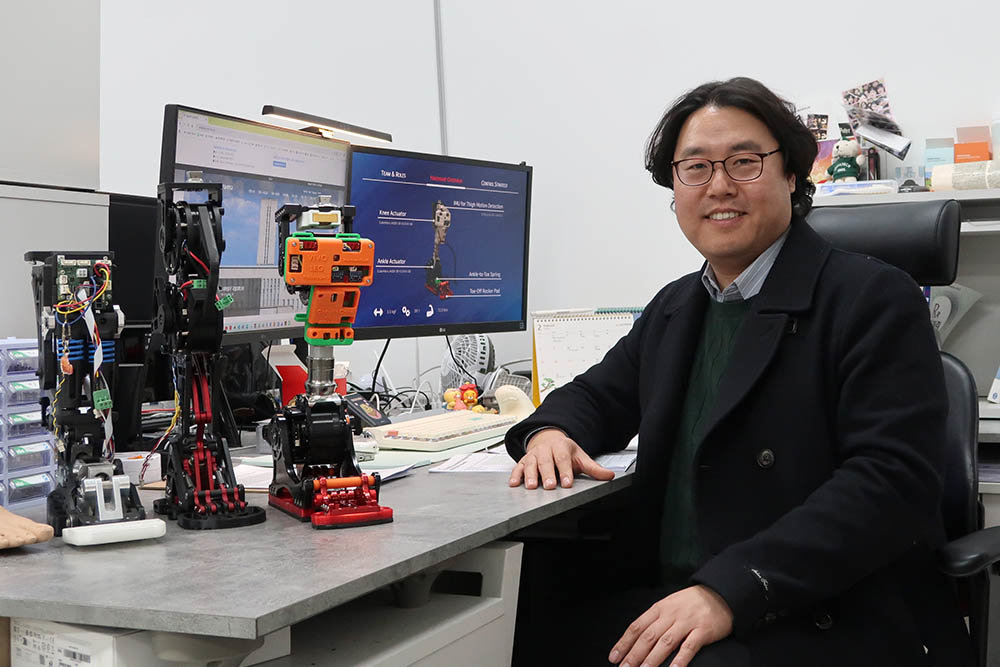
Kim Jeong-Yeop, CEO of HarmonyGate / Source = IT Donga
Founded to help people with disabilities using humanoid robot technologyIT Donga: Hello, CEO Kim. Please introduce yourself.
CEO Kim Jeong-Yeop: Hello, I am Kim Jeong-Yeop of HarmonyGate. I received my PhD in Mechanical Engineering from the Korea Advanced Institute of Science and Technology (KAIST) in 2006 and played a leading role in developing the HUBO series, Korea’s first humanoid robots, at Professor Oh Jun-Ho’s Humanoid Robot Research Center (Hubo Lab) at KAIST.
After that, I worked as a postdoctoral researcher at the Robotics Institute of Carnegie Mellon University (CMU), then as a senior researcher at the 5th Robotics Directorate of the Agency for Defense Development (ADD). Since 2008, I have been serving as a professor of Intelligent Robotics in the Department of Mechanical System Design Engineering at Seoul National University of Science and Technology (hereinafter SeoulTech).
I am currently the head of the AI Robot Convergence Industry-Academic Cooperation Center at SeoulTech, vice president of the Dynamics, Control, and Robotics Division of the Korean Society of Mechanical Engineers, and academic vice president of the Korea Defense Robot Association. I also served as an outside director of Rainbow Robotics for six years from 2018, and I am currently acting as a technical advisor to SPG and an outside director of RoboRisen, providing technical consulting related to robot system development.
IT Donga: What led you to establish HarmonyGate?
CEO Kim Jeong-Yeop: Since my doctoral studies, I have been wondering how the humanoid robot and AI technologies accumulated through government R&D projects could be used in ways that help citizens, especially people in vulnerable groups such as persons with disabilities. This led me to develop an interest in robotic prosthetic legs for lower-limb amputees.
The global population of lower-limb amputees is relatively small, and many of them are unable to purchase expensive prostheses due to economic constraints. As a result, the global market size is small, and interest in prostheses is low. Under such circumstances, technology development inevitably lags. In fact, existing prostheses cause various inconveniences. Fatigue accumulates easily while walking, and walking stability decreases on slopes or complex terrain. I decided to develop a robotic prosthetic leg that can help amputees regain their daily lives, and as a result, I founded HarmonyGate in October 2025.
IT Donga: What kind of company is HarmonyGate?
CEO Kim Jeong-Yeop: HarmonyGate is developing Vivo-Leg, an AI robotic prosthetic leg for amputees. Our goal is to leverage physical AI technology to support the social reintegration of persons with disabilities, thereby contributing to reducing the state’s social expenditure and maintaining a stable driving force for society.
The company name signifies the gait formed in harmony between the robotic prosthetic leg we developed and the amputee user. This “gait” refers not only to walking with the robotic prosthesis but also to the supportive steps taken alongside amputees as they return to society.
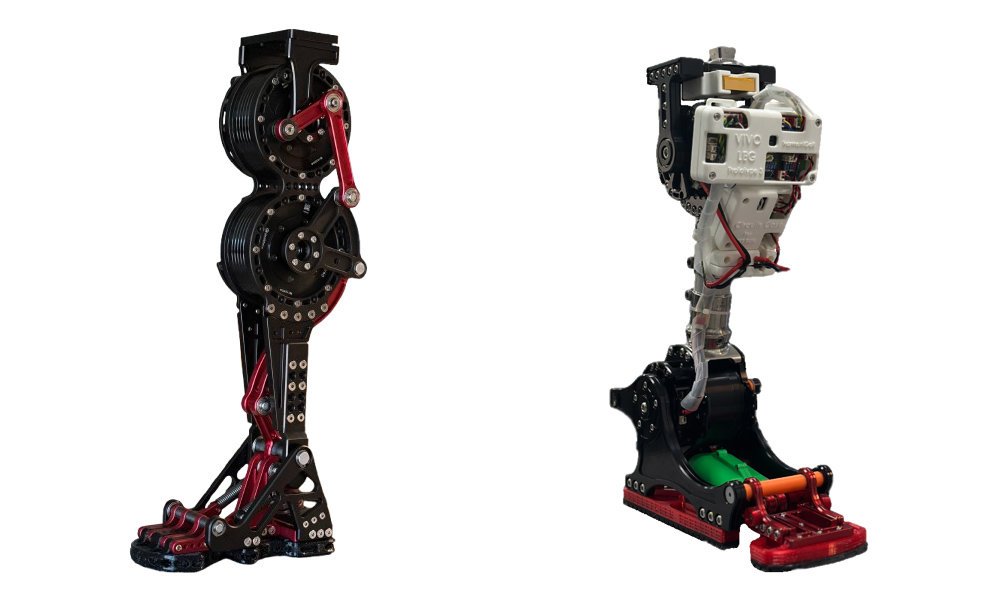
First (left) and second prototypes of Vivo-Leg / Source = HarmonyGate
Actuators and toe joints applied: Vivo-LegIT Donga: You are currently developing the AI robotic prosthetic leg Vivo-Leg. What kind of product is it?
CEO Kim Jeong-Yeop: Vivo-Leg is an AI robotic prosthetic leg for amputees. It applies humanoid robot technology to improve the functional limitations of existing electronic prostheses and helps amputees walk more comfortably and safely.
Electronic prostheses change resistance according to joint movement via an internal cylinder. They are sufficiently useful on flat ground. However, because they lack actuators, a lot of fatigue accumulates during walking. There is also a risk of falling when going up and down stairs or walking on uneven terrain. To address these inconveniences, we equipped Vivo-Leg with actuators at the knee and ankle. The knee actuator reduces fatigue when going up and down stairs, while the ankle actuator improves stability on slopes and stairs.
The addition of toes is another characteristic of Vivo-Leg. When people walk, their toes push against the ground to gain propulsion and maintain left-right gait symmetry. Maintaining left-right gait symmetry can also help prevent musculoskeletal disorders. Therefore, we added toes to Vivo-Leg. We also linked the toe joint with the ankle actuator so that it moves together with the ankle during walking. As the toes push against the ground to assist walking, this reduces user fatigue and improves left-right gait symmetry.
IT Donga: What AI technologies are applied in Vivo-Leg?
CEO Kim Jeong-Yeop: We applied human-mimicking AI technology. Based on gait data obtained via motion capture, we model walking patterns and estimate the gait state of amputees to assist them in moving smoothly. We are currently advancing the system to apply imitation learning that learns from human gait data and reproduces similar movements, and we expect this to deliver a more natural walking pattern.
In the future, we plan to further enhance gait performance by applying reinforcement learning to generate diverse human models in virtual environments and train them to walk on various terrains. We also plan to link with smart wearable devices that collect amputees’ motion, voice, and environmental information, so that transitions between movements—such as flat walking, slopes, stairs, sitting, and standing—can be achieved more easily.
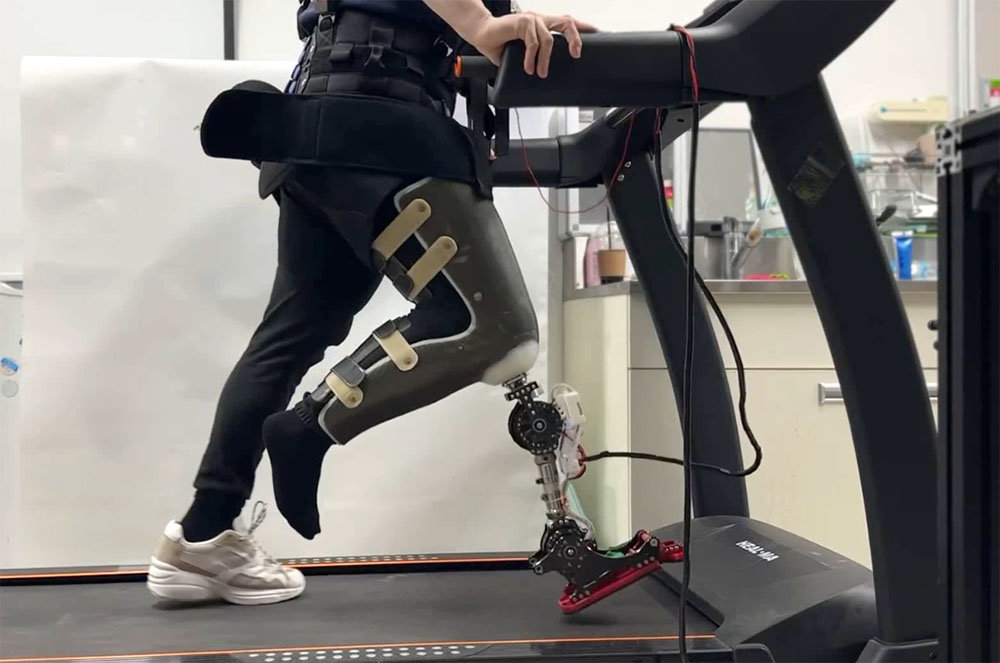
Walking test of the second Vivo-Leg prototype / Source = HarmonyGate
Targeting commercialization in 2027, Cybathlon participation in 2028IT Donga: What is the current development stage of Vivo-Leg?
CEO Kim Jeong-Yeop: We have completed the second prototype, and we plan to enhance completeness through government-supported projects by adding components such as batteries and sockets that connect the residual limb to the prosthesis. Around the middle of this year, we plan to recruit amputees and conduct usability tests in real-world conditions. Through this, our goal is to finalize the prototype within this year and commercialize it in 2027.
We are also collaborating with the University of Illinois Chicago (UIC) in developing Vivo-Leg. If a prosthesis does not fit the wearer, their gait appears awkward, and energy consumption during walking increases, causing them to tire easily. Therefore, technology is needed to adjust gait parameters in real time during walking to optimize the prosthesis to the wearer. We are developing this element in collaboration with the University of Illinois Chicago.
IT Donga: You are currently receiving support from SeoulTech Technology Holdings. What kind of support have you received?
CEO Kim Jeong-Yeop: HarmonyGate has been incorporated as a subsidiary of SeoulTech Technology Holdings. Since our members are either current students or graduates of SeoulTech, we believed it would help in running the business, and we also thought we could contribute to the university, so we decided to become a subsidiary. Thanks to this, we are receiving extensive support from SeoulTech Technology Holdings.
The most representative support is investment attraction consulting. We are planning to secure investment from an accelerator that operates the TIPS program, but as our members are specialized in R&D, we lack expertise in the investment ecosystem and investment attraction processes. SeoulTech Technology Holdings helps by arranging meetings with investors and participating in those meetings with us, among other forms of support. They also inform us of government projects and support programs and help resolve related questions.
In addition, we are receiving support for technology commercialization and strengthening market competitiveness through the BRIDGE 3.0 program. BRIDGE 3.0 is a program run by the Ministry of Education to support the practical use of universities’ creative assets. It aims to promote technology transfer and commercialization by connecting university research outcomes with companies.
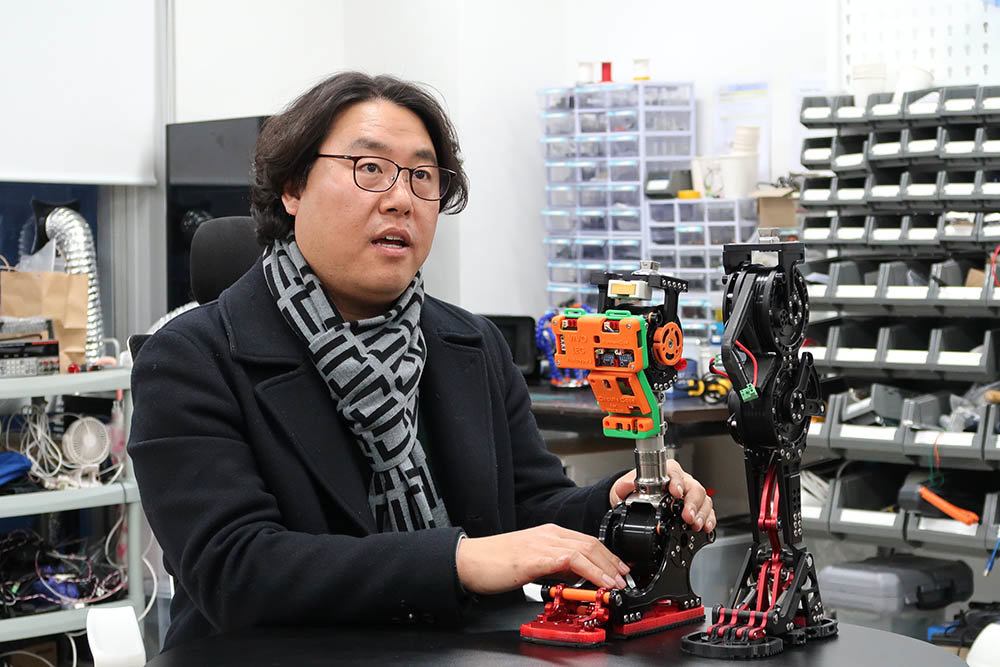
CEO Kim Jeong-Yeop explaining Vivo-Leg / Source = IT Donga
IT Donga: Finally, please share your future plans and goals.
CEO Kim Jeong-Yeop: Our first goal is to successfully commercialize Vivo-Leg through collaboration with various universities and companies. We also plan to participate in the international robot competition for people with disabilities, Cybathlon, in 2028. Cybathlon includes an event where amputees wear prosthetic legs and perform tasks, and by placing in that event, we aim to raise our international profile and then develop markets, primarily in North America and Europe.
While we are currently focused on robotic prosthetic legs for amputees, in the future we plan to develop wearable robots for the elderly and people with paralysis, and ultimately humanoid robots to assist in caring for bedridden patients with limited mobility.
The goal of HarmonyGate is to help amputees and patients return not only to everyday life but also to society. Through this, we aim to grow into a robotics company that prevents vulnerable groups from being marginalized. Rather than simply pursuing profit, we will strive to become a respected company that creates social value.
Reporter Han Man-Hyeok, IT Donga (mh@itdonga.com)
ⓒ dongA.com. All rights reserved. Reproduction, redistribution, or use for AI training prohibited.
Popular News