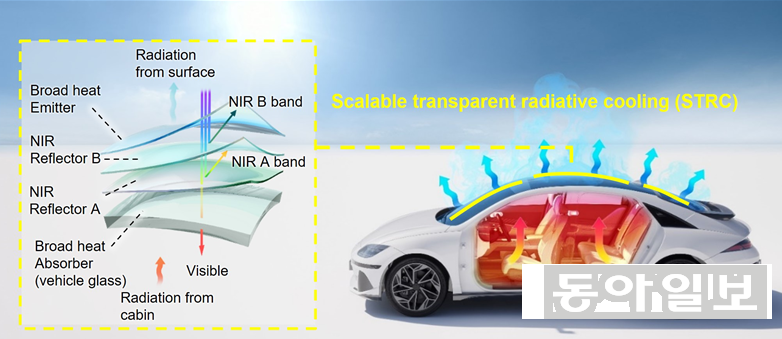
Technology schematic. Provided by the National Research Foundation of Korea
Researchers from Seoul National University and the Massachusetts Institute of Technology (MIT) in the United States have developed a new film technology that can cool the stifling heat inside vehicles during summer.
On the 11th, the National Research Foundation of Korea announced that a joint research team led by Professor Seung Hwan Ko of Seoul National University, Professor Gang Chen of MIT, and researchers at the Basic Materials Research Center and the Thermal Energy System Development Office of Hyundai Motor and Kia has developed a “transparent radiative cooling film” that can be applied to vehicle windows.
When a vehicle is exposed to solar radiation in summer, the interior temperature rises rapidly, requiring energy-consuming methods such as running the air conditioner to cool it down again. Existing technologies such as “low-emissivity (Low-E) coatings,” which minimize the transfer of radiative heat by spreading a thin layer of metals such as silver on the glass surface, only partially block the inflow of sunlight and cannot release the heat already accumulated inside the vehicle to the outside.
To address this, the research team developed a multilayer film structure that maintains a visible light transmittance of 70% or more so as not to obstruct the view, while reflecting the sun’s near-infrared radiation from entering the vehicle and emitting the heat inside the vehicle to the outside.
The research team evaluated the designed and fabricated film under various climates and driving conditions in regions including Korea, the United States, and Pakistan. It reported that the results demonstrated energy savings in air conditioning and a reduction in carbon emissions. When measuring the time required for the interior temperature to reach a comfortable level with the air conditioner running, the time was reduced by 17 minutes compared with vehicles without the film applied.
The research was conducted with support from the Global Research Leader Program promoted by the Ministry of Science and ICT and the National Research Foundation of Korea. The results were published in the international academic journal “Energy & Environmental Science” in the energy and environment field. Researcher Minjae Lee of Seoul National University stated, “The significance of this study lies in the fact that it goes beyond laboratory performance and has been validated in actual vehicles, taking into account different countries, seasons, and driving conditions.”
Park Jong-min
AI-translated with ChatGPT. Provided as is; original Korean text prevails.
ⓒ dongA.com. All rights reserved. Reproduction, redistribution, or use for AI training prohibited.