※ Kyungpook National University Startup Support Group operates the “Startup Leap Package (Large Enterprise Collaboration Track)” for startups in cooperation with SKT. It promotes innovative growth by activating startups’ ideas and technological capabilities based on collaboration with large corporations. ITDongA introduces promising startups that participated in the Kyungpook National University–SKT collaboration track of the Startup Leap Package.
Unmanned cafés, which once remained at the level of vending machines, have evolved into the culmination of “food tech,” equipped with artificial intelligence (AI) and robotic arms. However, behind the growth of the unmanned café market, unresolved challenges remain: operational shutdowns caused by machine errors, limited menus, and consumers’ concerns over quality. Many unmanned cafés fail to recoup their initial investment and disappear for these reasons. The introduction of robots does not guarantee success; only by optimizing device stability and the entire operating system can a sustainable business model be completed.
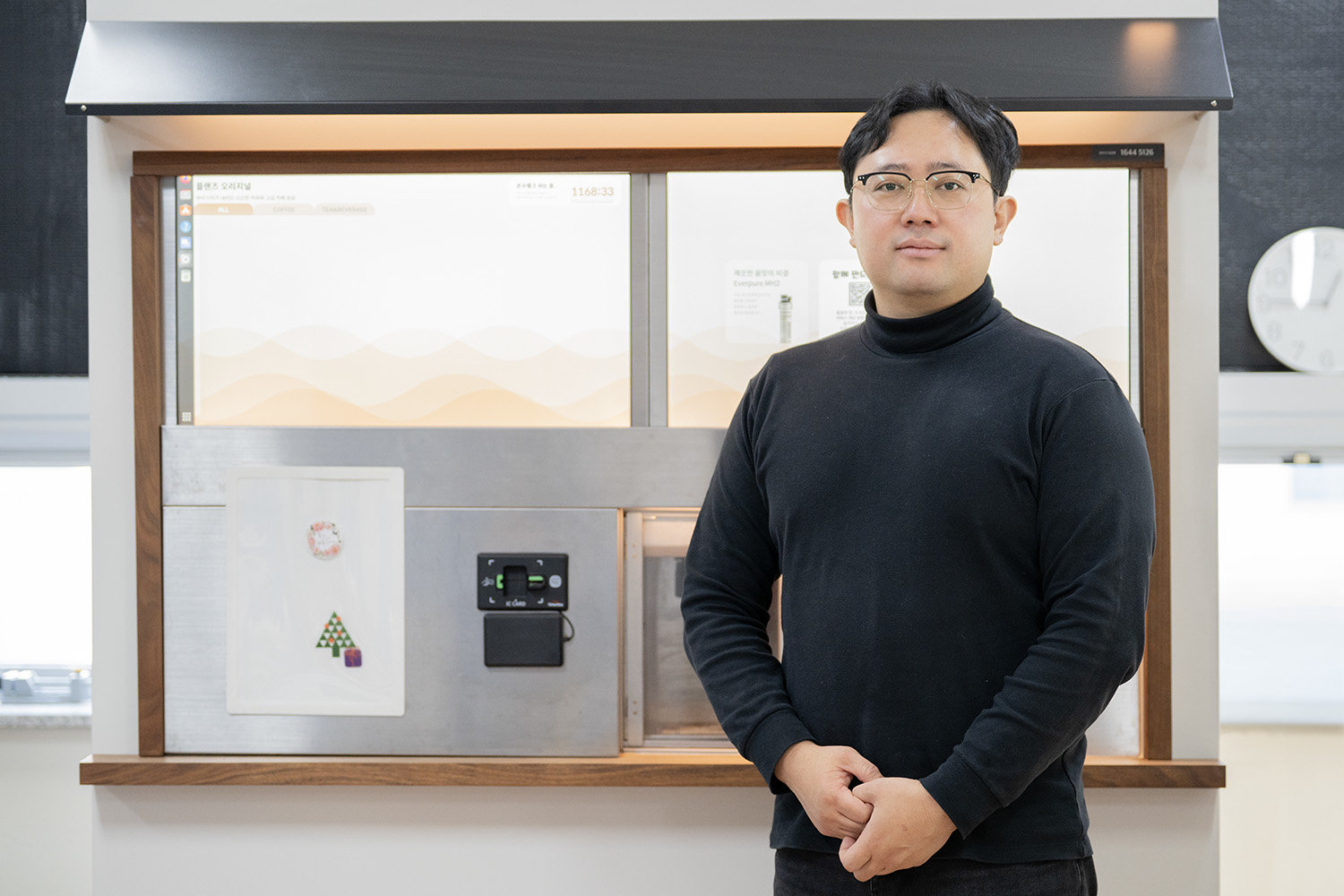
CEO Choi Jun-hyuk of PlanZ Coffee / Source = ITDongA
PlanZ Coffee, which has been operating unmanned café outlets for eight years, is attracting attention for this reason. PlanZ Coffee focused on solving the core issues of unmanned cafés: “device stability” and “operational efficiency.” It built an engineer-based organization to minimize errors and established a remote management system through an artificial intelligence (AI)-based customer service (CS) system. How did PlanZ Coffee seek to combine AI with unmanned cafés? ITDongA spoke with CEO Choi Jun-hyuk about the sustainable growth strategy pursued by PlanZ Coffee.
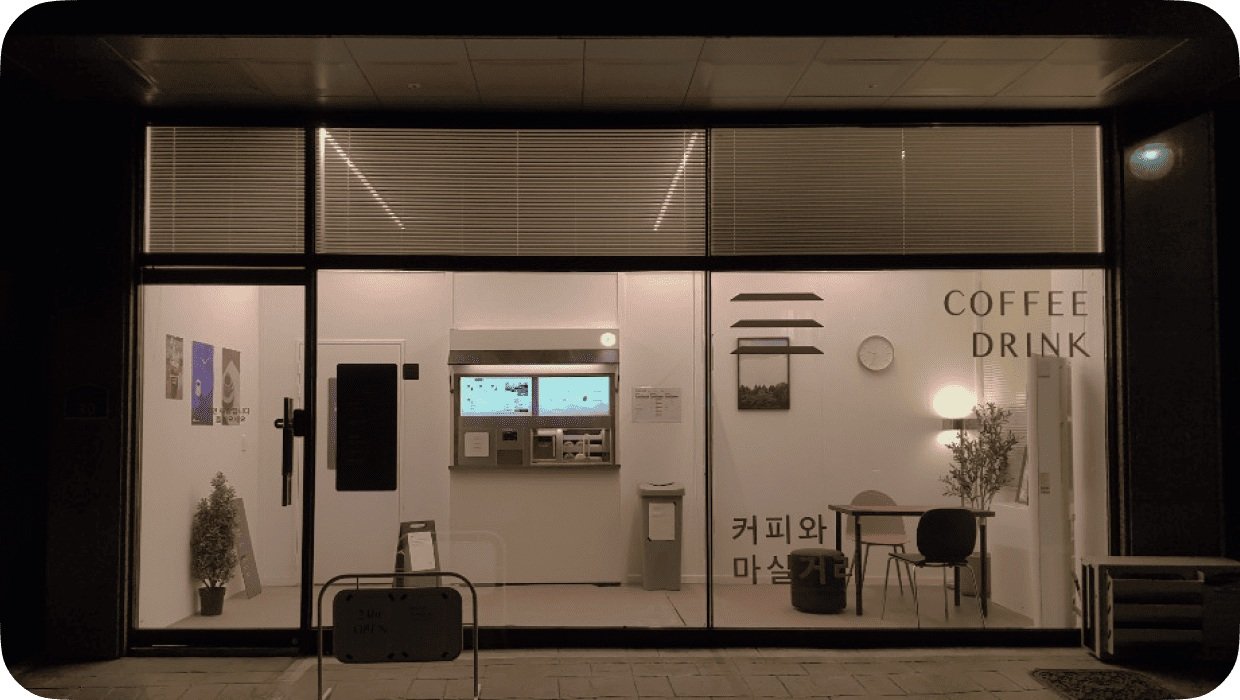
The reason for founding: “Eliminating coffee blind spots”PlanZ Coffee started as a university student startup club. Although CEO Choi and his colleagues, then in their fourth year at university, were aware that the café market was already a red ocean, they focused on the sheer scale of the market. They then devised a strategy to target buildings isolated from commercial districts, so-called coffee blind spots.
“The Korean coffee market exceeds KRW 10 trillion. Because the market is so large, we judged that even meeting a small new demand could be a viable business. We focused on spaces outside commercial districts. Most cafés are concentrated in specific commercial zones. Once you move slightly away from those areas, it becomes difficult to buy coffee. We wanted to target this segment.”
The inconvenience CEO Choi experienced as a student was precisely this. At universities with large campuses, buildings far from the main gate often have no café. Companies located in industrial complexes face the same situation. In factories or office buildings without nearby commercial areas, employees frequently have to drive out just to drink coffee. CEO Choi focused on these “café blind spots.”
PlanZ Coffee was established with the aim of eliminating coffee blind spots / Source = PlanZ Coffee
PlanZ Coffee targeted spaces far from commercial districts but with sufficient demand. Considering the expanding scale of the coffee market into so-called niche segments, it was an area with clear revenue potential. The idea proved successful. Solid mid-sized companies located in industrial complexes chose PlanZ Coffee’s unmanned café solution as part of their employee welfare programs.
PlanZ Coffee now operates numerous in-house corporate cafés and directly managed unmanned cafés. It did not stop at running unmanned cafés; based on its self-developed equipment, it built a hardware-as-a-service model that assumes full responsibility for operations and management.
Achieving flavor consistency with liquid coffee and fresh milk“Coffee quality is actually very leveled up these days. So we focused on calibrating the coffee taste so it is consistently acceptable, not strange. Instead, we differentiate ourselves in aspects such as milk and fruit bases. By using liquid ingredients properly, we have created an environment where beverages can be extracted hygienically.”
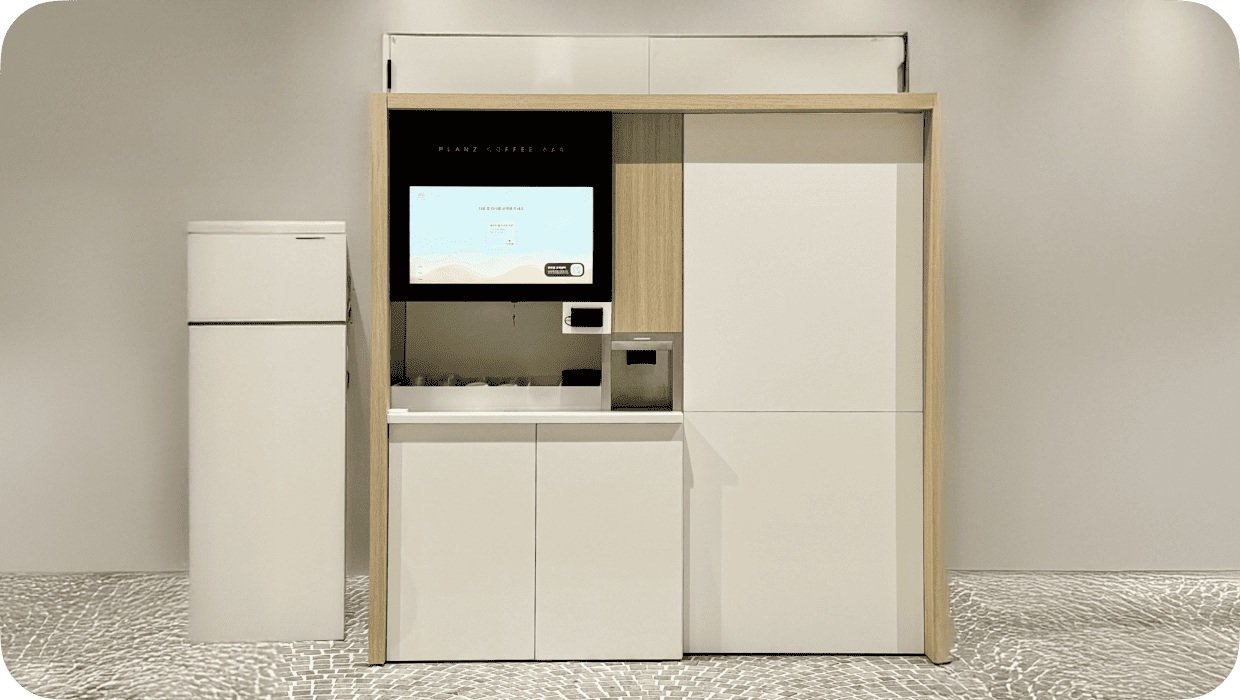
PlanZ Coffee’s unmanned café solution concentrated on differentiation from typical unmanned cafés. First, it uses a system that supplies espresso concentrate extracted directly by baristas through a cold chain (refrigerated distribution). It also developed its own fresh milk. Instead of the powdered milk commonly used in ordinary unmanned cafés, it aimed to provide a fresh and rich taste. All liquid ingredients are handled within a quality control system under which they can be supplied only after passing bacterial tests.
PlanZ Coffee’s coffee lineup is divided into two types: regular coffee and specialty coffee. Regular coffee focuses on providing a stable taste while maintaining reasonable price points. Specialty coffee forms the premium line, using beans from Colombia.
“Because we targeted the low-priced market, beverage cost ratios tend to be relatively high. Nevertheless, we strive to use good ingredients to preserve the flavor of the drinks. Our structure is to procure high-quality raw materials at reasonable prices and generate profit by reducing quality control and operating costs.”
Because unmanned cafés have no baristas, there are inherent limitations in recipes. CEO Choi judged that the only way to overcome this and still provide good beverages is to use high-quality ingredients. However, high-quality ingredients entail higher costs. To maintain this advantage, PlanZ Coffee adopted a strategy of lowering costs by optimizing distribution and operating systems.
PlanZ Coffee optimized its overall operating system to maintain beverage quality / Source = PlanZ Coffee
From a corporate perspective, there may be concerns about the initial investment burden, but PlanZ Coffee mostly operates outlets directly. The cafés are installed at corporate sites and managed by PlanZ Coffee. The operation model is that companies pay a fixed fee, within which discounts are offered. Revenue is generated as employees purchase beverages.
The core competency of PlanZ Coffee lies in its engineer-centric organizational culture. With engineers comprising half of its staff, PlanZ Coffee has devoted itself to building machines that do not break down. The key risk in unmanned outlets is revenue loss due to machine failure. “We installed sensors throughout the machines to detect issues in advance and built a system that resolves them remotely. Our overwhelming hardware stability, which competitors cannot easily follow, is our greatest strength,” CEO Choi said confidently.
Building a robust distribution system is also crucial for stable management of unmanned cafés. Although PlanZ Coffee is a small organization, it divides work rigorously so that each member performs a clear role. In effect, it has a system that allows a small organization to operate like a large company. “We constantly think about how to make continuous operations possible. From accounting management to beverage quality and customer demand, we want to align these elements as much as possible and create a circulation structure,” CEO Choi said.
Building an AI CS system through the Kyungpook National University–SKT Startup Leap Package collaboration trackIn 2025, PlanZ Coffee was selected for the Kyungpook National University–SKT collaboration track of the Startup Leap Package program. Through this program, it worked with the SKT AI R&D Center to develop an AI-based CS system. The goal was to develop an AI agent that could be used in various unmanned outlets, including small business and single-operator stores. An additional benefit was the accumulation of real-world hardware-based proof-of-concept experience through the collaboration.
PlanZ Coffee focused on the CS system because it judged that optimizing CS costs is essential for sustainable operations. Its main concern in running outlets was the simultaneous influx of customer inquiries. During lunchtime, CS requests flooded in from multiple locations at once. “When CS requests pour in simultaneously at lunchtime, it is difficult to respond. So we aimed to optimize CS costs and develop a system capable of handling concurrent requests,” CEO Choi explained.
However, the company faced difficulties in data collection during the process of building the AI system. Although various sensors installed inside the machines detect problems, identifying the exact point of failure was not easy. For example, it could detect that a cup was stuck, but could not determine precisely where it was jammed. This issue was resolved with vision AI technology. Cameras were installed inside the machines to enable data learning. As the cameras grasped and analyzed the internal state of the machines, identifying problems became easier.
Thanks to the system built using vision AI, PlanZ Coffee can now respond to issues more precisely. It enhanced its system so that CS requests received via text can be resolved in natural language. The AI can identify the problem and respond by remaking a beverage or issuing a refund. Software-level errors are also handled automatically. The technology developed by PlanZ Coffee in collaboration with SKT may evolve into a general-purpose solution for other unmanned outlets in the future. “The AI technology foundation we established with SKT is conceptually similar to a chatbot, but since it is connected to actual hardware, it can also be classified as physical AI,” CEO Choi said.
Breaking biases about unmanned cafés and aiming for sustainable growth“For the unmanned café market to gain real popularity, multiple aspects must be done well. Drinks must taste good, response must be quick, and service reliability is also necessary. It is meaningless to satisfy customers only once or twice. The structure itself must be designed to be sustainable from the outset.”
CEO Choi believes that PlanZ Coffee has achieved product–market fit. Based on the know-how accumulated over eight years, it has completed new equipment and optimized its operating systems, including CS and after-sales service (AS). In his view, the company has acquired a certain level of capability to manage a highly complex value chain.
CEO Choi Jun-hyuk of PlanZ Coffee / Source = ITDongA
“Rather than becoming a brand that rises and disappears with flashy marketing, we want to be a company that quietly focuses on fundamentals and consistently generates profits, like Gcova Chicken. In the machinery field, our goal is to become a company like InBody, which becomes the market standard with unrivaled technological capabilities.”
PlanZ Coffee plans to concentrate fundamentally on establishing a structure that creates profit by building a pleasant unmanned store environment and a stable distribution network. Instead of seeking name recognition like a conglomerate, it aims to become a company with steady growth, strong profitability, and a solid market position.
From the second quarter of 2026, PlanZ Coffee plans to significantly increase the number of new corporate locations through partners and realize economies of scale on top of its meticulously built system. Attention is focusing on what results will emerge from the journey of PlanZ Coffee, which has captured both the quality of a single cup of coffee and operational efficiency with the tenacity of its engineers.
ITDongA reporter Kang Hyeong-seok (redbk@itdonga.com)
ⓒ dongA.com. All rights reserved. Reproduction, redistribution, or use for AI training prohibited.
Popular News