Pyun Sung-beom, Dean, Korea University College of Medicine
Full scholarships and dedicated curricula: admissions must be redesigned from the selection stage
Shift research from individual to medical-school level…cultivate an evaluation culture that accepts failure
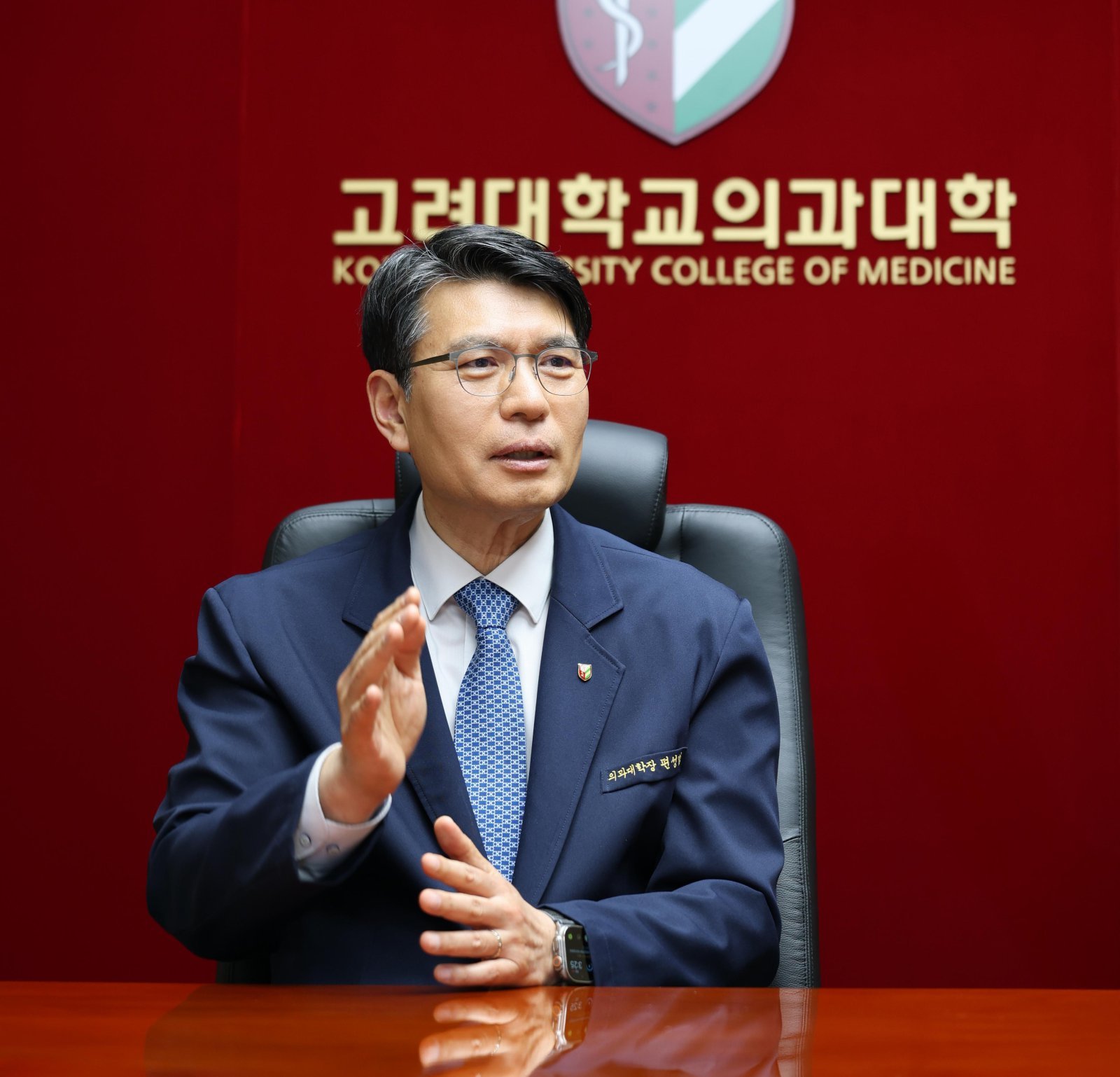
Pyun Sung-bum, Dean of Korea University College of Medicine. Courtesy of Korea University College of Medicine
“What a medical school recognizes as an achievement determines the quality of its research and education.”
Pyun Sung-bum, Dean of the Korea University College of Medicine, defines the transition to a “research-centered medical school” not as a simple expansion of facilities but as an effort to reset the standards of the academic community. He said a culture must take root that prioritizes long-term inquiry and the nurturing of future generations over easily obtained results.
Korea University College of Medicine is strengthening a “one-stop translational research” system in which clinical physicians and basic researchers design, verify, and standardize experiments on the same platform, by building an MRI (magnetic resonance imaging) Precision Imaging Research Center based at the Jeongneung Mediscience Park. It has also brought to the fore its goal of systematically cultivating global talent, particularly physician-scientists. Dean Pyun was asked about the upgrading of research infrastructure and global cooperation strategies, the conditions for fostering physician-scientists, and the direction for transforming the culture of medical schools.
―What is the biggest change currently underway at Korea University College of Medicine?
“In a word, the core axis of research is being shifted to the entire medical school. In the past, research was driven by individual researchers publishing papers, but now the paradigm is being shifted to a structure in which the medical school systematically nurtures succeeding generations along a continuum of ‘medical school–research trainees–clinical physicians.’ The school has produced many clinically outstanding professors. The next role of the medical school, therefore, is to cultivate physician-scientists by adding research capability to clinical competence.”
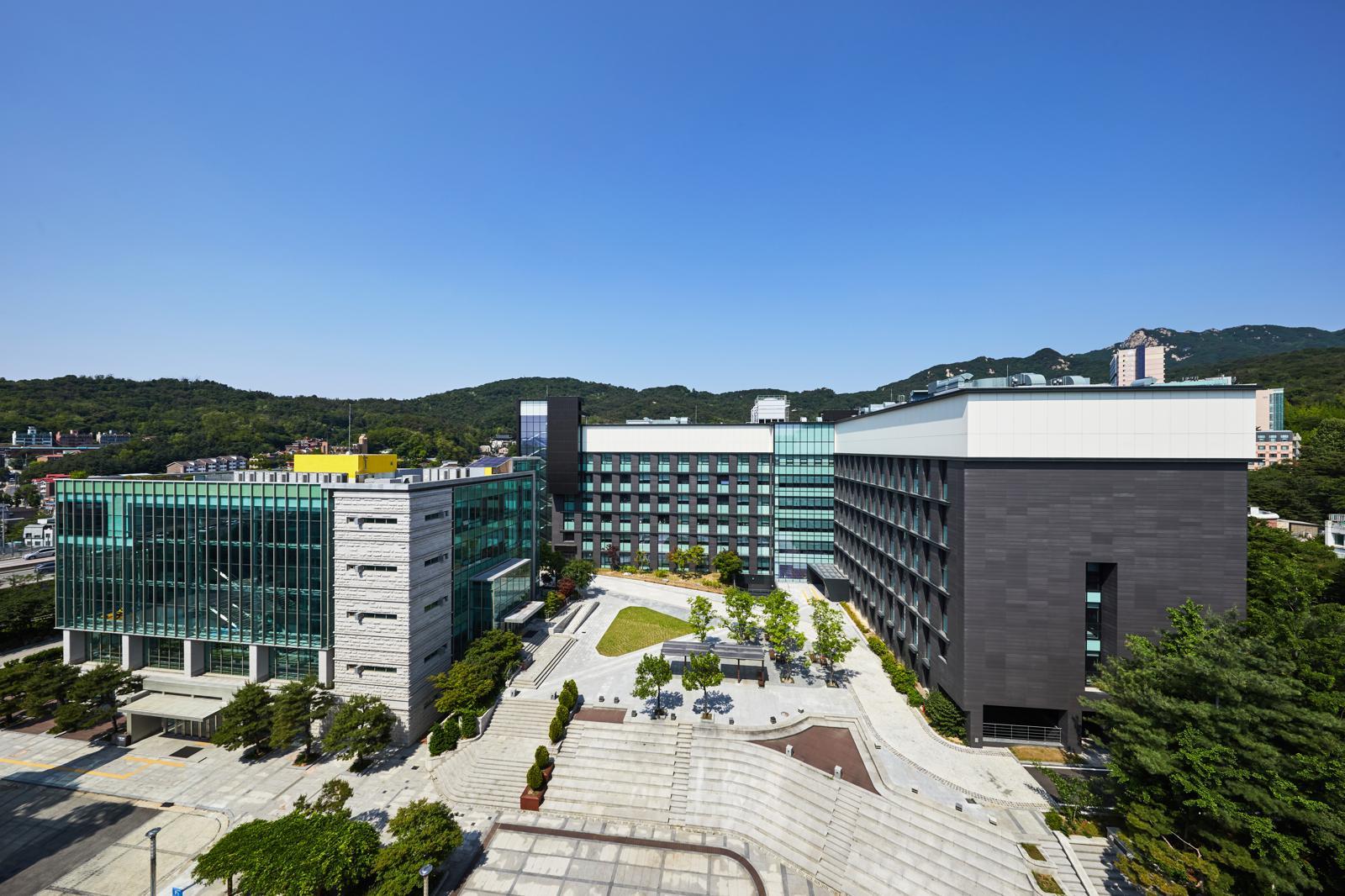
The Chung Mong-koo Future Medicine Hall at Korea University Mediscience Park in Jeongneung, Seongbuk-gu, Seoul.
―Jeongneung Mediscience Park and the MRI Precision Imaging Research Center appear to symbolize this change. Why MRI?“The MRI Precision Imaging Research Center is core infrastructure for building a multidisciplinary platform. This is the first case in Korea of a medical school introducing and directly operating a research-dedicated MRI. For clinical physicians to connect questions derived from clinical experience in their departments to research, there must be a research platform on which they can immediately design and conduct experiments. The specifications of the equipment itself are important, but the key is whether it can ‘measure and standardize with precision.’ It enables more precise implementation of micro brain structures and functional imaging, and, through AI-based automation technology and high-channel coils, allows complex scans to be performed stably. Above all, the distinguishing feature is that the system is designed so that research can be executed immediately, with established reservation, testing, and standardization procedures, rather than having researchers simply ‘wait for’ the equipment.”
―How is a “research-centered medical school” different from a conventional medical school?“The point is that doing research is not reduced to individual achievements alone. A research-centered medical school is one in which the medical school, as an organization, builds a research ecosystem and provides a structure that helps excellent groups grow within it. It must meticulously design pathways that connect undergraduate–graduate–research–clinical practice, encourage international research experience and participation in joint projects, and operate stepwise tracks. If everyone is educated in the same way, it is difficult to produce physician-scientists. The selection process itself must be different.”
―What kind of “tracks” are needed in concrete terms?“The physician-scientist track must be designed separately from the selection stage. It needs clear support such as full scholarships, and its curriculum must be differentiated. There must also be discussion on re-examining the educational structure, including the premedical system. Fostering physician-scientists is not a declaration but a system. The track must be divided at an appropriate stage, and students must accumulate actual research experience. Otherwise, it is difficult for them to embark on the path of a physician-scientist.”
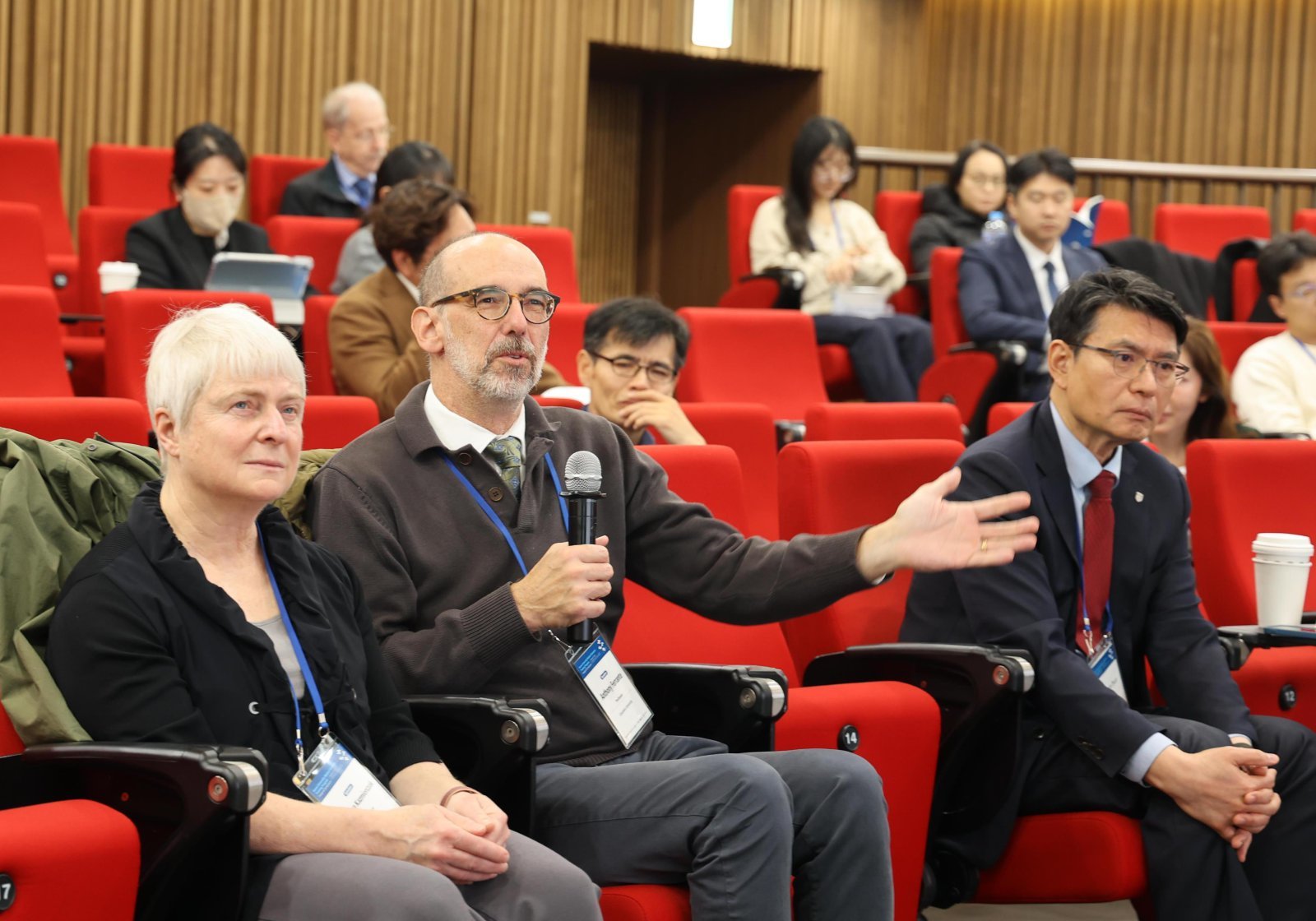
At the Korea University College of Medicine Physician-Scientist Training Program (KU-MSTP) international symposium, Professor Barbara Kazmierczak of Yale University (left) and Professor Anthony Ferrante of Columbia University pose questions after a researcher’s presentation. Dean Pyun Sung-bum is on the far right.
―Cooperation with institutions such as Yale University and the University of Nottingham is expanding rapidly. Why do leading overseas universities seek to partner with Korea University College of Medicine?“Cooperation ultimately comes down to people and outcomes. Brand power as Korea University plays a role, but more important are the performance and capabilities of students and researchers. The research outcomes of postdoctoral researchers or visiting scholars who went abroad were solid, and as the medical school clearly stated its mission to foster physician-scientists, points of collaboration increased. Discussions with Yale University are progressing toward concrete programs, including student clerkships and opportunities for doctoral study. When excellent talent comes in, it benefits Yale University itself, and Korea University College of Medicine secures opportunities to conduct research in a global environment.”
―What do you see as “the most essential element” in fostering physician-scientists?“The environment. Research cannot be achieved simply by teaching techniques. There must be an environment in which research is part of everyday life, encompassing rational reasoning, a questioning attitude, an academic atmosphere, and even time to endure failure. Research-centered hospitals and research-centered schools must work in tandem. The difficulty in Korea is that there are fewer mentors who can show students a vision of ‘joy and fulfillment greater than money.’”
―As dean, you have emphasized “culture.” What kind of cultural change do you mean?“In a medical school, the direction of the community is determined by what is recognized as an achievement. There must be standards under which the core missions of research and education are properly respected, and long-term accumulation of results is fairly assessed. For professors, education and research are fundamental; clinical practice, while an important role, cannot substitute for this core mission. When evaluation and reward systems focus only on short-term performance or external quantitative indicators, mentorship and the quality of research inevitably weaken. That is why the community must reset its standards for ‘what it recognizes as valuable.’”
―What changes do you hope to bring about during your term?“To properly set in motion the nurturing of succeeding generations and the ecosystem for physician-scientists. High-quality research requires substantial research funding. A virtuous cycle is needed in which research leads to outcomes that, in turn, connect to the next research. We must strengthen qualitative evaluations of research and devise a structure that enables professors to continuously maintain their research capabilities. The more professors enter this virtuous research cycle, the more researchers and students grow and the larger the ecosystem becomes. Only when such an ecosystem exists can excellent overseas talent flow back in again.”
ⓒ dongA.com. All rights reserved. Reproduction, redistribution, or use for AI training prohibited.
Popular News