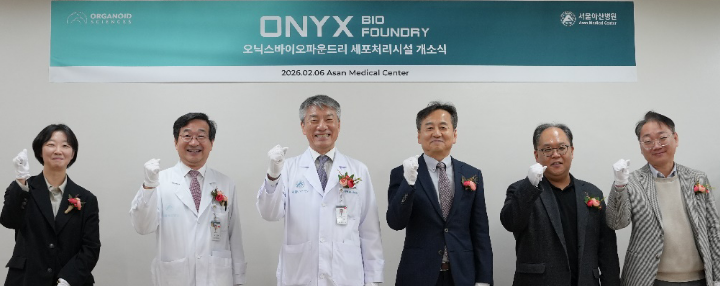
A commemorative photo is taken after the opening ceremony of the Onyx Biofoundry cell processing facility. From left: Yang Seung-hye, Director at Organoid Science; Kim Tae-won, Director of Asan Institute for Life Sciences; Park Seung-il, President of Asan Medical Center; Oh Sang-hoon, CEO of Organoid Science; Shin Dong-myung, Head of the Cell Therapy Center at Asan Medical Center; and Song Dong-hoon, Director at Organoid Science. Photo courtesy of Organoid Science.
Organoid Science, a regenerative therapeutics company specializing in organoid-based therapies (co-CEOs Yoo Jong-man and Oh Sang-hoon), has officially opened its hospital-based cell processing facility “Onyx Biofoundry AMC” at the Convergence Research Building of the Asan Institute for Life Sciences at Asan Medical Center in Seoul and has begun full-scale operations.
At the opening ceremony held on the 6th, hospital and corporate officials, including Park Seung-il, President of Asan Medical Center; Kim Tae-won, Director of the Asan Institute for Life Sciences; Shin Dong-myung, Head of the Cell Therapy Center; and Organoid Science CEO Oh Sang-hoon, attended and shared the significance of building a research infrastructure based on hospital–industry collaboration.
The newly opened Onyx Biofoundry AMC is the core hub of the hospital-based Contract Research, Development and Manufacturing Organization (CRDMO) platform that Organoid Science is promoting. It has been designed to systematically support clinical research in accordance with the Advanced Regenerative Bio Act and other relevant regulations, and it has been established to enable rapid development of advanced biopharmaceuticals through integration with existing manufacturing centers.
In particular, the facility is differentiated by being located inside the hospital, directly at the clinical site. It not only allows for direct production of researcher-developed cell-based therapeutics in research or clinical form, but also enables real-time discussions with medical staff to adjust development strategies, thereby creating a translational research environment that swiftly connects research results to the clinical stage. The core strategy is to minimize temporal and structural gaps that can arise in the process of translating laboratory-level data into clinical research.
Through this hospital-based CRDMO model, Organoid Science plans to organically link research, clinical practice, and manufacturing, thereby enhancing both development efficiency and the probability of success. A structure that allows for immediate incorporation of clinical feedback within the hospital is expected to be particularly advantageous in fields such as cell therapies and organoid therapeutics, where a high degree of precision and safety is required.
CEO Oh Sang-hoon stated, “Establishing a therapeutics production facility within Asan Medical Center, which possesses world-class clinical capabilities, is an important milestone in new drug development that organically connects research and clinical practice,” adding, “The clinical outcomes generated from this optimized system will serve as a driving force not only for new drug development but also for enhancing the global competitiveness of Korea’s advanced bioindustry.”
Organoid Science plans to use Onyx Biofoundry AMC as a base to expand joint research and technological collaboration with hospital researchers and to build a leading position in the fields of organoid- and cell-based precision medicine.
ⓒ dongA.com. All rights reserved. Reproduction, redistribution, or use for AI training prohibited.
Popular News