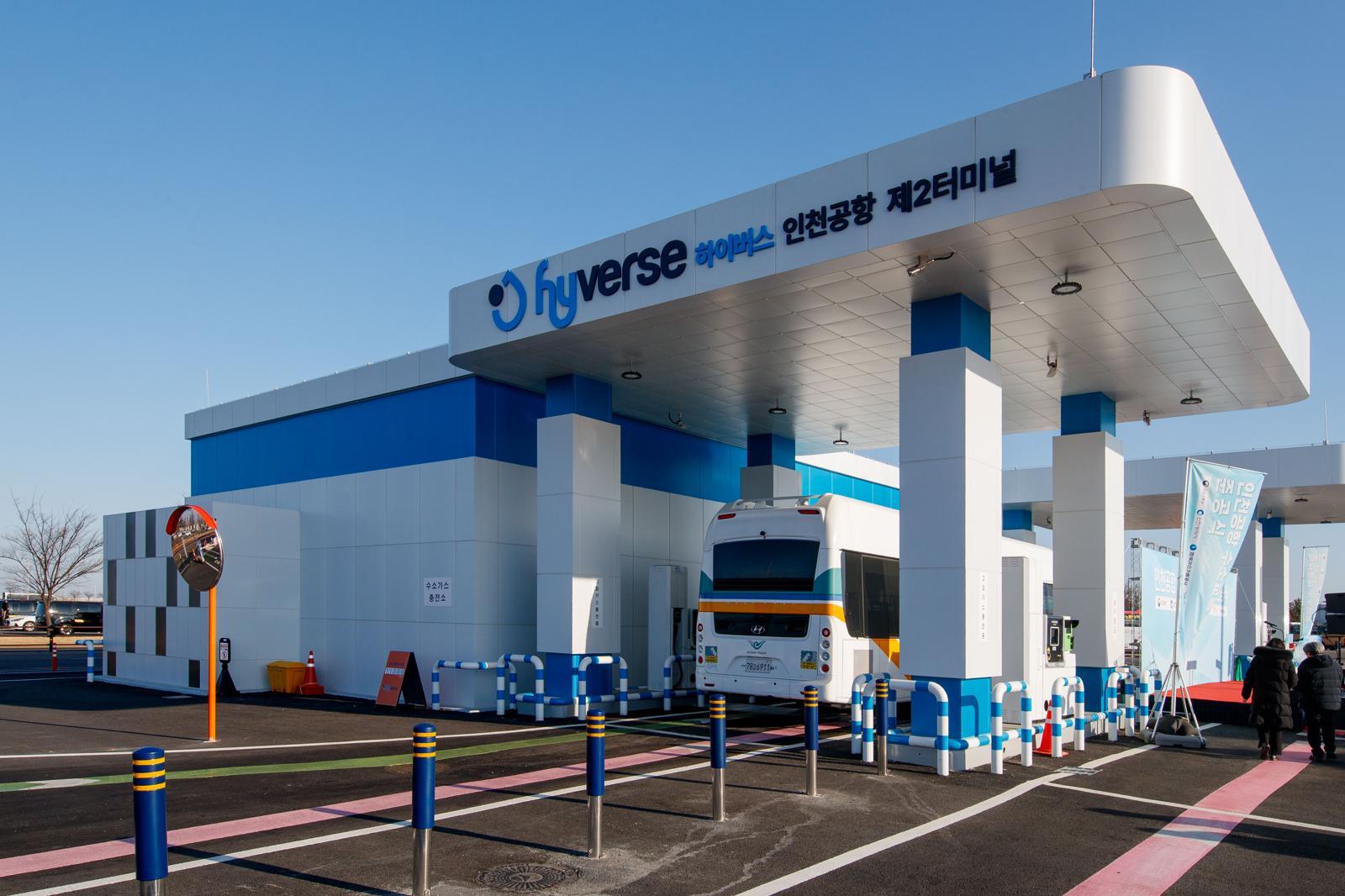
A hydrogen bus being refueled at the “Incheon Airport Hydrogen Mobility Hub” in Unseo-dong, Jung-gu, Incheon Metropolitan City, on the 29th. SK Innovation
SK Innovation E&S’s subsidiary Hybus announced on the 29th that it held a “Completion Ceremony for the Incheon Airport Hydrogen Mobility Hub” in Unseo-dong, Jung-gu, Incheon Metropolitan City. With the completion of this hub, Incheon International Airport will become the world’s first airport equipped with hydrogen mobility infrastructure, including a hydrogen refueling station.
According to SK Innovation, the project was promoted through public-private cooperation with a total budget of KRW 14.3 billion. The budget consisted of KRW 7.0 billion in support from the Ministry of Land, Infrastructure and Transport, KRW 3.0 billion in investment from the Incheon Metropolitan City Government, and KRW 4.3 billion in Hybus’s own investment. Hybus currently has 21 liquefied hydrogen refueling stations built and in operation nationwide.
A Hybus representative explained that the completion of the world’s first hydrogen mobility hub within an airport will serve as a starting point to accelerate the conversion of airport transport demand to hydrogen and to explore ways to expand hydrogen mobility based on public-private cooperation.
The event was attended by key officials including Lee Nam-joo, Director General for Future Industry of Incheon Metropolitan City, Shin Seong-yeong, member of the Incheon Metropolitan Council, Park Yoo-jin, Vice Mayor of Jung-gu District in Incheon, Bae Young-min, Head of Infrastructure Division at Incheon International Airport Corporation, Song Min-ho, Head of Energy Business Division at Korea Gas Technology Corporation, and Jeon Young-joon, Head of New Energy Business Division at SK Innovation E&S.
The hydrogen mobility hub was built on a 2,771㎡ site within the parking depot of Incheon Airport’s Terminal 2. The newly built liquefied hydrogen refueling station has a refueling capacity of 320 kg per hour, sufficient to refuel up to 240 large hydrogen buses per day.
Industry officials explained that liquefied hydrogen is produced by cooling gaseous hydrogen to an ultra-low temperature of minus 253℃ to turn it into a liquid, based on a principle similar to liquefied natural gas (LNG), which is produced by cooling natural gas. Through this process, its volume is reduced to about 1/800 of gaseous hydrogen, which is advantageous for large-scale storage and transportation.
For each delivery, gaseous hydrogen can typically transport 200–400 kg, whereas liquefied hydrogen can transport up to 3,000 kg. In addition, while gaseous hydrogen requires high pressure of more than 200 bar for storage and transportation, liquefied hydrogen can be stored and transported under conditions close to atmospheric pressure, which means a relatively lower risk of explosion due to pressure.
Officials stated that the establishment of the hydrogen mobility hub inside Incheon Airport through public-private collaboration took into account the airport’s characteristics, where nationwide airport access traffic demand, such as airport shuttles and limousine buses, is concentrated.
According to data released by the Ministry of Land, Infrastructure and Transport, total traffic volume on routes including the Incheon International Airport Expressway reaches approximately 172,000 vehicles per day on average. In this regard, project officials said that, considering Incheon Airport is the primary entry point for visitors to Korea, converting airport buses to hydrogen buses is also meaningful in that it can leave an environmentally friendly and positive first impression of Korea on foreign travelers.
In fact, 36 out of 68 Incheon Airport shuttle buses, more than half, have already been converted to hydrogen buses, and additional hydrogen buses are expected to be introduced this year. Airport limousine operators that connect to other local governments such as Seoul and Gyeonggi Province are also reportedly preparing to adopt hydrogen buses following the establishment of this refueling station.
Local governments are also actively promoting the adoption of hydrogen mobility. Incheon City plans to convert 100% of its city buses to hydrogen buses by 2030, while the Seoul Metropolitan Government and Gyeonggi Provincial Government also intend to actively introduce hydrogen airport buses.
The average daily driving distance of airport buses is 548 km, more than twice that of city buses at 229 km, resulting in a significant carbon reduction effect when converted to hydrogen buses. A single hydrogen bus can reduce greenhouse gas emissions by 56 tons per year, equivalent to planting approximately 8,000 30-year-old pine trees. Officials emphasized that hydrogen buses are suitable for airport routes that require long-distance operation, noting that they have a shorter refueling time of under 30 minutes compared to electric buses and a driving range of more than 600 km.
The hydrogen mobility hub receives a stable supply of hydrogen in connection with the liquefied hydrogen production base located in Seo-gu, Incheon. IGE, a subsidiary of SK Innovation E&S, established a system for liquefied hydrogen production, supply, and transportation following the completion of its liquefied hydrogen plant in May 2024. It is the world’s largest facility of its kind, with a production capacity of 90 tons per day and approximately 30,000 tons per year per single plant.
Jeon Young-joon, Head of New Energy Business Division at SK Innovation E&S, said, “The Incheon Airport Hydrogen Mobility Hub will serve as a hub to supply stable fuel to hydrogen buses traveling to and from airports nationwide,” adding, “We will make every effort to provide a competitive hydrogen supply infrastructure in connection with the Incheon liquefied hydrogen plant.”
ⓒ dongA.com. All rights reserved. Reproduction, redistribution, or use for AI training prohibited.
Popular News