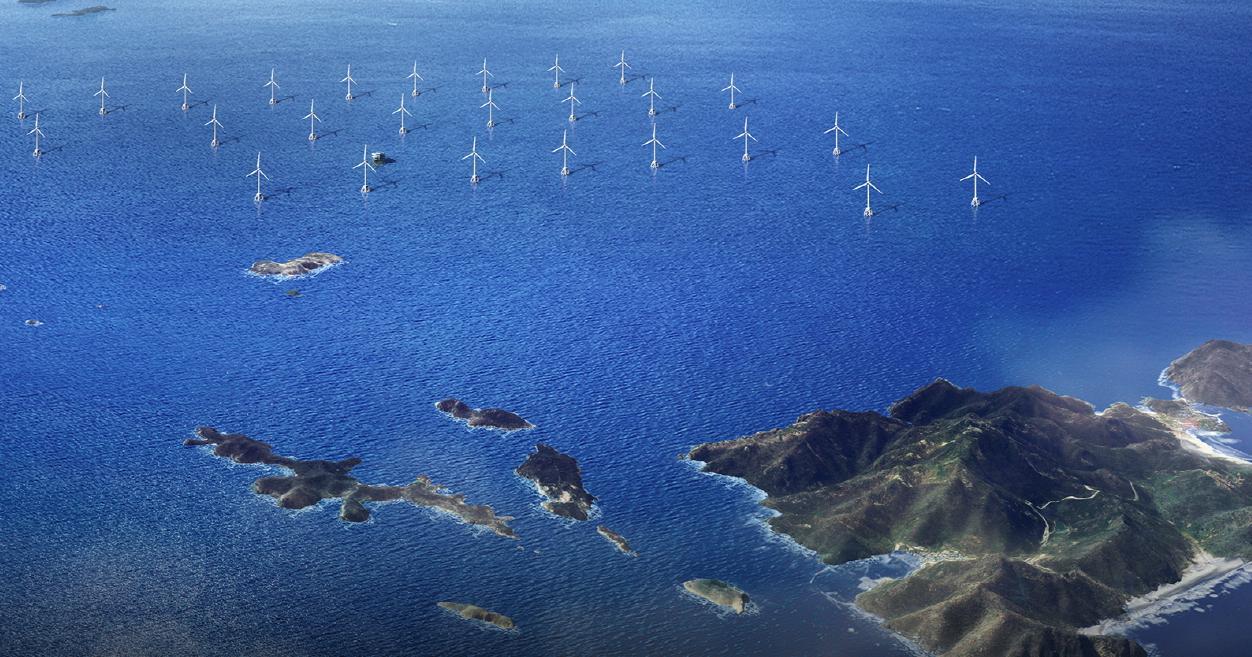
Bird’s-eye view of the Wui offshore wind power project in Sinan-gun, Jeollanam-do, selected as the first project of the National Growth Fund. Provided by Jeollanam-do
The Wui offshore wind power generation project in Sinan-gun, Jeollanam-do has been selected as the first investment destination of the National Growth Fund, a core financial policy of the Lee Jae-myung administration. The project is expected to establish a stable power supply base in Jeollanam-do and accelerate the attraction of high-tech companies.
According to Jeollanam-do Province on the 1st, the Financial Services Commission convened the National Growth Fund Fund Management Deliberation Committee last month and approved an agenda to support the Sinan Wui offshore wind power generation project by extending KRW 750 billion in long-term, low-interest loans.
The National Growth Fund is a flagship growth policy of the Lee Jae-myung administration, a mega-project under which the government, the financial sector, and the public jointly raise KRW 150 trillion to invest in key industries. It was officially launched in December last year with the aim of fostering advanced industries by injecting policy funds into long-term, high-risk investments that are difficult for the private sector to undertake.
The Sinan Wui offshore wind power project involves installing 26 generators of 15 megawatts (MW) each in the waters south of Wui Island in Dochodo-myeon, Sinan-gun, to build facilities with a total capacity of 390 MW, with a total investment of KRW 3.4 trillion. Construction is scheduled to begin in the first half of this year (January–June), continue for three years, and then enter full operation from 2029. Once completed, it will produce enough clean energy to supply 290,000 households of four people for one year. This exceeds the maximum power demand (270 MW) of the largest data center currently in operation in Korea.
Market observers view the selection as the first project of the National Growth Fund as reflecting the fact that Sinan is the project site, giving it significance for balanced regional development, and that it is a renewable energy project, an area the Lee Jae-myung administration emphasizes.
As the National Growth Fund will provide loan capital for 18 to 19 years on a long-term, low-interest basis, the project is expected to gain greater financial stability and to encourage participation by private financial institutions. Korea Development Bank and the banking sector will support the project with KRW 544 billion from a future energy fund. Of this, KRW 204 billion will be provided as equity investment and KRW 340 billion as subordinated loans.
The project is also significant in that it will be the first large-scale offshore wind power project in Korea of 300 MW or more to be pursued solely with domestic capital and technology. Most equipment will be domestically produced, with the domestic supply chain used for substructures, submarine cables, substations, and installation vessels, excluding the wind turbines. In particular, Hanwha Ocean plans to newly build a turbine installation vessel worth KRW 800 billion specifically for this project and deploy it for the first time.
Residents of Sinan-gun will also participate in the power generation project by investing in bonds to a certain extent and will receive a portion of the profits in the form of vouchers and local currency. Jeollanam-do expects the project to serve to expand the power infrastructure essential for advanced strategic industries in the region, including the National AI Computing Center being established in Haenam.
In line with the government’s offshore wind expansion roadmap, Jeollanam-do plans to steadily build 30 GW of offshore wind power generation complexes across the province by 2035, including 8.2 gigawatts (GW) of offshore wind in Sinan, a 3.6 GW offshore wind clustering complex in Jindo, and 13 GW in Yeosu and Goheung.
An official from Jeollanam-do said, “The selection as the first project of the National Growth Fund is a remarkable achievement that proves Jeollanam-do is emerging as a new hub for the nation’s high-tech industries,” adding, “We will focus on creating RE100 industrial complexes based on renewable energy and attracting global high-tech companies.”
ⓒ dongA.com. All rights reserved. Reproduction, redistribution, or use for AI training prohibited.
Popular News