Reporters from the Dong-A Ilbo IT Science Team introduce notable technologies, trends, and companies in the IT, science, space, and bio sectors. “What’s this company about?” The behind-the-scenes stories of tech companies changing the world with technology! From the ideas that astonished the world to the latest concerns of founders, it digs into everything people have been curious about.
At the beginning of this month, the hottest topics at CES 2026, the world’s largest consumer electronics and information technology (IT) exhibition, were “physical artificial intelligence (AI)” and “humanoids.” Visitors were enthusiastic about robots that walk like humans, tighten screws, take drinks out of refrigerators to prepare breakfast, or fold and organize towels after washing. In this CES setting, alongside Nvidia, AMD, Qualcomm, and Samsung Electronics, which drive the global AI semiconductor market, a Korean startup was introduced as a representative company leading AI trends. It is DeepX, a fabless (semiconductor design) startup developing low-power semiconductors.
On 8 January (local time), at CES 2026 in Las Vegas, United States, DeepX CEO Kim Nok-won described DeepX’s strength in a single phrase: the
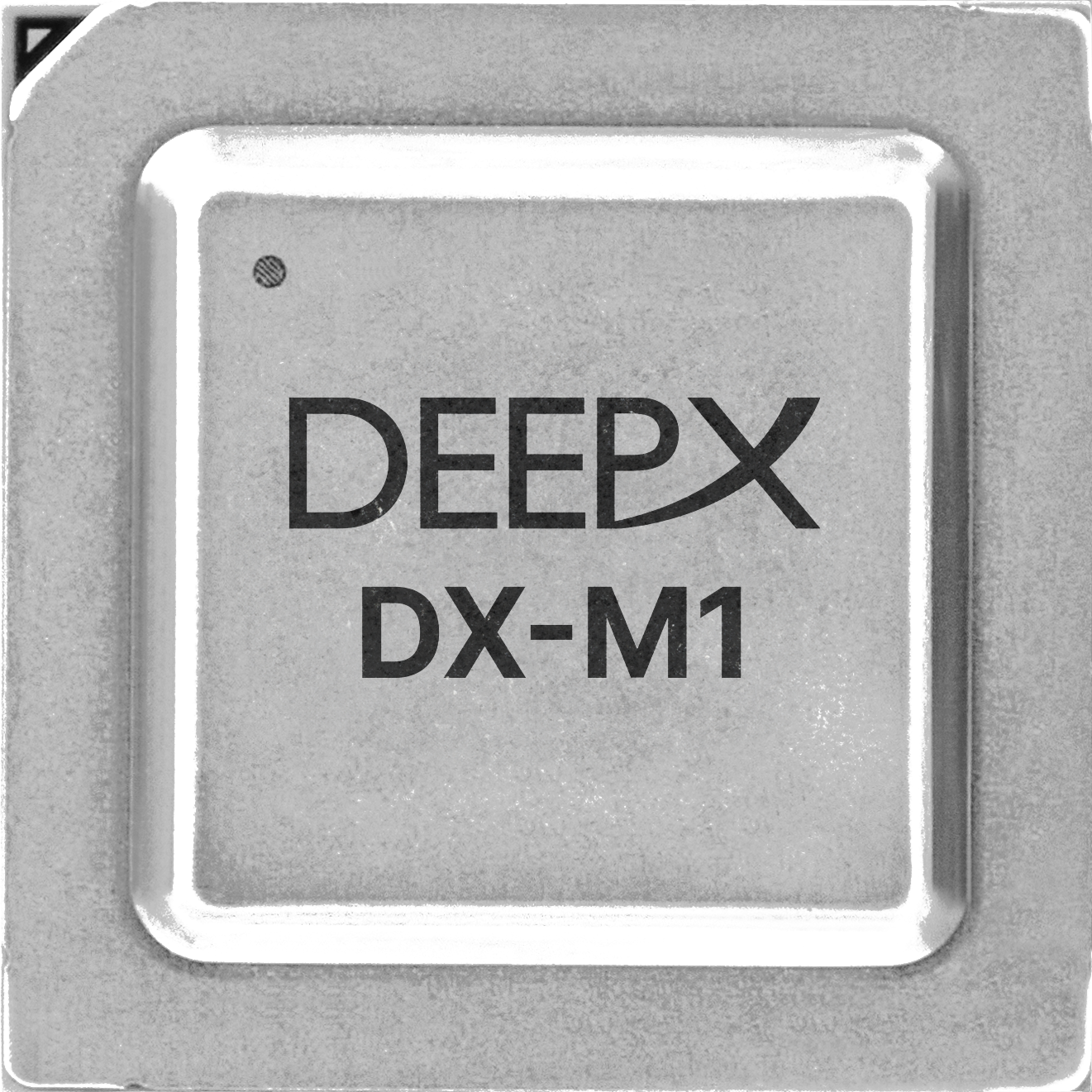
“butter benchmark.” DeepX’s first-generation neural processing unit (NPU) DX-M1 demonstrates such excellent heat control performance that a piece of butter, which melts at 30–36°C, placed on the chip during highly power-intensive video analysis computations does not melt. There is no need to attach a separate cooler to control the chip’s heat generation. The power required to run this DX-M1 is only 5W (watts).
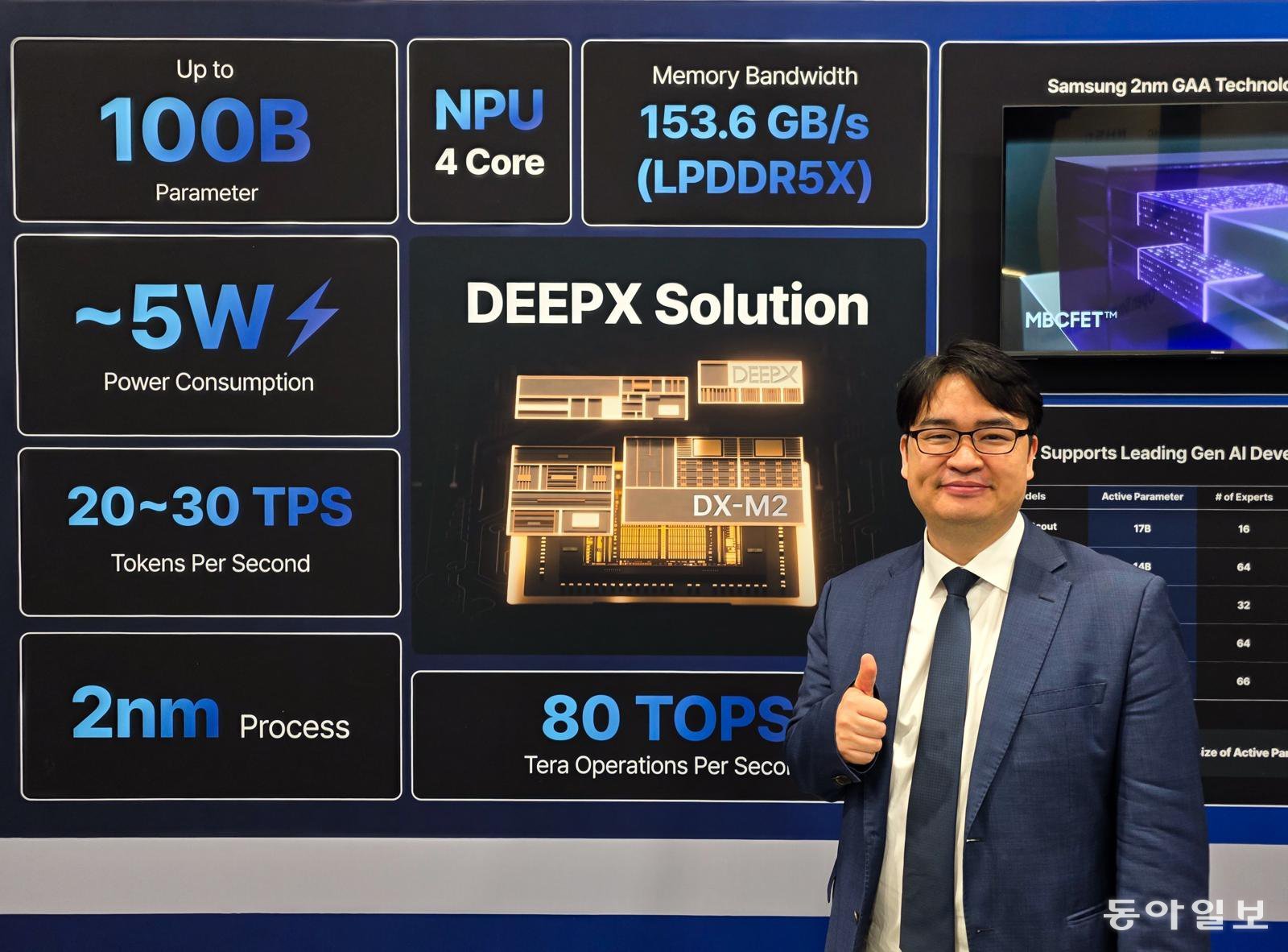
At CES 2026, DeepX also unveiled its development roadmap for the second-generation NPU DX-M2. DX-M2 is designed to run large language models (LLMs) with up to 100 billion parameters within a single device using the same amount of power as the first-generation chip. Kim said, “By using DeepX’s chips, generative AI computation and processing can be done on-device without data centers,” adding, “The goal is to become number one in the physical AI semiconductor market.” The following is a Q&A with CEO Kim.
Physical AI has become a global topic.
“In the past, AI was roughly a ‘promise technology.’ Everyone only said, ‘It may not make money now, but the future will be good.’ But now AI has become ‘physical reality.’ In the past, when potential customers saw our chips, they would say, ‘Shall we try it once?’ and proposals would only come at the PoC (proof of concept) level. Now, however, we receive concrete inquiries such as, ‘From when can we start mass production and apply it?’
In this situation, the AI chip market for physical AI is still a blue ocean. Nvidia’s graphics processing units (GPUs) also require a large amount of power and are difficult to cool, making it hard to attack this segment immediately. DeepX’s goal is to preempt this field with NPUs with high performance per watt (power efficiency).”
On 8 January (local time), at the CES 2026 booth in Las Vegas, United States, the world’s largest consumer electronics and information technology (IT) exhibition, DeepX CEO Kim Nok-won introduces the next-generation neural processing unit (NPU) DX-M2. Park Jong-min, Reporter, blick@donga.com
What differentiates DeepX’s NPU?
“In the physical AI field, as important as attaching arms and legs to AI is attaching ‘eyes, ears, and a mouth’ to it. AI must analyze video to recognize, analyze, and judge the surrounding situation, and it must understand human speech and respond. Simply put, it must be able to run generative AI inside the device.
DeepX’s chips enable such computation inside devices using very little power. It means AI can be independent of data centers, which consume enormous amounts of electricity. DeepX’s goal is not just simple physical AI, but to realize ‘physical generative AI.’”
Can it be competitive compared with physical AI connected to data centers?
“If physical AI such as humanoids and autonomous driving relies on data centers and a communication problem occurs, they all stop together. But if the computations are performed inside the device, performance remains stable. The same goes for security. Once physical AI is introduced to industrial sites, everything that physical AI sees, hears, and learns becomes confidential. If AI is embedded in home appliances, personal activities inside the home are likewise sensitive. On-device AI is free from risks such as external hacking. Operating data centers also entails enormous electricity costs. DeepX’s chips have an advantage in this respect as well.”
Is there actual demand in the field?
“We have secured 50 global partners for DX-M1. We have obtained mass production projects from a wide range of industries and companies, from Baidu to Hyundai Motor and POSCO. What remains now is to successfully carry out mass production of the chips that will go into these projects.
Development of the next-generation chip DX-M2 is also in its final stages. The goal is to have samples by the end of this year and to complete mass production readiness by mid-2027. DX-M2 can process more parameters with the same power consumption as the first-generation chip. It will use Samsung Electronics’ 2-nanometer (nm; 1 nm is one-billionth of a meter) foundry process, and among the companies to which Samsung has allocated its 2 nm process, DeepX is the only startup. That in itself suggests how much potential there is.”
DeepX’s first-generation neural processing unit (NPU) DX-M1. Courtesy of DeepX
The market is as interested in DeepX’s initial public offering (IPO) as in its performance.
“An IPO is not an option but a milestone (a critical goal that a startup must achieve within a certain period). However, for now, even just developing and selling chips is a heavy lift. The priority is to stabilize DeepX’s business in all aspects, including revenue and global networks.”
Who is CEO Kim Nok-won?
He earned his PhD from UCLA in the United States in 2011, then worked at global companies Broadcom and IBM before handling semiconductor design at Cisco Systems. He later worked at Apple as an application processor (AP) design engineer and left the company in 2018 to found DeepX in Korea.
ⓒ dongA.com. All rights reserved. Reproduction, redistribution, or use for AI training prohibited.
Popular News