AI Robots Transforming Korean Manufacturing Major Digital Shift in Both Factory Floors and Offices AI Management Systems Rolled Out in Construction and Logistics Companywide Drive to Strengthen Employees’ AI Capabilities
ⓒNewsis
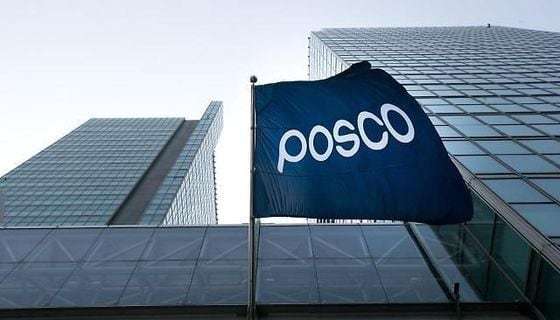
The changes at Pohang Steelworks are only the beginning of the “digital transformation (DX)” being pursued by POSCO Group, according to the company. POSCO Group is accelerating a group-wide DX strategy that encompasses both manufacturing and office operations, based on artificial intelligence (AI) and data capabilities proven at its steelmaking sites.
POSCO’s DX blueprint consists of two main pillars: the “Intelligent Factory” in the manufacturing sector and the “Intelligent Office” in the office sector. Among these, concrete results are already emerging in manufacturing. In 2019, POSCO became the first company in Korea to be selected as a “Lighthouse Factory” by the World Economic Forum (WEF), which recognizes companies that are innovatively transforming the future of global manufacturing. Since then, POSCO’s smart factory technologies have advanced one step further into intelligent factories by integrating AI.
The blast furnace operation method, which previously relied on the experience of skilled operators, has been transformed into a system in which AI analyzes tens of thousands of data points to precisely control molten iron. In addition, AI detects abnormal signs in equipment in advance, and robots perform hazardous tasks in place of humans, spreading a collaborative system between humans and technology across production sites.
These efforts to build intelligent factories are expanding beyond steel into the secondary battery materials business, which is the group’s new growth engine. POSCO Future M is establishing a smart production system in which AI monitors the entire process in real time, from raw material input to product packaging, by leveraging equipment control technologies and data analysis capabilities accumulated at steelworks.
The DX wave is spreading not only across manufacturing sites but also to all business areas of the group, including construction and logistics. POSCO E&C has introduced a safety management system in which closed-circuit (CC) TV automatically detects when workers enter hazardous areas at construction sites and issues warning announcements. POSCO International has enhanced operational efficiency by establishing a smart logistics system in which AI manages inventories at grain terminals.
The organizational culture is also being restructured to be more digitally oriented. Through innovation in “Digital-Based Ways of Working (WX),” POSCO Group is strengthening AI utilization capabilities for all employees. At the “WX Zerothon” competition held in June, even employees without coding knowledge developed their own work automation programs using “no-code” solutions, broadening the base of AI utilization.
Within POSCO Group, there is a strong perception of AI not merely as a tool for efficiency but as a core strategy for future survival. At this year’s New Year’s address, POSCO Group Chairman Jang In-hwa stated, “Technology is becoming the yardstick by which corporate competitiveness is measured,” and emphasized, “We must respond preemptively to paradigm shifts in industry, including the transition to artificial intelligence.”
Kim Jae-hyeong
AI-translated with ChatGPT. Provided as is; original Korean text prevails.
ⓒ dongA.com. All rights reserved. Reproduction, redistribution, or use for AI training prohibited.