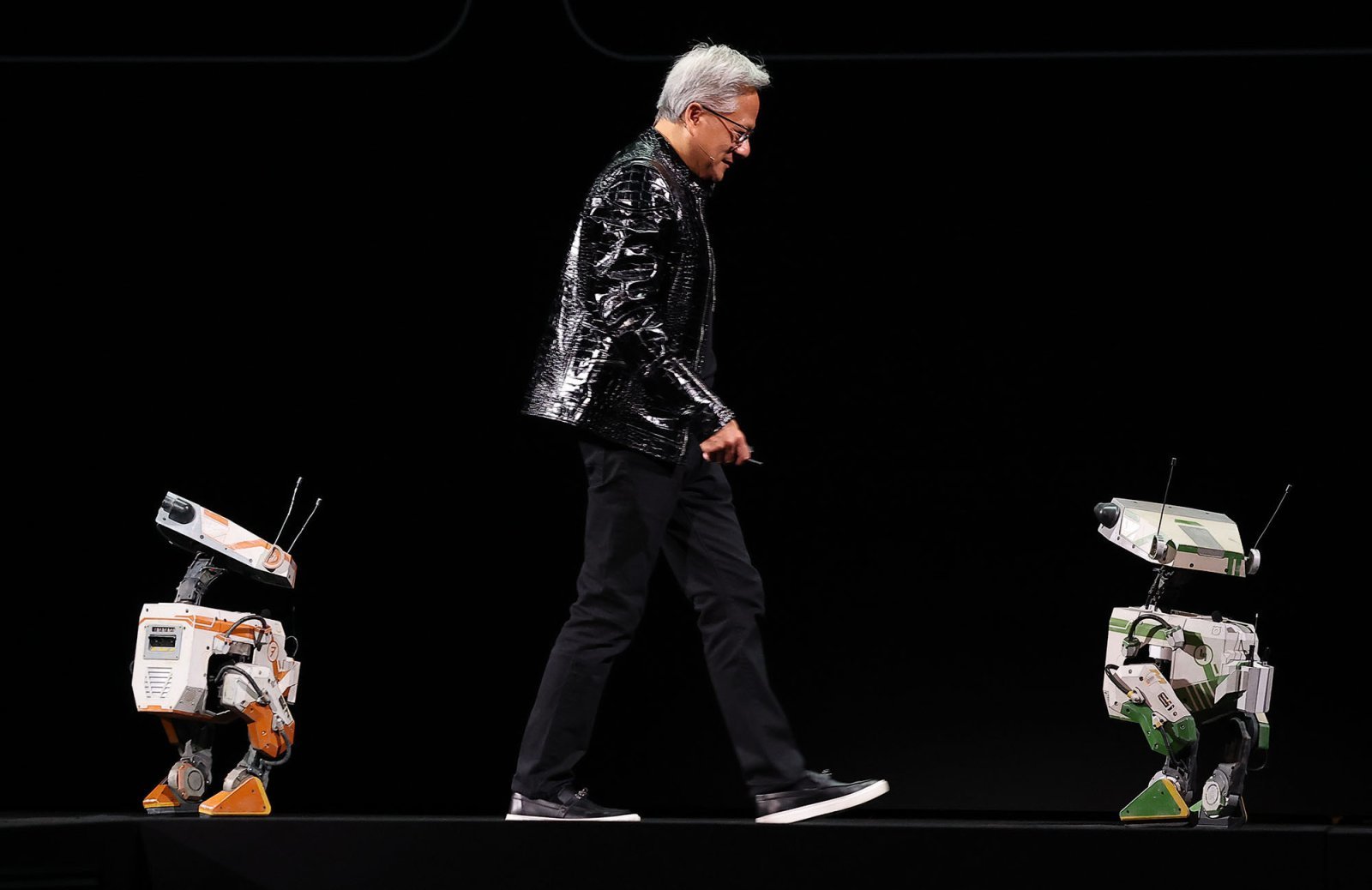
Jensen Huang, NVIDIA CEO, delivers a keynote speech alongside a robot during the NVIDIA CES 2026 Live event held at the Fontainebleau Hotel in Las Vegas, Nevada, United States, on the 5th (local time). 2026.1.6/Photo Joint Press Corps
Jensen Huang, Chief Executive Officer (CEO) of NVIDIA, stated that “We will be the first consumer of HBM4 (6th generation), the next-generation High Bandwidth Memory (HBM),” adding, “For a considerable period of time, there will be no other company besides NVIDIA using this memory.” With the launch of ‘Vera Rubin’, the next-generation artificial intelligence (AI) accelerator, scheduled for the second half of this year (July–December), he stressed that commercialization of 6th-generation HBM will begin in earnest this year.
On the 6th (local time), Huang held a briefing for the press and analysts at the Fontainebleau Hotel in Las Vegas, United States, where the world’s largest consumer electronics and information technology (IT) trade show ‘CES 2026’ is taking place, and said, “NVIDIA is the most influential consumer in the global memory market,” making these remarks.
Addressing concerns that graphics processing unit (GPU) prices could rise due to AI data center demand, Huang underscored NVIDIA’s dominant position. “The HBM4 production lines being built around the world are essentially intended to meet NVIDIA’s demand,” he said.
Huang also expressed satisfaction with cooperation with semiconductor suppliers. Without naming specific companies, he said, “All factories and suppliers have completed their preparations, and they are all doing an excellent job.” Samsung Electronics and SK hynix are currently in the final stages of procedures to supply HBM4 for NVIDIA’s Vera Rubin. Vera Rubin is the next-generation AI accelerator that will succeed its predecessor, Blackwell, and the previous day Huang announced plans to launch Vera Rubin in the second half of this year.
Huang also forecast that the AI era will present structural opportunities for memory semiconductor companies. “The world will increasingly need data centers called ‘AI factories’,” he said, adding, “In this trend, both memory suppliers and semiconductor manufacturers will benefit.”
ⓒ dongA.com. All rights reserved. Reproduction, redistribution, or use for AI training prohibited.
Popular News