Gyeonggi Center for Creative Economy & Innovation (CEO Kim Won-kyung) is operating the 2025 Startup Leap Package support program to support the growth of companies in the leap stage that have been founded for three to seven years. Organized by the Ministry of SMEs and Startups and the Korea Institute of Startup & Entrepreneurship Development, the program selects a total of 46 companies, including 26 companies in a large enterprise collaboration track with corporations such as KT and LG Electronics, and 20 companies in a Korea Venture Investment Corp. (KVIC) investment-linked track. It provides up to KRW 200 million in business funding per company and an accelerating program including growth strategy consulting.
Source = Gyeonggi Center for Creative Economy & Innovation
In addition, the Gyeonggi Center for Creative Economy & Innovation operates various startup support programs for startups at multiple stages, focusing on revitalizing the domestic startup market and discovering and nurturing outstanding startups. Among these startups, it has selected and introduced companies that achieved notable results last year and are expected to perform strongly in 2026.
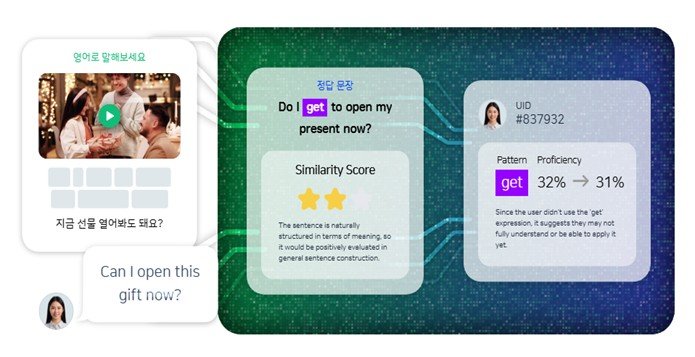
‘Plang’ correcting ‘Konglish’ through AI coachingPlang (CEO Kang Min-gyu), founded in 2020, is an edtech startup that uses AI technology to solve the challenges Koreans face in English speaking. With the vision of “a world without language barriers,” it provides an AI English conversation solution that analyzes users’ spoken English sentences in real time and corrects them into more natural native-level expressions. In other words, it focuses on providing a personalized learning experience by precisely diagnosing users’ pronunciation and sentence structure.
Its proprietary AI-based sentence analysis and correction technology is Plang’s core competitive edge. When users speak sentences in English, the AI immediately recognizes them and not only corrects grammatical errors but also refines awkward expressions (so-called “Konglish”) into sophisticated sentences actually used by native speakers.
In particular, it offers an interface optimized for the “shadowing” learning method, in which users repeatedly follow and speak sentences. Its algorithm that repeatedly trains weak sentence patterns based on learning data has been well received among learners.
Plang’s AI analyzes sentences spoken directly by the user and designs the next learning steps / Source = Plang
Since launching its service, Plang has recorded high retention (reuse rate), secured a top-tier position in the education category on Google Play and the App Store, and successfully attracted early-stage investment from venture capital (VC). It was also selected for the TIPS program, thereby securing R&D funding for advancing its AI engine.
Plang aims to provide a service where AI understands learners’ intentions like a personal tutor and suggests the most appropriate expressions. Building on its success in the domestic market, the company plans to expand its services to markets in Asia such as Japan and grow into a global edtech platform most trusted by language learners worldwide.
‘Fluffyduck’ rewriting the grammar of ‘bishoujo subculture games’Fluffyduck (CEO Lee Jung-hoon) is a bishoujo subculture game developer that leverages high-quality bishoujo illustrations and stable development capabilities. In a market dominated by major game companies focusing on MMORPGs and subculture games, it targets niche segments with differentiated concepts. Despite being a small development studio, it is known in the game industry as a strong startup thanks to its solid planning capabilities and original artwork.
Source = Fluffyduck
Its flagship title “Project C.V.” is the first game that fully embodies the team’s development capabilities and is scheduled for release in Korea and globally this year. While highlighting a unique universe and 2D artwork, it also maximizes detailed fun elements, control feel, and the strategic aspects of character development and skill combinations. In particular, it has received positive evaluations for its sophisticated 2D animation and impactful action direction that strongly appeals to enthusiasts and otaku users.
As a studio entering its third year since founding and third year of development, the factors that make its first title highly anticipated include Fluffyduck’s distinctive “communication-based management.” CEO Lee and the development team place emphasis not only on internal communication but also on customer communication after launch, planning to closely monitor user feedback in real time and actively reflect it in updates.
Fluffyduck has consistently been selected for government-backed game production support programs by receiving high marks for its development capabilities, development culture, and expected operational competencies after launch, and is regarded as one of the most promising subculture game developers this year. With a global publishing contract imminent, Fluffyduck plans to continuously discover original IPs and grow into a developer loved by gamers worldwide.
‘Sikpharma’ innovating the offline F&B market with “data beyond payments”Sikpharma (CEO Seo Jung-hwan) provides data-driven management solutions to small business owners based on order and payment data from offline stores. Founded in 2020, this fintech startup’s main business item is a QR smart order system that allows customers to order and pay using only their smartphones, without installing separate kiosks or tablets. In a traditional order market centered on hardware, which entails a heavy initial cost burden, Sikpharma accelerates digital transformation (DX) in the food service industry by promoting an easy-to-adopt SaaS model and powerful customer data analytics capabilities.
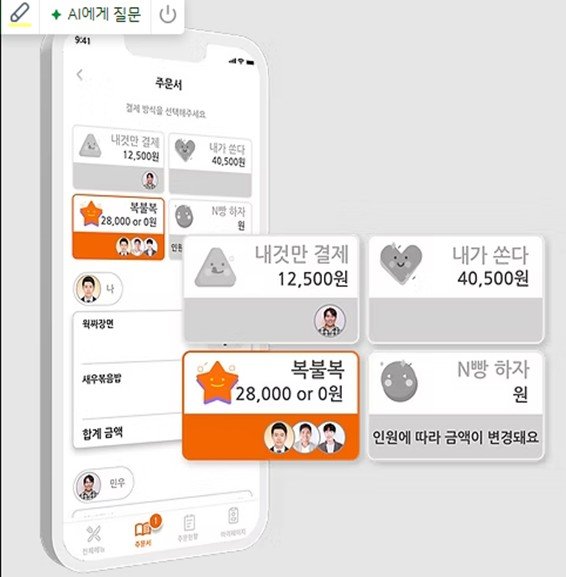
Various payment methods in Sikpharma’s “Wonder” service / Source = Sikpharma
The company’s “Wonder” service enables the entire process from menu viewing to ordering and payment simply by scanning the QR code attached to the table. In particular, it offers distinctive entertainment value through features such as “N-way split payment” and “random payment,” targeting the Dutch pay culture of the MZ generation.
Sikpharma’s technological strength lies in its ability to identify data not only on payers but also on their companions. Through this, it collects data on actual visitors to the store and uses a proprietary algorithm to identify “Key Diners,” highly influential loyal customers who bring in new customers. This is the key differentiator of Wonder.
Sikpharma recently attracted pre-Series A investment from a Singapore-based venture capital firm and a Swiss accelerator, and was also selected for the TIPS program. These achievements demonstrate that Sikpharma is not merely an order intermediary platform but a data intelligence company that enhances the operational efficiency of offline stores.
Sikpharma is a startup focused on uncovering the true patterns of customer behavior hidden behind payment data. It plans to accelerate its entry into global markets such as Southeast Asia and grow into an essential partner that increases data accessibility for all offline businesses beyond restaurants.
‘Kkun Co., Ltd.’ seeking to dominate the full value chain of commercial EV vehicles based on empirical dataKkun Co., Ltd. (CEO Shim Byung-chan), an eco-friendly smart logistics startup, has announced an expansion strategy covering the entire ecosystem of EV transport vehicles based on exclusive data secured through its own direct delivery services, and has begun raising pre-A investment.
Kkun’s differentiator lies in its field-verified technology rather than desk-based theory. Conventional delivery and transport systems are typically developed and operated from the perspective of customers receiving goods, making it difficult to apply systems that reflect the supplier’s point of view. In contrast, Kkun has advanced its FMS and TMS systems by developing functions and operations from the perspective of carriers and drivers as suppliers.
Through this approach, it has verified the field suitability of its FMS (fleet management system) and TMS (transportation management system) solutions via its own B2B/B2C same-day delivery service “DolDol.” More than 1 billion exclusive driving and charging data points accumulated through actual transactions with around 60 corporate clients constitute a core asset of Kkun Co., Ltd.
Based on this, the company has developed “DolDol EV FMS,” which, unlike existing FMS solutions focused on internal combustion engine vehicles, offers functions specialized for electric freight vehicles such as: ▲ battery charging and operation management ▲ AI-based optimal charging station recommendation ▲ real-time dynamic routing. These functions have delivered verified cost reduction effects in the field.
Kkun’s “DolDol” service for efficient delivery / Source = DolDol website
With this pre-A investment as an inflection point, Kkun plans to maximize profitability by collecting data through direct delivery and then converting it into a SaaS (subscription model), while simultaneously pursuing a strategy to build a global patent portfolio. Through a phased expansion strategy, the company aims to evolve from a simple transport support system provider into a full-cycle service company for the commercial EV vehicle value chain, similar to global FMS players such as Samsara and Geotab.
Starting with its participation in “GITEX ENS 2025” in Dubai last October, Kkun is also preparing for global expansion by taking part in events such as the SME Fair in Shenzhen, China. By 2028, it plans to expand the number of managed vehicles to 50,000 and lead the electrification and digital transformation of the sub-1-ton freight truck market worth KRW 1 trillion, as well as the electric taxi and public vehicle markets.
IT Donga reporter Lee Moon-kyu (munch@itdonga.com)
ⓒ dongA.com. All rights reserved. Reproduction, redistribution, or use for AI training prohibited.
Popular News