Gyeonggi Center for Creative Economy & Innovation (CEO Kim Won-kyung) is operating the 2025 Startup Leap Package Support Program, supporting the growth of companies in the leap phase between three and seven years after establishment. Supervised by the Ministry of SMEs and Startups and the Korea Institute of Startup & Entrepreneurship Development, the program selects a total of 46 companies, including 26 large corporate cooperation-type companies in collaboration with conglomerates such as KT and LG Electronics, and 20 Korea Venture Investment Corp. (KVIC) investment-linked companies. It provides up to KRW 200 million in business funds per company and an accelerating program that includes growth strategy consulting.
Source = Gyeonggi Center for Creative Economy & Innovation
In addition, the Gyeonggi Center for Creative Economy & Innovation operates various startup support programs for startups at multiple stages, focusing on revitalizing the domestic startup market and discovering and fostering outstanding startups. Among these startups, it has selected and introduced promising companies that achieved notable results last year and are expected to perform strongly in 2026.
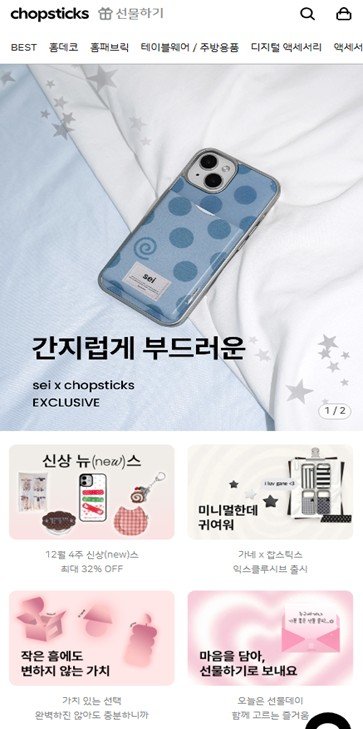
Art commerce platform ‘Climbrs’ that supports Asian creators’ global expansionClimbrs (CEO Seo Kang-seok) is an art commerce platform startup founded in March 2019 and headquartered in Cheonan, Chungcheongnam-do. Climbrs operates the design commerce platform “Chopsticks,” providing a design commerce platform for creators with distinctive identities and millennial consumers seeking new consumption experiences.
Its core vision is to discover and support the growth of skilled but not yet widely known designers, artists, writers, and arts graduates, while introducing unique works to consumers and proposing a value-driven lifestyle.
Chopsticks targets the global market based on the cultural identity of East Asia. Focusing on competitive East Asian design, it is building a platform where design enthusiasts around the world can interact. Its ultimate goal is to create the largest design ecosystem in Asia, starting from Korea.
Climbrs’ art commerce platform ‘Chopsticks’ / Source = Chopsticks website
Chopsticks has focused on the shift in consumption of handicraft products toward the MZ generation, and reflects craft consumption culture tailored to the clear preferences and values of this cohort. By quantifying the screening filters for creators, it reduces the search cost for creators and provides efficient matching for both creators and consumers.
Climbrs is driving market expansion through technological strength and differentiation by launching a new overseas sales service called “Ketchap.” Ketchap helps small domestic brands enter overseas markets more easily in Korea’s growing reverse direct-purchase (reverse cross-border e-commerce) market. In July last year, at the Osaka Pitching Festival held as part of the Osaka Kansai International Art Festival, the company delivered a final pitch and was selected as one of the final eight teams out of 77 companies worldwide.
In June 2023, the company was selected for the TIPS program, securing private investment and government R&D support to build a growth foundation. It has been recognized for its growth potential as an innovative startup, including being named one of 30 first-round candidates for the 2024 Forest of Innovation Awards.
Climbrs is expanding its presence as a next-generation commerce platform that combines art and technology by connecting independent creators and consumers through an AI-based personalized recommendation system and content curation.
‘Lightweight’ aims to become a game changer in the content market by combining generative AI and gamesLightweight (CEO Yeon Yun-ho), founded in 2021, combines generative AI technology with interactive content. True to its mission of “light and fast innovation,” the company is growing in the rapidly changing digital content market by leveraging agile development capabilities and original planning. It presents a vision that goes beyond a simple game developer, aiming to build an ecosystem where anyone can easily and quickly produce and enjoy high-quality content through AI technology.
Lightweight’s core competitiveness lies in its proprietary AI image and video generation solution “XBrush” and its solid lineup of mobile games. XBrush has dramatically lowered the entry barrier to content production, with technology that enables intuitive generation of high-quality images without complex prompt inputs.
The company has also successively launched popular mobile games such as “Tower Royal,” “Degul Degul,” and “Sandbox Run,” and is actively using the accumulated graphics processing technologies and user experience (UX) data from this process to advance its AI solutions.
XBrush, an integrated workflow solution / Source = Lightweight
XBrush began to be developed in response to the needs of on-site practitioners, allowing the company to naturally meet market demand. Lightweight was established in February 2021 as a game development studio and, in the course of developing and operating games, internally developed AI tools specialized for content generation and editing in the game industry. From 2024, it reorganized the service into a SaaS model and is preparing for an official launch in the first half of this year.
Because development began to meet in-house needs, the company was able to sensitively identify changes in content demand in the industry. Reflecting this, it has built a low-cost, high-efficiency AI-based content production environment that incorporates various on-site workflows, giving it a strong advantage in responding quickly to rapidly changing market demands.
Lightweight recently secured official recognition of the differentiation and future growth potential of its proprietary generative AI technology by being selected for the Startup Leap Package and raising KRW 1.5 billion in investment. It plans to focus the secured funds on refining its AI models and advancing services for entry into global markets.
Lightweight aims for content innovation that starts with games and is completed with AI. It is determined to evolve beyond games that are simply played into an interactive platform where AI brings users’ imaginations to life.
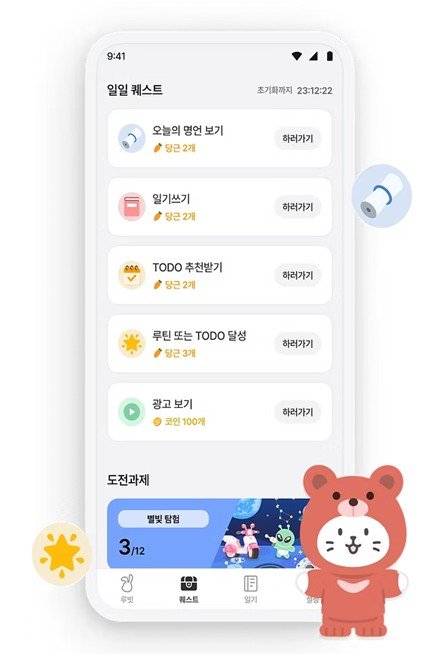
‘Lubit’ seeks to transform the global healthcare market through gamificationLubit (CEO Lee Jun-young) is a healthcare startup founded in 2021 that is rapidly growing in the global market by incorporating gamification elements into a self-improvement app. Developed based on CEO Lee’s own experience overcoming burnout, Lubit helps users manage their daily routines as if playing a game, under the philosophy of “sustaining life through habitual routines.” The unique user experience (UX), in which users grow a cute rabbit character named “Lubit,” earn rewards (carrots), and decorate a virtual room, strongly appeals to the tastes of the global MZ generation.
Cute self-improvement routine app ‘Lubit’ / Source = Lubit
Lubit’s competitiveness lies in its ability to create “sustainable motivation.” While existing self-management apps relied solely on user willpower, Lubit has significantly lowered the entry barrier to habit formation through an immediate reward system and charming storytelling. Recently, it introduced a generative AI function based on ChatGPT, adding a “mental care” feature in which AI sends warm, encouraging letters in response to users’ emotional diaries.
Lubit surpassed 1 million global downloads within two years of launch purely through word of mouth, without significant marketing activities. More than 80% of its total users are from overseas, demonstrating strong global scalability. The app has been recognized for both technological capabilities and business potential, being selected as one of Google Play’s “Best Self-improvement Apps of the Year” and for the TIPS program.
Lubit’s ultimate goal is to grow beyond a simple habit-forming app into a “life care solution” that heals both body and mind for users worldwide. Through services based on behavioral activation (BA) treatment that are easily accessible to everyone—from people with depression to the general public—it aims to present a new paradigm in digital healthcare.
‘Cleverain’ aims for digital sheet music innovation in the classical music market with ‘listening AI’Cleverain (CEO Park Ung-chan) is a startup pioneering the music tech field by incorporating AI technology into the conservative classical music market. Founded by Park, who majored in piano, the company focuses on improving the inefficient analog environment that performers face during practice.
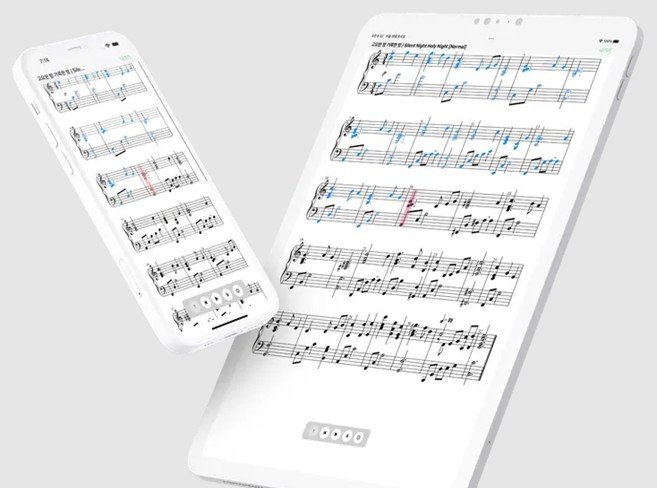
Cleverain combines advanced acoustic signal processing technology with AI to eliminate the inconveniences of paper scores and provide a scientific practice solution based on performance data. Its core service “Klwii” is an “AI practice partner” app that goes beyond a simple sheet music viewer.
Digital sheet music service ‘Klwii’ / Source = Cleverain
The key feature of this app is its proprietary “AI Page Turning” technology. It recognizes the performer’s playing speed and position in real time and turns the pages at the appropriate timing without the need for physical contact. It also analyzes recorded performances to visualize tempo, dynamics, and missed notes, providing feedback that has resulted in high satisfaction among music majors and entrance exam students.
This technological capability and market potential have been validated through investments and selection for government support programs. From its early days, Cleverain secured seed funding after the originality of its technology was recognized and was subsequently selected for the TIPS program. Its score recognition and performance analysis algorithms are evaluated as more accurate than those of global competitors, and the company is building a stable revenue model by expanding B2B partnerships with major arts high schools and universities in Korea.
Cleverain aims to create an environment in which artists can fully immerse themselves in performance through technology. It plans to expand its current piano-centric service to cover a wider range of instruments, including orchestral instruments, and to grow into a global music platform connecting performers around the world.
IT Donga reporter Lee Moon-gyu (munch@itdonga.com)
ⓒ dongA.com. All rights reserved. Reproduction, redistribution, or use for AI training prohibited.
Popular News