Yangcheon District: Using waste sorting and night patrols
Gangseo District: Piloting a recycling collection robot
Dongdaemun District: Introducing patrol robots to traditional markets
Seoul Metropolitan Government: Moving to revise the Hangang Park ordinance
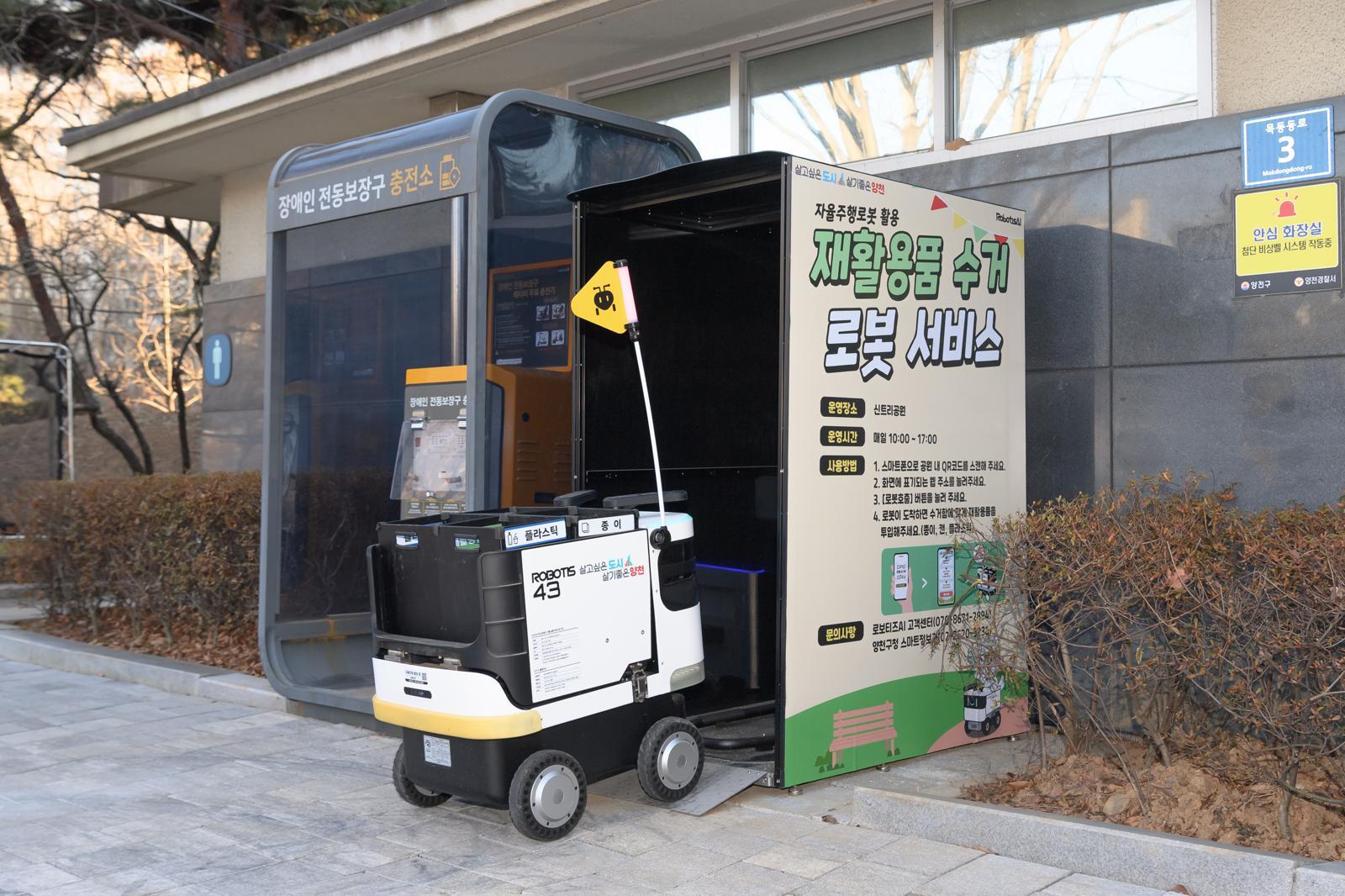
The autonomous waste-sorting robot “Gaemi” enters a charging booth after completing recyclable waste collection at Shintree Park in Yangcheon District, Seoul, on the 5th. Gaemi is an autonomous recycling and waste-sorting robot introduced at Yangcheon Park by Yangcheon District after being selected for a Seoul Metropolitan Government pilot project competition, and has been in operation since September 2024. Provided by Yangcheon District
“Collecting recyclable waste. Please make way.”
When the autonomous waste-sorting robot requested right of way with a voice prompt at Shintree Park in Yangcheon District, Seoul, on the 5th, elderly walkers on the trail burst into laughter. Comments such as “It’s really good at finding its way,” “It’s cute,” and “I don’t have any recyclables to give it” were exchanged as the robot passed. A district official said, “It was installed at Shintree Park last month, and it has already become a landmark of this park.”
● From waste sorting to patrols… robot “Gaemi” “Gaemi” is an autonomous recycling and waste-sorting robot adopted by Yangcheon District. After Yangcheon District was selected in a Seoul Metropolitan Government pilot project competition, operations started in September 2024 at Yangcheon Park, Omok Park, and Paris Park. According to Yangcheon District, this is the first case in the country of a park operating an autonomous waste-sorting robot on a regular basis.
The robot has a box-shaped structure approximately 70 cm in height with four wheels. It is equipped with five cameras—four in the front and one in the rear—and a LiDAR (Light Detection and Ranging) sensor that uses lasers to recognize surrounding terrain and objects. It autonomously travels within the park by detecting pedestrians and obstacles and adjusting its route.
Robots can be summoned via QR codes installed throughout the park. When a user connects to the QR code and presses the “Call Robot” button, “Gaemi” moves to the specified location in about five minutes. When beverage cans and other recyclable items are placed into the basket mounted on the robot, it waits briefly and then resumes its route. Park maintenance staff regularly collect the recyclables gathered by the robot.
After completing its tasks, “Gaemi” moves on its own to a charging booth and begins charging with accompanying voice guidance. A Yangcheon District official stated, “Once fully charged, it can operate continuously for about six hours,” adding, “It reduces the inconvenience of having to walk to a waste-sorting station while using the park, so citizen feedback has been positive.”
The “Gaemi” deployed at Paris Park is also used for night patrols in addition to waste sorting. Between 8 p.m. and 9 p.m., it records the park surroundings with its front and rear cameras, and if an abnormal situation is detected in the control room’s monitoring, staff can respond immediately.
● From food and beverage delivery to fire detectionIn Yangcheon District, beyond the waste-sorting robots, an autonomous robot called “Yangcheon Nurion” provides food and beverage delivery services within the park. It delivers drinks or ice cream ordered from the park café to designated locations. A district official said, “We plan to analyze the results of the pilot and review how far to expand the scope and deployment of autonomous robots.”
Experiments using autonomous robots are not limited to Yangcheon District. Gangseo District is conducting a pilot project by introducing an autonomous recycling collection robot at Magok Hani Park. Dongdaemun District, in cooperation with the Ministry of the Interior and Safety, the Seoul Metropolitan Government, and the Korea Land and Geospatial Informatix Corporation, carried out a pilot operation of an address-based autonomous patrol robot in traditional markets from October to December last year. For this robot, a route database was built so it can move autonomously even in complex indoor and outdoor environments such as Cheongnyangni Traditional Market and Cheongnyangni Agricultural and Marine Products Market, and its patrol and fire/risk detection functions were tested.
The Seoul Metropolitan Government plans to revise relevant ordinances in the first half of this year (January–June) to enable patrol, cleaning, and guidance services by autonomous robots in Hangang Park. The amendment will include safety measures such as permitted operating sections and hours, speed limits, and weight standards.
ⓒ dongA.com. All rights reserved. Reproduction, redistribution, or use for AI training prohibited.
Popular News