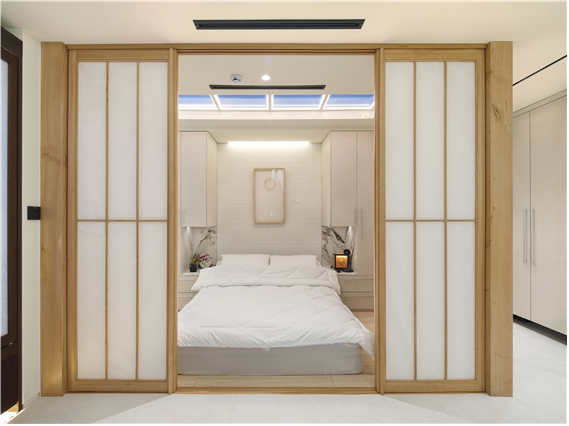
In the bedroom space inside the senior residence, environmental data can be measured in a non-contact, unconscious manner. The wooden finishes evoking the sensibility of hanok and the skylight lighting that appears to reproduce the real sky are notable. Photo provided by Homeflix
AI-based residential solution company Homeflix Co., Ltd. announced in January 2026 that it is presenting a new perspective on “Physical AI,” suggesting that the role of living spaces may fundamentally change.
The core question is simple: “When AI enters the home, what in everyday life will be different?” In the global tech industry, discussions of Physical AI currently focus mainly on humanoid technologies, that is, robots in human form. Industry leaders, including NVIDIA CEO Jensen Huang, have emphasized the evolution of robotics, saying that “AI has moved beyond the screen and started to operate in physical space.”
Homeflix takes a different view. The company focuses on the fact that “robots appear only when needed, whereas space surrounds us 24 hours a day.” Accordingly, it proposes a new direction for Physical AI that extends the space itself as the body of AI, not the robot—creating a structure in which the home itself responds and makes judgments autonomously.
Physical AI, as defined by Homeflix, takes as its long-term technological goal the concept symbolized by Jarvis in the film “Iron Man”: environmental intelligence that reads the situation first and responds, even without users giving instructions one by one. Whereas conventional smart homes are “houses where users open an app to turn on the lights and adjust the temperature,” Homeflix’s Physical AI is closer to a home that first checks its own status and prepares the necessary environment. It detects the resident’s movements and daily flow to automatically adjust lighting, temperature, and air conditions, and in the longer term, it envisions a structure that can connect to external care services if abnormal signs, different from usual patterns, are detected. In other words, the home functions as a kind of “quiet care partner.”
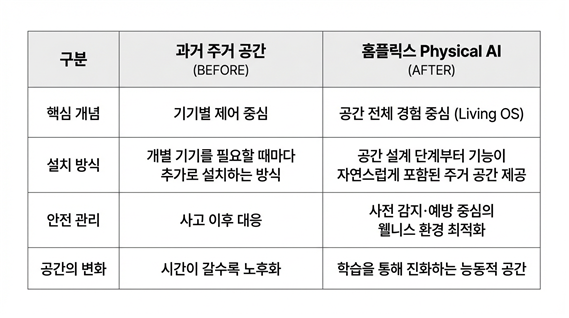
Along with this vision announcement, Homeflix clearly distinguishes and explains what a space looks like before and after the application of Physical AI and the Living OS.
In past residential environments, sensors and devices often operated independently. Motion sensors, temperature sensors, and security devices were not interconnected, making it difficult to grasp the overall status of the home at a glance. Even when dangers occurred, most had to be discovered directly by people, and in homes with hard flooring structures, fall accidents among older adults or those with walking difficulties remained a serious issue. To compensate for this, wristband or necklace-type wearable devices were sometimes used, but many users stopped wearing them due to inconvenience.
The Living OS-based space proposed by Homeflix takes a different approach. The floor is designed from the outset to reduce impact in the event of a fall, and non-contact sensors installed throughout the home naturally detect movement and changes in condition without requiring wearables. The information collected in this way is organized at the level of a single spatial unit, allowing the home to understand the overall situation and automatically adjust lighting, temperature, and ventilation. In essence, the home changes from a place that “responds later to risks” to one that anticipates and prepares for them in advance.
Before & After at a glance. Image provided by Homeflix
Overseas, “residential OS” solutions that manage the entire space as a single system have already penetrated deeply into everyday life. A representative success case is Germany’s “Future Living® Berlin,” which integrates energy and care OS for an entire housing complex. There, AI learns residents’ lifestyle patterns and optimizes light and air quality in real time. In particular, it has demonstrated the proactive role of residential spaces through a preemptive response system that detects abnormal resident activities and notifies the management office or family members.
In Korea, Homeflix is inheriting this global trend of residential innovation by supplying the nation’s first “Physical AI-based spatial OS.” Based on its current technology, in which spaces detect residents’ conditions in real time and adjust the environment accordingly, Homeflix plans to expand its system into an active intelligence entity that, similar to the German case, automatically connects to medical staff and care services when abnormalities occur.
Homeflix Chairman Seo Dong-won (50) stated, “For construction and development companies, this technology is not just a differentiation factor but a direct revenue-generating tool,” adding, “Spaces where the Living OS is applied can command premium sale prices, reduce management fees through increased operational efficiency, and create additional revenue models by linking medical and care services. This is not merely a technology investment, but an elevation of spatial value and the beginning of a new business model.”
Homeflix is already validating its Living OS through the “Aurum Senior Residence Jamsil” project in Songpa-gu and aims to expand beyond senior housing to convert all types of spaces—general housing, offices, and commercial facilities—into intelligent Physical AI platforms.
ⓒ dongA.com. All rights reserved. Reproduction, redistribution, or use for AI training prohibited.
Popular News