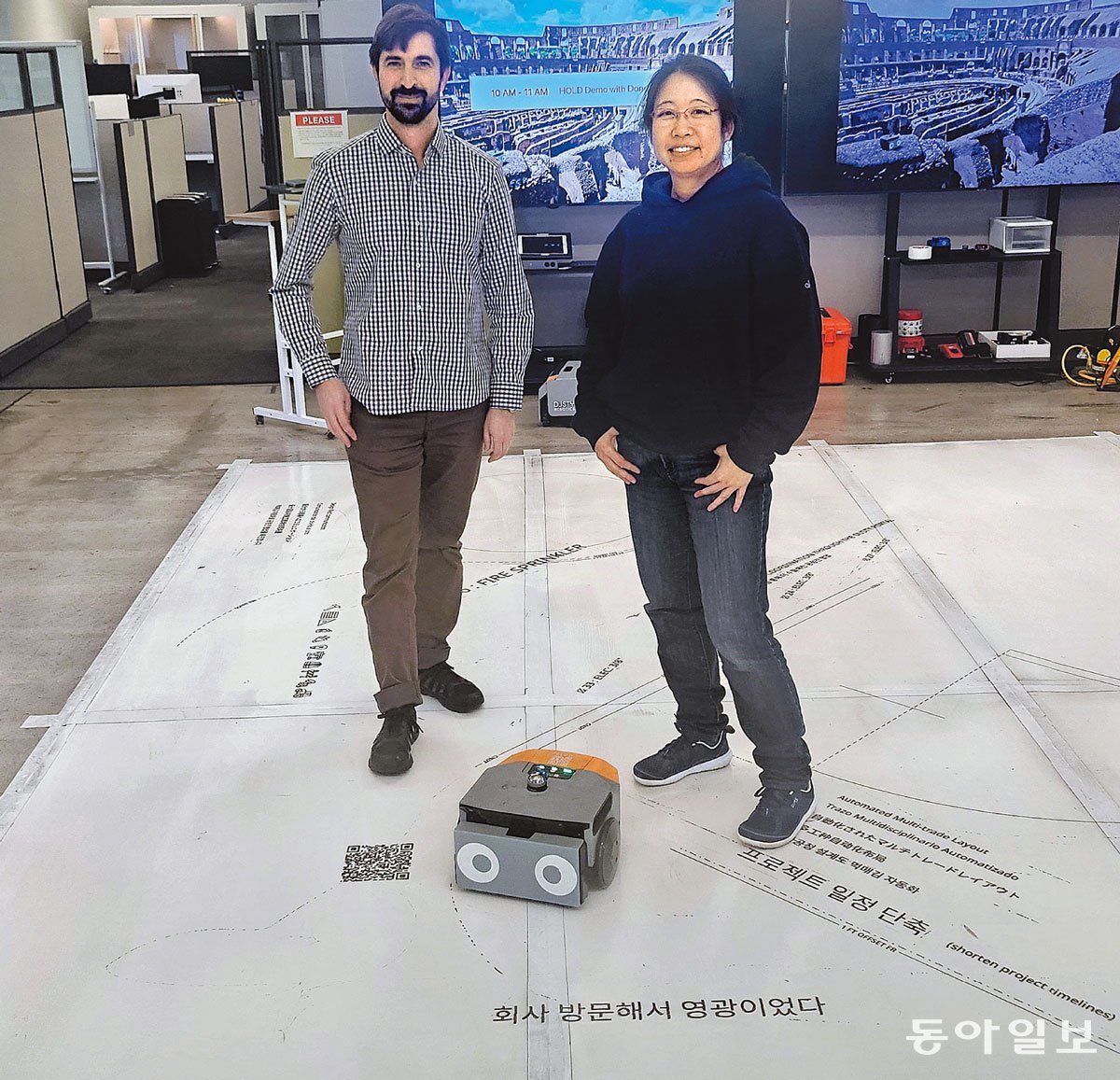
On 16 December last year (local time), at Dusty Robotics, a robot startup in Mountain View, Silicon Valley, California, a small robot shaped like a vacuum cleaner was busily moving across a white floor. As the robot passed, floor plans showing the outline of the building and the locations of pipes were drawn on the floor, and construction instructions in various languages including English, Spanish, and Korean were printed on top. On-site workers of various nationalities were able to work regardless of language barriers.
This robot is used by major US construction companies and at data centers and apartment complexes. Developed to resolve labor shortages in the construction sector, this technology has increased work efficiency several times compared with the previous method in which people drew the plans directly. Senior Director Jack Rice Davis said, “If the robot draws the plans accurately, people can focus on construction work.”
Silicon Valley’s characteristic “innovation finance” has been a solid fuel for bringing construction robot technology to the fore. Founders there said in unison, “Investors back us without looking at profits for the first two to three years after founding.” In Silicon Valley’s financial ecosystem, a culture that “embraces 99 failures for one home run” has long taken root.
Big tech companies such as Google and Apple, which grew on the soil of innovation finance, have become pillars supporting the US stock market. The reason the US stock market has maintained solid growth recently, recording gains in the 20% range for three consecutive years, can also be found in the performance of innovative companies nurtured by innovation finance. By contrast, in Korea, where the base for innovation finance is weak, not only founders who feel constrained but also financial institutions seeking investment destinations are turning their footsteps to Silicon Valley.
[Now the Innovation Finance War] 〈2〉 Silicon Valley invests even if companies fail
US robot startup that experienced technical defects
Cites steady venture capital funding as key to rebounding after failure
Unlike Korea, where funds flock to trendy sectors, Silicon Valley prioritizes corporate potential
“Even a B-grade business is chosen if it has A-grade manpower”
At Dusty Robotics, a robot startup in Silicon Valley, California, company executives demonstrated the robot’s operation on 16 December last year (local time). The robot, which can print in multiple languages, stamped a Korean sentence on the floor reading, “It was an honor to visit the company.” Silicon Valley = Correspondent Shin Jin-woo niceshin@donga.com
“Our first investor decided to invest after having coffee with us a few times.”
Tessa Lau, chief executive officer (CEO) of Dusty Robotics, a robot startup in Silicon Valley, recalled the moment of securing her first investment in this way on 16 December last year (local time).
Founded in 2018, CEO Lau met her first investor once a month in the early days of the startup to have coffee and share what she had newly learned about the construction industry and her business ideas. “The investors highly appreciated how we progressed over time,” she said. At that time, Dusty Robotics was a fledgling company with no clear achievements, but investors focused on the fact that it was moving forward. They believed it could grow into a profitable company.
CEO Lau had previously suffered the bitter experience of a failed startup. The power of “innovation finance,” which offers investment opportunities even after failure, helped build Dusty Robotics. Thanks to this, the company has raised about US$70 million (about KRW 101.1 billion) over seven years. It was also selected by US business magazine Fast Company as one of the “Most Innovative Companies” in 2024. Silicon Valley entrepreneurs say innovation financiers understand startup failures and value the learning that comes from failure.
● “Multiple failures make companies grow” Although CEO Lau had already shut down one business before founding Dusty Robotics, she faced another crisis. Early on, a construction company in San Francisco returned the robot after using it at an apartment construction site. Due to an operating error, the robot drew the floor plans in curves instead of straight lines on the floor.
The company immediately started to identify the problem. It discovered that Wi-Fi wireless internet was not suitable for real-time control of the robot. It then redesigned the product. After the technological improvements, it brought back as a customer the same apartment builder that had previously rejected the robot. CEO Lau recalled, “Our history is full of many failures, and those failures made us grow.”
Dusty Robotics’ ability to endure and rebound despite failures owes much to the role of Silicon Valley’s venture capital (VC) ecosystem. Investors look beyond short-term business completeness or profit and loss, focusing instead on how quickly a technology can evolve through failure and resolve structural issues. In other words, they are willing to wait for one success even if there are 99 failures. Jack Rice Davis, the company’s senior marketing director, said, “Investors are always looking for companies that are thinking about ‘How can we change this industry?’”
Major US venture capital firms do not ask about monetization for the first two to three years after an investment. Ahn Joon-young, head of Lotte Ventures’ US office, said, “Venture funding is similar to raising a child, so expecting growth in four to five years is too much to ask.”
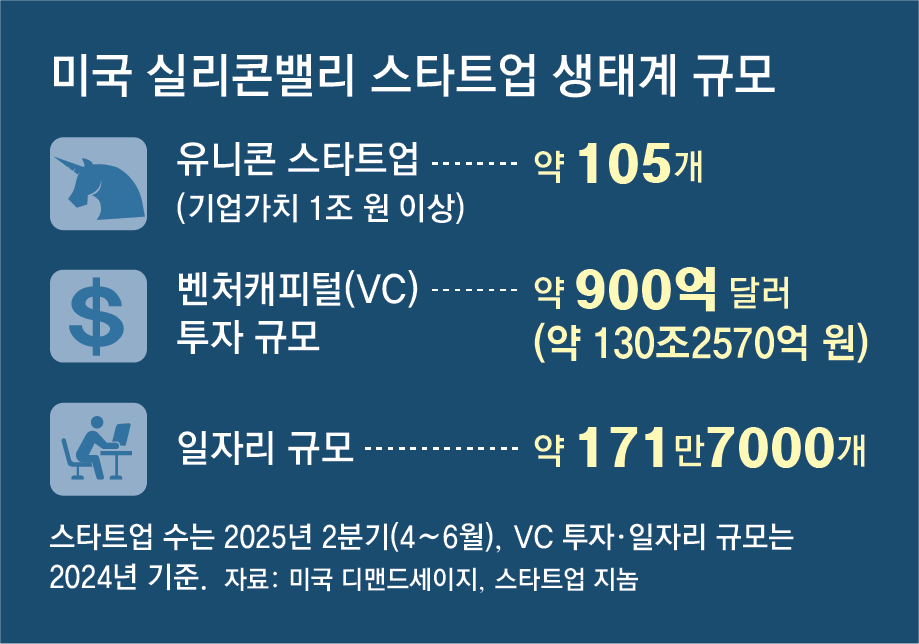
● “Manpower can turn a B-grade business into A+” According to data analytics firm DemandSage, more than 1,148,000 startups were operating across the United States in the second quarter (April–June) of last year. A substantial portion of these are in Silicon Valley.
Silicon Valley has 105 unicorns—companies valued at US$1 billion (about KRW 1.4455 trillion) or more. By contrast, according to the Korea Chamber of Commerce and Industry, there were 13 unicorns in all of Korea as of October last year. The number of unicorns in the Silicon Valley area is eight times the total in Korea.
The secret behind Silicon Valley’s prolific creation of unicorns is its “innovation finance” investment formula. Innovation-focused investors place greater weight on the capabilities of founding members than on the excellence of the business itself. Global venture capital firm Sequoia regards founders it has already vetted as part of the “Sequoia family.” Park Hyo-min, CEO of gene therapy developer GeneEdit, which has received investment from Sequoia, said, “Sequoia verifies people rather than the business, and considers the ‘Sequoia family’—those who have been vetted—extremely important,” adding, “They tell us, ‘Even if you fail, come to us first when you start your next venture.’”
Ilya Strebulaev, a professor at Stanford Graduate School of Business, said, “One legendary venture capital investor put it this way: ‘I would rather invest in an A-grade team pursuing a B-grade idea than a B-grade team executing an A-grade idea, because an A-grade team can quickly recognize the limitations of a B-grade idea, pivot, and develop it into an A+ idea.’”
In contrast, Korea’s financial sector tends to focus on whatever theme is trendy at the moment, rather than on people’s capabilities or a company’s potential. Lee Ki-dae, head of the Startup Alliance Center, said, “Investments in platforms, as opposed to thematic areas such as artificial intelligence (AI), have frozen,” adding, “In particular, startups serving domestic demand industries have found it harder to attract investment.”
“One more zero on profits” Rush of Korean venture support organizations into Silicon Valley
‘IBK Changgong’ supports US entry of Korean startups
HD Hyundai and the SME Ministry also establish local bases
“Investment methods must change with a long-term perspective”
Calls grow to strengthen startup ecosystem at home
“If a startup succeeds in the United States, there is one more zero at the end of the profit figure than in Korea.”
An official from “IBK Changgong,” which supports Korean startups’ entry into the US from Silicon Valley in San Francisco, California, explained the reason for entering Silicon Valley in these terms.
The organization is a startup incubation arm of IBK Industrial Bank of Korea. The idea is that success in starting a business in the United States allows companies to attract larger investments and increase profits compared with Korea. An IBK official said, “In Silicon Valley, when an investment opportunity comes, the size is large,” adding, “If you secure even a small amount of funding here, it remains a strong credential even if the business fails. This makes it advantageous to start a new venture in another country.”
Not only Korean startups, but also Korean banks and large corporations are setting up startup support organizations in Silicon Valley. They are heading to Silicon Valley because of its abundant innovation capital and more diverse opportunities to develop overseas markets.
Korea Development Bank established KDB Silicon Valley in 2021. It holds “Next Round,” an investment networking event where founders can naturally meet investors, in Silicon Valley every year. Asan Nanum Foundation, a public-interest foundation of HD Hyundai, opened “MARU SF,” a startup support space in San Mateo, California, in November last year. It provides housing and community space for founders who have only recently entered the US market. The Ministry of SMEs and Startups is creating a Startup Venture Campus (SVC) in Menlo Park, Silicon Valley, with the goal of opening this month. The SVC is being set up by expanding the Silicon Valley office of Korea Venture Investment Corp. (KVIC), an agency under the ministry that has been operating since 2013.
The fact that the government, corporations, and banks are helping Korean startups enter the US is to be encouraged. However, there are increasing calls to strengthen the domestic startup ecosystem by fostering innovation finance at home as well. Many argue that corporations and banks must change their perspective on investing in startups. The message is that even if invested startups do not produce results quickly, capital should be provided with a long-term outlook. A venture industry official said, “In Korea’s financial sector, where short-term performance is critical, venture investment, which requires a long time before yielding returns, is easily shunned.”
Special Reporting Team
▽ Team leader: Cho Eun-ah, Deputy Editor, Business News Department achim@donga.com
▽ Singapore: Reporters Kang Woo-seok; Stockholm: Kim Su-hyun
▽ Silicon Valley: Shin Jin-woo; Boston: Lim Woo-seon,
▽ London: Correspondent Yoo Geun-hyung
▽ Seoul: Reporters Jeon Joo-young, Shin Moo-kyung, Joo Hyun-woo, Choi Mi-song
ⓒ dongA.com. All rights reserved. Reproduction, redistribution, or use for AI training prohibited.
Popular News