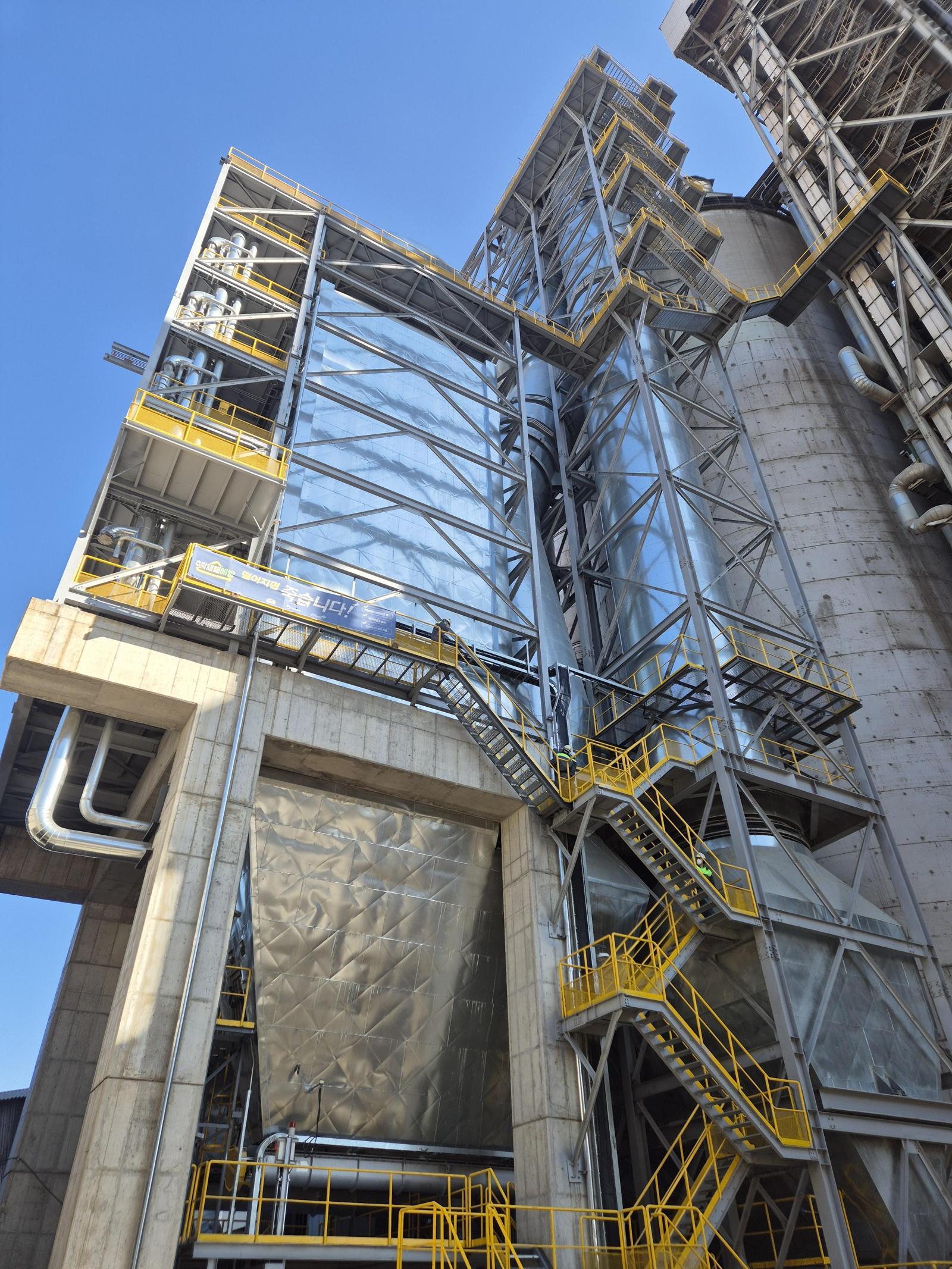
SCR (Selective Catalytic Reduction) facility overview. Provided by Korea Cement Association
The test operation of the high-efficiency pollution control facility, SCR (Selective Catalytic Reduction), designed to reduce nitrogen oxides (NOx) emissions during cement manufacturing, has been completed, marking the beginning of its full-scale introduction across the industry. The cement industry plans to expand these facilities to all plants following this demonstration, but given the worsening business conditions due to the construction market downturn, they assert that government financial support is necessary.
The Korea Cement Association announced on the 9th that an SCR demonstration was held at the Jecheon plant of Asia Cement in Chungbuk. This demonstration was an opportunity to verify the on-site application results of SCR, essential for reducing nitrogen oxides emissions. Representatives and executives from major cement companies such as Sampyo Cement, Hanil Cement, Sungshin Cement, and Union attended to inspect the operation and efficiency of the facility.
This SCR installation and pilot operation were part of a national research project by the Ministry of Trade, Industry, and Energy, with approximately KRW 36.2 billion invested. After announcing the installation plan in December 2023, it took about two years to complete the two-month pilot operation and commence full-scale operation.
SCR is considered one of the most efficient facilities for reducing nitrogen oxides, but it had not been applied to large-scale, high-density production facilities like those in the domestic cement industry. While it has been introduced in some small-scale plants overseas, its efficiency and stability in a mass production system had not been verified. The pilot results at Asia Cement's Jecheon plant confirmed the reduction performance and stability, accelerating the industry's overall adoption.
The cement industry will be subject to integrated environmental permits starting in July 2027, with the nitrogen oxides emission standards for Gangwon region plants set to be significantly tightened to 118 ppm compared to the current standards. Consequently, each cement plant is in a situation where installing at least one SCR unit is inevitable.
However, amid the construction market downturn, cement demand has fallen to its lowest level in 34 years, and the installation cost of KRW 30 billion to KRW 40 billion per unit poses a significant burden on the industry. Therefore, the industry is calling for government financial support, suggesting the utilization of the annual KRW 16 billion nitrogen oxides emission charges they pay.
An association representative stated, “The successful pilot operation at Asia Cement’s Jecheon plant has proven the effectiveness of SCR in large-scale facilities,” adding, “We will expand environmental facility improvements across the industry to establish a production system that meets strengthened environmental regulations and public demand levels.”
ⓒ dongA.com. All rights reserved. Reproduction, redistribution, or use for AI training prohibited.
Popular News