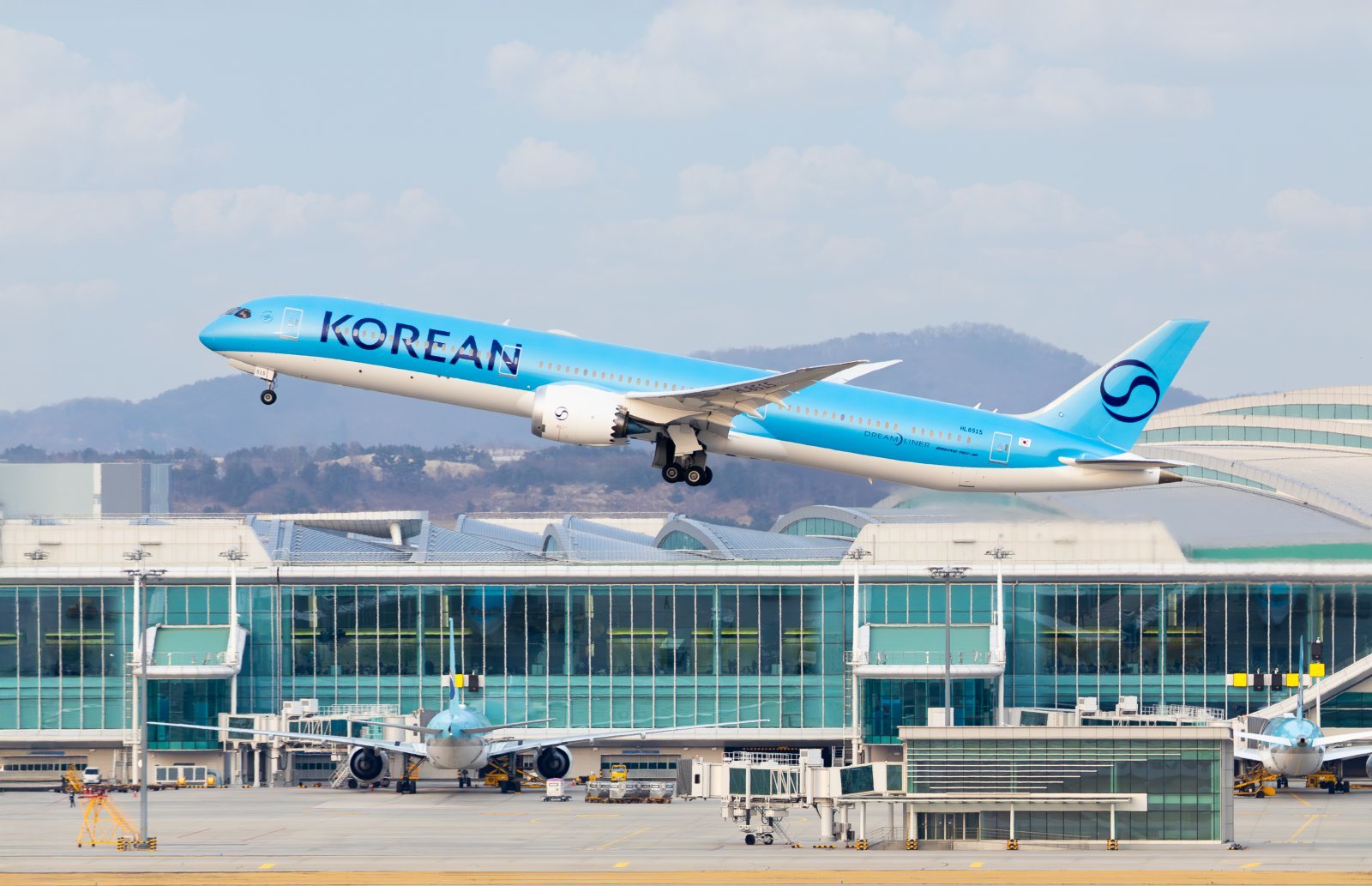
Korean Air's high-efficiency new Boeing 787-10 aircraft. Provided by Korean Air
Korean Air announced on the 9th that it is implementing environmental management for a sustainable future in line with the global aviation industry's goal towards a decarbonized society. Activities are underway to minimize environmental impact, including the introduction of new aircraft, replacement of outdated facilities, improvement of in-flight service items, waste upcycling, and forest creation.
Korean Air stated that it has introduced new aircraft to reduce greenhouse gas emissions and noise. The Boeing 787-10 and Airbus A350, which reduce carbon emissions by improving fuel consumption per seat compared to existing aircraft, have been introduced. The low-noise models Boeing 787-9, 737-8, Airbus A220-300, A321neo, and A350-900, which meet the International Civil Aviation Organization (ICAO) noise standards of Chapter 14, are currently in operation.
The company is also focusing on efficient fuel management, which is directly linked to carbon emission reduction. Since 2004, Korean Air has operated a permanent fuel management organization, accumulating data and know-how related to carbon emission reduction. In 2023, a new fuel management system was introduced to establish a fuel management framework where all organizations communicate and cooperate organically. Last year, a total of 143,111 tons of fuel reduction was achieved. A project to reduce the weight of aircraft carpets to improve fuel efficiency is also underway. Korean Air participated from the development stage of new carpet materials, and since the initial application in July 2023, it has been applied to all owned aircraft, reducing the weight by about 200 kg for the Boeing 777-300ER aircraft.
Additionally, the use of plastic materials in in-flight service items has been reduced and packaging has been improved. Starting in December this year, some economy class meal containers on short-haul routes will be gradually changed to non-wood pulp materials. The economy class cutlery, previously made of plastic, has been improved to biodegradable bamboo material. Recycled materials have been applied to the earphone packages provided to passengers.
Upcycling is also being practiced. Aircraft fuselages that have reached the end of their service life are specially processed to create limited edition name tags and golf ball markers. Old maintenance uniforms have been made into driver pouches and distributed to mechanics. Returned crew uniforms have been made into medicine pouches and portable battery pouches.
A Korean Air representative explained, "We are also committed to supporting the introduction of Sustainable Aviation Fuel (SAF) and facility investments." Since 2017, Korean Air has been operating 14 domestic and international routes with SAF blended aviation fuel, following its first operation on the Chicago-Incheon route with SAF blended aviation fuel as the first Korean airline. In 2024, domestically produced SAF was blended at 1% on the Incheon-Haneda commercial route, and SAF blended aviation fuel is partially applied on the Incheon-Kobe and Gimpo-Osaka commercial routes.
Employees are also engaged in forest creation activities by planting trees. Domestically, the "Green Skypass" project is being implemented. When Korean Air Skypass members use mileage to purchase bonus tickets or brand goods, Korean Air accumulates funds linked to this to create urban forests. Internationally, the "Korean Air Forest" has been established for 22 years.
A Korean Air representative stated, "Korean Air plans to continue its decarbonization efforts for sustainable flight and strengthen the 'Environmental' aspect of ESG management in the future."
ⓒ dongA.com. All rights reserved. Reproduction, redistribution, or use for AI training prohibited.
Popular News