Samsung Electronics will unveil its first in?house?developed humanoid (human?type robot) early next year. It is reportedly putting emphasis on “precision hands,” equipping each hand with 20 motors for a total of 40. The ultimate goal is to realize hand movements precise enough for smartphone assembly. The company plans to apply its hinge technology, developed for foldable smartphones that can withstand repeated folding and unfolding, to the robot’s joints, and to install a display on the face to depict eyes and a mouth.
According to multiple Samsung Electronics officials on the 23rd, the company is working to showcase its first in?house humanoid at CES 2027, the world’s largest information technology (IT) and home appliance exhibition to be held in Las Vegas, USA, in January next year. To this end, it is integrating the technological capabilities accumulated in the development and manufacturing of smartphones and home appliances to enhance the level of completion of the robot. The move is said to reflect the strong commitment of Lee Jae?yong, Chairman of Samsung Electronics, to unveil a highly advanced humanoid at CES.
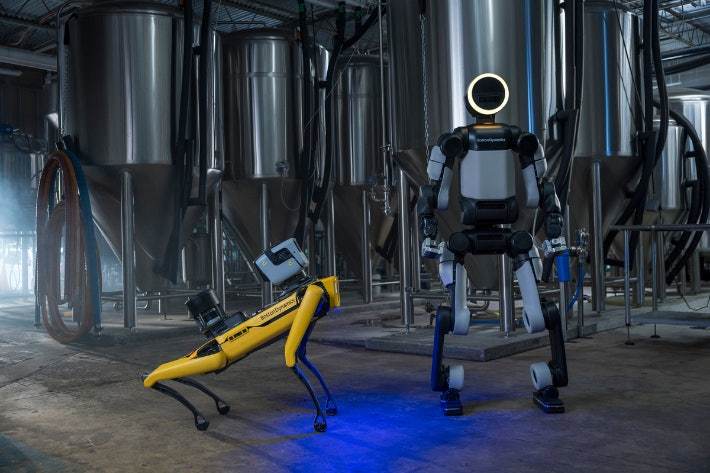
● 20 motors per hand… display on the face Samsung Electronics has decided to install 20 motors in each humanoid hand and adopt a direct?drive system that transmits the motors’ power directly to the joints. This is advantageous for precise control of movement and force. Unlike Tesla’s “Optimus,” which moves its fingers by pulling cables, Boston Dynamics’ “Atlas” uses the same direct?drive method as Samsung.
Samsung Electronics has focused on securing hand technology to the extent that it established “Hand Lab” this year, dedicated exclusively to robotic hand development. A Samsung Electronics official said, “The ultimate goal is to achieve a level of precision in the robot’s delicate hand technology that would allow it to assemble mobile phones,” adding, “If it can handle assembly as delicate as that of mobile phones, it will be able to manage most manufacturing processes.”
Hinge technology accumulated through the development of the Galaxy Z Fold and Z Flip has also reportedly been applied to the robot’s joints. The company aims to make humanoid movements more natural and improve durability by actively adopting hinge technology designed to place sophisticated components in small spaces while operating reliably even after repeated folding and unfolding.
The robot’s face will feature a display to implement eyes and a mouth. Samsung Display’s organic light?emitting diode (OLED) panel will be used. Having long produced devices such as mobile phones, TVs, and home appliances that interact with people in the home, the company intends to give the humanoid “facial expressions” to create a human?friendly appearance. Earlier, at “K?Display 2026” in July, Samsung Display unveiled a prototype that applied a 6.9?inch curved OLED to a humanoid face.
Samsung Electronics is developing two types of humanoids: the basic “HR (Human Reference)” model and the high?performance “HE (Humanoid Extreme)” model. In July this year, it integrated the Future Robot Task Force and other units to launch the “RX (Robot eXperience) Business Promotion Office” under Roh Tae?moon, head of the Device eXperience (DX) Division.
● USD 5 trillion market by 2050… Samsung to build a robot hub in Gumi Samsung Electronics’ entry into humanoid development is backed by the growth potential of the “physical AI” market, in which artificial intelligence (AI) moves actual objects and performs tasks. As AI advances increase the possibility that robots will perform a wide range of tasks, global companies are accelerating investment competition.
The humanoid market is still in its early stages. According to the International Federation of Robotics (IFR), sales of large humanoids taller than 140 cm worldwide totaled only about 7,000 units last year. However, Morgan Stanley forecasts that by 2050 the global humanoid installed base will exceed 1 billion units and that the market, including related supply chains and maintenance, will surpass USD 5 trillion (about KRW 7,000 trillion).
Manufacturing sites are particularly seen as the core market. Hyundai Motor Group plans to deploy Boston Dynamics’ “Atlas,” which it unveiled at CES this year, at its plant in Georgia, USA, in 2028. Tesla is also pushing for mass production of “Optimus.”
In March this year, Samsung Electronics also announced that it would transform its manufacturing sites into “AI autonomous factories” by 2030 and gradually introduce humanoid robots into production facility management, logistics, and assembly processes. One of the hubs for this initiative is Gumi in North Gyeongsang Province. Samsung Electronics and Samsung SDS plan to invest a total of KRW 19 trillion in Gumi to establish a mass?production system for humanoids, a robot data factory, and an AI data center (AIDC).
Gumi is particularly advantageous as a testbed for Samsung humanoids to practice and learn precision assembly operations, as it already hosts Samsung Electronics’ smartphone production facilities. The company plans to utilize the high?performance graphics processing units (GPUs) of the AIDC that Samsung SDS is building with completion targeted for 2028 to process task data collected by the robots and to train them in precision assembly movements. At a mega?project briefing in July, Roh stated, “In Gumi, we will pursue an AI?driven factory by establishing a humanoid mass?production system and converting manufacturing to AX (Automation Transformation).”
ⓒ dongA.com. All rights reserved. Reproduction, redistribution, or use for AI training prohibited.
Popular News