[From Korea to the World, and into the Future: K-Defense] Part 1: Breaking into the U.S., the Home of Defense
World’s No.4 K-Defense Knocks on the U.S. ‘Home Turf’
Hanwha’s Changwon plant in full swing developing wheeled K9… Can deploy and move within 30 seconds for rapid shoot-and-scoot
Utilizing existing turret, 70% of processes automated… Prototype delivered one month after winning U.S. military contract
Mass-production contract to be pursued after up to four years of performance evaluation
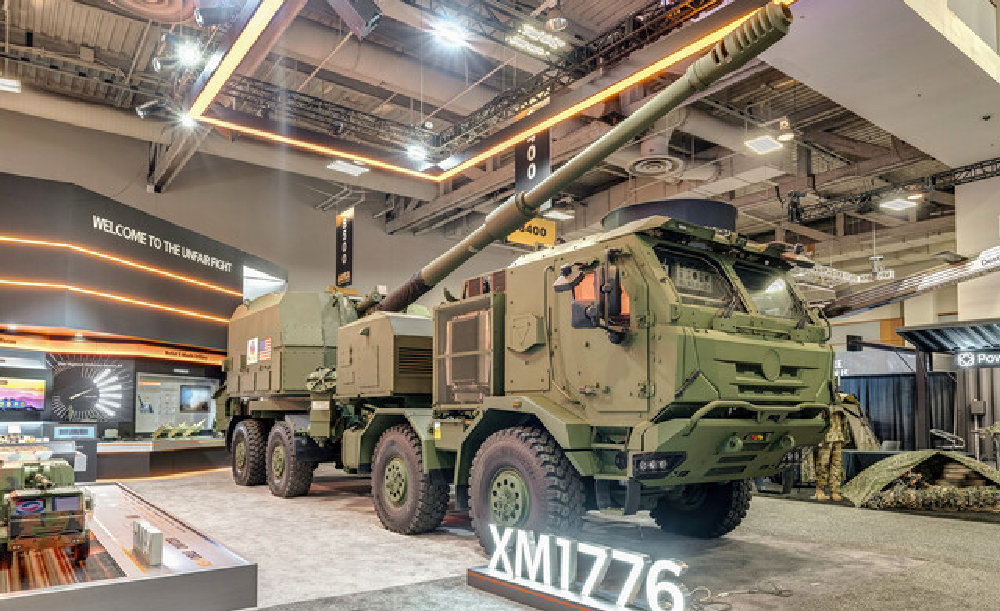
On the 12th of last month (local time), Hanwha Aerospace showcased a wheeled K9 self-propelled howitzer prototype at the Association of the United States Army’s annual defense exhibition “AUSA 2026” held in Washington, D.C. The U.S. Army designated this prototype howitzer with the formal name “XMI776.” The “X” stands for “experiment,” combined with 1776, the year of U.S. independence. Provided by Hanwha Aerospace
《Korean defense companies, which grew to become the world’s fourth largest last year, are now squarely targeting the United States, the “home base” of the global defense industry. As this year’s defense sector results have declined from last year, prompting some to raise a “K-defense stagnation” theory, these firms are knocking on the door of the world’s No. 1 market to overcome the concerns. Hanwha Aerospace has expanded its reach to the United States with the wheeled K9. In August, it beat overseas competitors from Germany, Sweden, and elsewhere to win the U.S. Army’s Mobile Tactical Cannon (MTC) program. The Bigung (Flying Arrow), a coastal infiltration force interdiction rocket developed by LIG D&A (formerly LIG Nex1), also recently achieved a 100% hit rate on targets during a demonstration test operation in the United States.》On the 5th, at Hanwha Aerospace’s Changwon Plant 3 in Changwon, South Gyeongsang Province, the heavy iron gate lifted with a roar to reveal a 40-ton-class artillery truck in front of a wall hung with a giant Taegeukgi (national flag). This is the wheeled K9, which mounts the turret of the existing tracked K9, an armored-vehicle type, on an oversized truck platform with eight wheels. When this reporter climbed into the “head” of the more than 12 m-long vehicle—the driver’s cab—and started the engine, the power of the 600-horsepower engine set the body vibrating in unison.
The “standard” wheeled K9, now in the final stages of development for worldwide export, is currently only in a state where the engine can be started, but is expected to become a cutting-edge ground warfare system capable of traveling at up to 100 km/h in future battlefields. Compared with the tracked version, it can travel tens of kilometers per hour faster. Although still in development, a “U.S. type” prototype has already been supplied to the United States, the originator of the global defense industry. This is the first time a Korean company has entered a U.S. weapons acquisition program.
Hanwha Aerospace, together with the Agency for Defense Development and Technology Promotion (ADDTP), has expressed its ambition to export the combined tracked and wheeled K9s to a total of 30 countries around 2028, once the wheeled standard is established. This would expand the territory of K-defense into the global wheeled self-propelled howitzer market, where it had previously not had a presence.
● Fast development and delivery recognized by the United StatesAs a latecomer in the wheeled self-propelled howitzer market, Hanwha Aerospace secured the U.S. Army’s selection in August over leading global defense firms because it can develop high-difficulty products more quickly. Park Won-min, senior researcher at Hanwha Aerospace’s LS Research Center and in charge of development, said, “Weapons system development usually takes three to five years, but for us it took about one year.”
Government support and assistance from the Agency for Defense Development and Technology Promotion played a major role, as did the “one source multi-use” strategy. The turret and gun barrel from the company’s flagship tracked K9 were directly transplanted onto the wheeled platform. Automation of more than 70% of welding and assembly also delivered results. At the plant that day, six robotic arms were welding the turret to the combined upper and lower hulls.
Hanwha Aerospace is rapidly supplying the wheeled K9 to the U.S. side. After winning the U.S. Army program in August, the company delivered the first prototype to the United States in September, the following month. The second prototype is scheduled to be transported to the United States in early January next year, where it will undergo final installation of additional components before delivery in June. The U.S. Army plans to verify performance and adjust detailed specifications of these prototypes for up to four years. Barring any significant defects, a final mass production contract is expected around 2029–2030. Choi Ki-il, professor of military studies at Sangji University, said, “Arms exports to the United States can serve as an opportunity to prove the technological capabilities of Korean defense globally and accelerate exports.”
● “Final ground warfare weapon” at 100 km/h
The wheeled K9 observed on site is built in a “three-part” structure, including the forward driver’s cab. Its sheer size made even boarding the cab no easy task. The doors, equipped with protective armor and weighing 200–300 kg each, could not be opened and closed manually and could only be operated by buttons. With the vehicle body standing nearly 1.5 m high, it was necessary to climb a temporary steel staircase to get on. Inside, the driver’s cab resembled a combination of a first-row large truck cabin and an aircraft cockpit. In the khaki-finished space for three crew members, dozens of control buttons and multiple displays for controlling firing and other operations were installed.
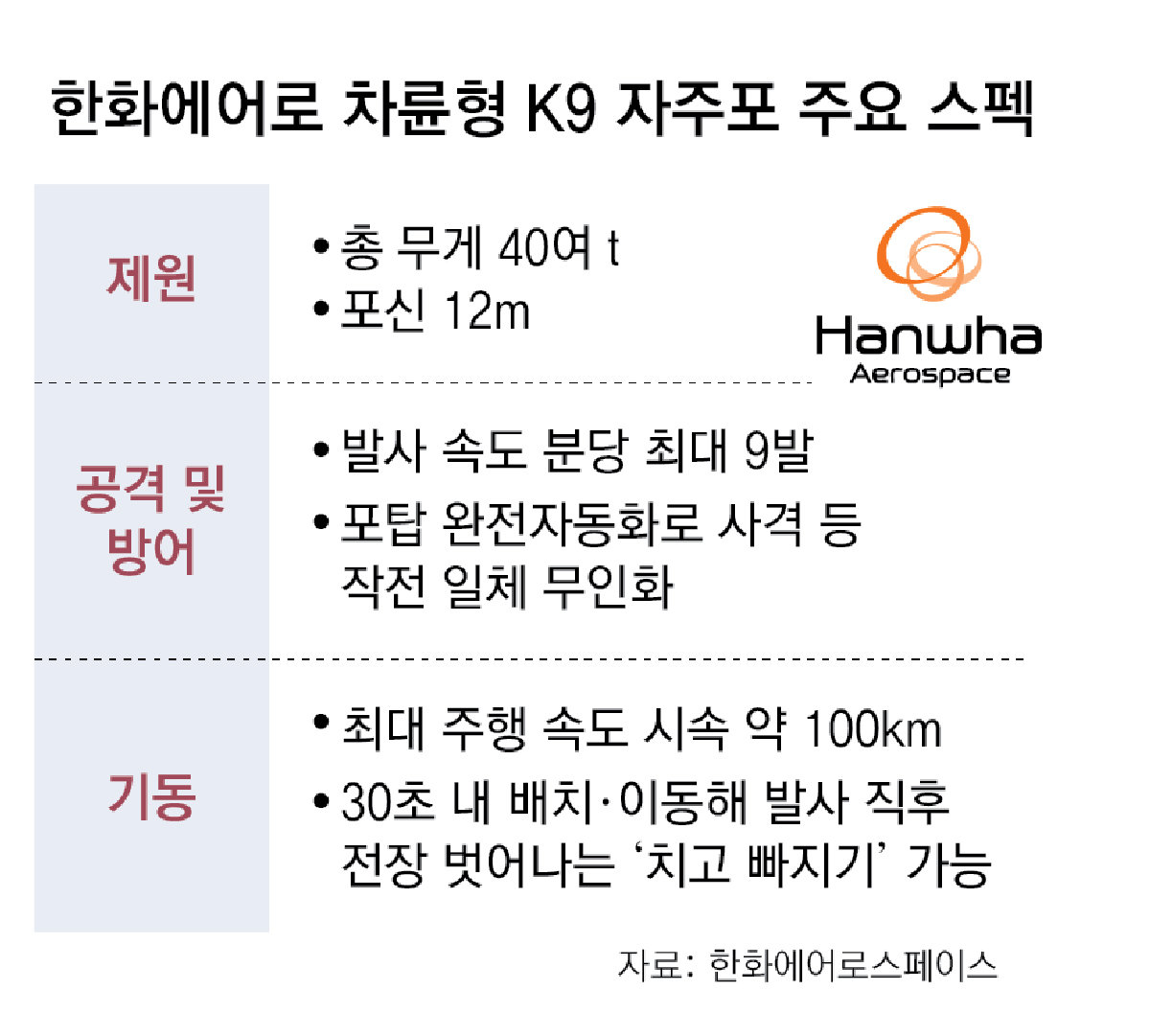
The structure at the far rear of the vehicle, the unmanned automated turret, is what receives remote fire-control commands. The wheeled K9 boasts a maximum firing rate of nine rounds per minute. This is equivalent to the firing capability of Germany’s RCH-155, regarded as the world’s top wheeled self-propelled howitzer in terms of technology.
It can also be deployed and moved within 30 seconds, enabling “shoot-and-scoot” tactics in which the system exits the battlefield before retaliatory fire arrives after firing. This tactic has rapidly emerged as a core strategy in urban warfare, as demonstrated in the Russia-Ukraine war.
Hanwha Aerospace plans to introduce artillery deployment supported by artificial intelligence (AI) in the future. From the third performance-upgraded version of the K9 (K9A3), expected in the mid-2030s, operation without a driver in the cab will become possible. Once only the target area coordinates are transmitted from a command armored vehicle located several kilometers away, the system will autonomously move to the optimal position using AI, deploy itself, and complete firing preparations.
ⓒ dongA.com. All rights reserved. Reproduction, redistribution, or use for AI training prohibited.
Popular News