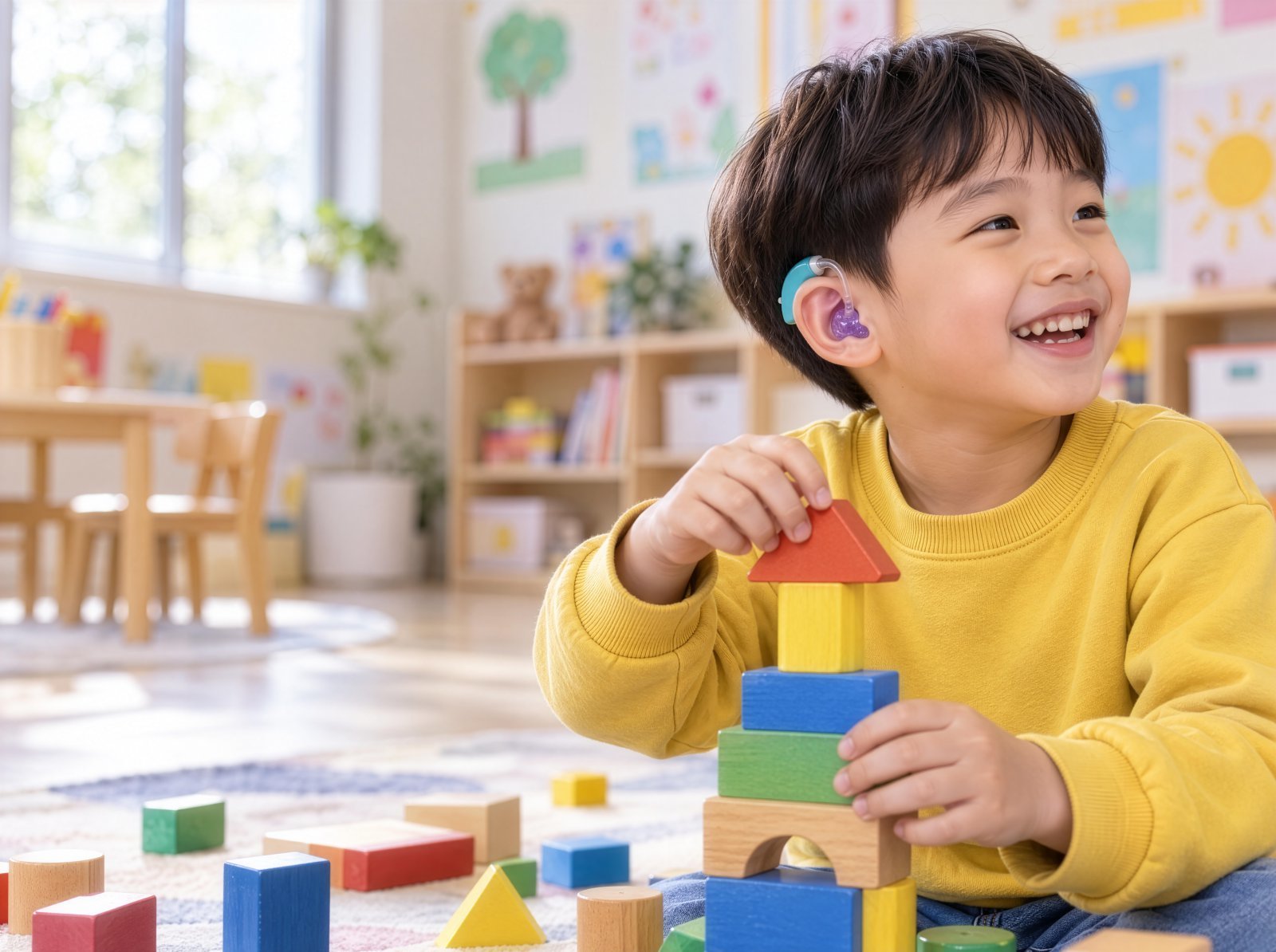
An AI-generated image depicting a child wearing hearing assistive devices related to a cochlear implant. A Korean research team has reported findings that, in pediatric patients who have undergone cochlear implant surgery due to congenital hereditary deafness, the function of certain cochlear cells can be maintained for several years. Getty Images Korea
New domestic research indicates that children who have undergone cochlear implant surgery for congenital deafness may have the possibility of receiving gene therapy in the future. It was confirmed that some sensory cells within the cochlea, which can be damaged during surgery, maintained their function for several years in children who received early surgery.
A joint research team led by Professor Choi Byoung Yoon of the Department of Otorhinolaryngology at Seoul National University Bundang Hospital and Professor Kim Chang Hee of the Department of Otorhinolaryngology–Head and Neck Surgery at Konkuk University Medical Center announced on the 12th that, after analyzing 11 pediatric patients with congenital deafness caused by OTOF gene variants, they confirmed that the function of certain cochlear cells can be preserved even after cochlear implant surgery.
The OTOF gene produces a protein necessary for transmitting sound signals detected in the ear to the auditory nerve. When this gene is mutated, congenital deafness can occur because sound signals are not properly transmitted to the auditory nerve, even if the sensory cells in the cochlea remain relatively intact.
Recently, gene therapies have been developed that restore hearing function by delivering a normal OTOF gene to the cochlea. This approach uses adeno-associated virus (AAV) vectors to deliver the normal gene, and clinical trials have reported cases where hearing improved substantially.
In April this year, the U.S. Food and Drug Administration (FDA) granted accelerated approval to the gene therapy “Otarmeni” for patients with severe hearing loss associated with OTOF gene variants. However, the outer hair cell function in the ear to be treated must be preserved, and patients who already have a cochlear implant in that ear are excluded from treatment.
Determining whether cochlear cells retain their function after cochlear implant surgery is an important research task for assessing whether the indications for gene therapy can be expanded in the future.
● In patients operated on within 12 months of birth, 7 out of 10 ears retained cell functionCurrently, early cochlear implant surgery is an important treatment option for pediatric patients with OTOF-related hereditary deafness. If infants and young children do not receive sufficient auditory stimulation during early childhood, their hearing and language development can be impaired.
A cochlear implant is a device that delivers electrical signals to the auditory nerve by inserting an electrode into the cochlea. However, there have been concerns that if the cochlear sensory cells are damaged during electrode insertion, it may become difficult to meet the conditions required for future gene therapy.
The research team examined outer hair cell function in the cochlea of 11 pediatric patients with OTOF-related hereditary deafness who underwent cochlear implant surgery at Seoul National University Bundang Hospital.
Outer hair cells amplify tiny vibrations in response to sound. The team assessed whether function was preserved after surgery by measuring the minute sound signals generated when these cells operate normally.
Analysis showed that in 7 (70%) of 10 ears of 5 children who underwent cochlear implant surgery within 12 months after birth and for whom less than 6 years had elapsed since surgery, outer hair cell function was detected.
In contrast, outer hair cell function was not observed in any of the 12 ears of 6 children who did not meet these conditions. The postoperative follow-up period for all patients ranged from 2 to 11 years.
The research team explained that the findings confirmed that even in cases where cochlear implant surgery is performed early, some cochlear cells can retain their function for several years.
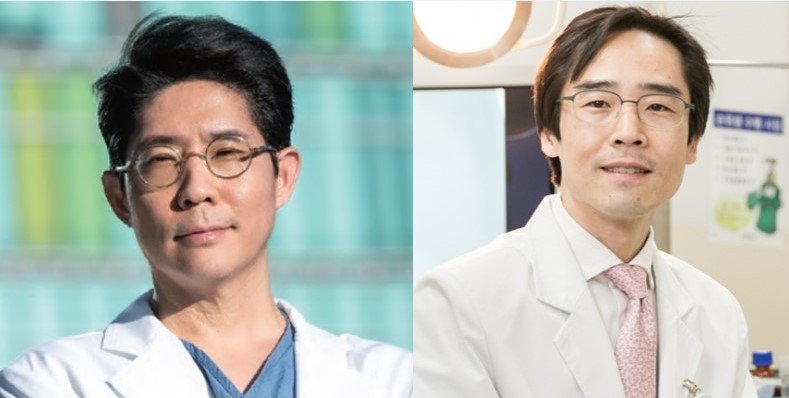
(From left) Professor Choi Byoung Yoon of the Department of Otorhinolaryngology at Seoul National University Bundang Hospital, Professor Kim Chang Hee of the Department of Otorhinolaryngology–Head and Neck Surgery at Konkuk University Medical Center
● Preservation of cell function does not immediately translate into eligibility for gene therapyThe present study assessed not the actual therapeutic effect of gene therapy, but whether outer hair cell function remains after cochlear implant surgery. The fact that cell function is preserved does not mean that these children can immediately receive gene therapy.
The sample size was small at 11 patients, and the study did not verify other requirements for gene therapy beyond outer hair cell function, indicating that further research is needed.
Professor Choi Byoung Yoon stated, “In the future, treatment for deafness is more likely to evolve into an approach that sequentially employs cochlear implants and gene therapy, depending on the patient’s genetic cause, age, and inner ear status, rather than choosing only one of the two,” adding, “In particular, if the potential for future gene therapy is taken into account, strategies to preserve cochlear structure and function as much as possible from the stage of cochlear implant surgery may become even more important.”
Professor Kim Chang Hee commented, “For children with OTOF-related deafness, it is realistically difficult to delay the early auditory rehabilitation needed for language development while waiting solely for gene therapy, whose long-term efficacy has not yet been fully established,” and added, “The significance of this study lies in showing that, even when cochlear implant surgery is performed early, there is a possibility that the physiological function of the cochlea can be preserved for a certain period.”
This study was published in the international journal “MedComm” and received the Best Oral Presentation Award at the 100th Annual Meeting of the Korean Society of Otorhinolaryngology–Head and Neck Surgery.
Related paper
Preservation of Distortion Product Otoacoustic Emission After Cochlear Implantation in Children With OTOF-Related Deafness
ⓒ dongA.com. All rights reserved. Reproduction, redistribution, or use for AI training prohibited.
Popular News