Infosys and Seoul National University Launch Development of Full-Scale “Drawing Recognition AI”
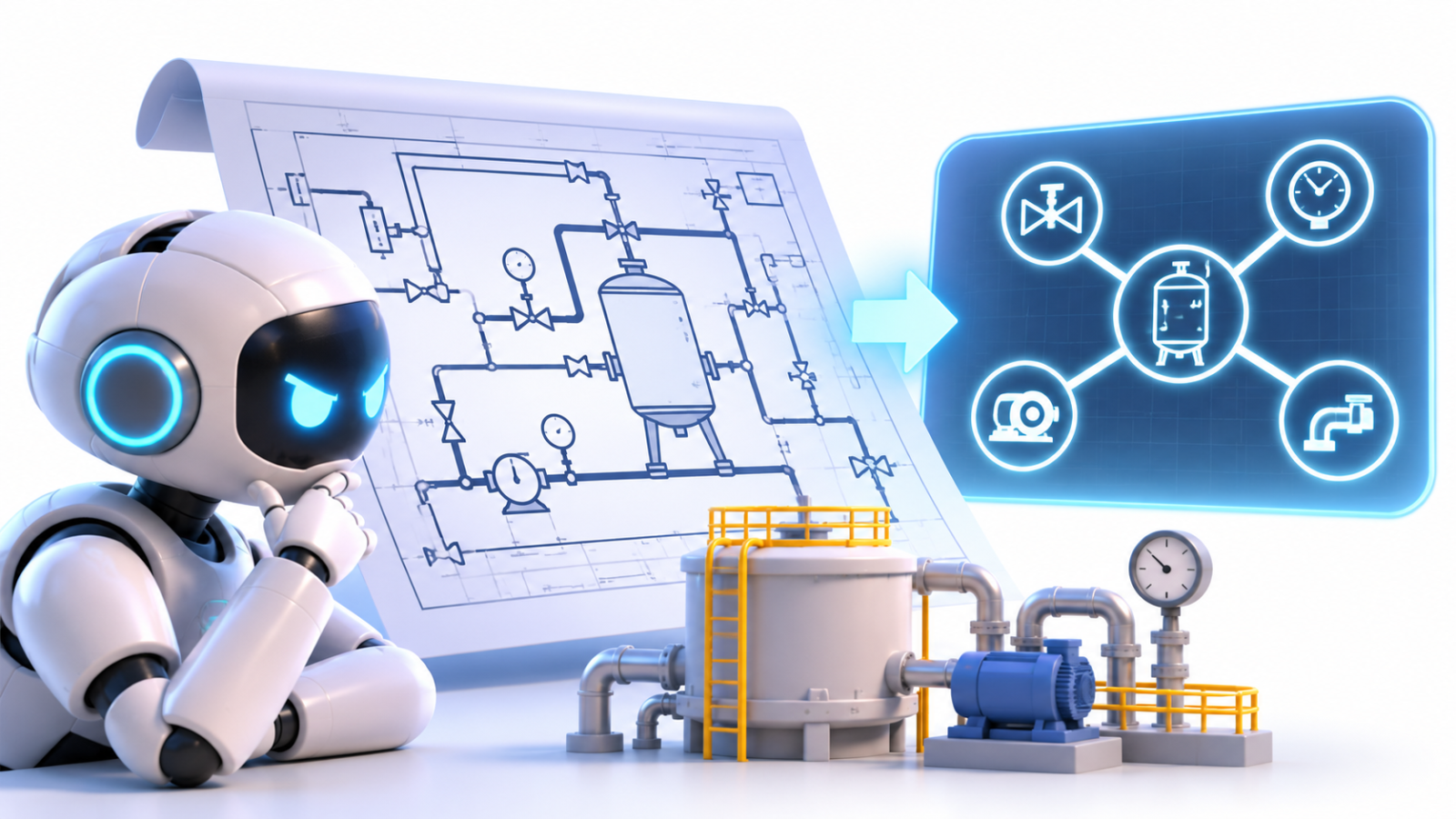
Infosys and Professor Kim Geon-hee’s lab at Seoul National University have launched joint AI research to read industrial drawings in a single pass without splitting them, identifying even the inter-equipment connection relationships. Image generated by ChatGPT
Domestic company Infosys and a Seoul National University research team have launched the development of artificial intelligence (AI) that can read industrial drawings in a single pass without breaking them into pieces.
On the 12th, Infosys (CEO Tak Jeong-su) announced that it has begun joint research with Professor Kim Geon-hee’s lab in the Department of Computer Science and Engineering at Seoul National University on “AI technology for full industrial drawing recognition.”
Infosys is a company that supports AI transformation (AX) for numerous industrial enterprises with its proprietary drawing recognition and ontology auto-conversion technologies.
Industrial drawing recognition has long been regarded as a technically demanding task. This is because it must read the overall context of an entire drawing, identify each of the numerous pieces of equipment, piping, and instrumentation, and determine how they are interconnected.
Until now, industrial sites have mainly used methods that recognize drawings by splitting them into multiple parts. With this approach, it is difficult to identify equipment connection relationships that span an entire drawing.
In fact, according to a 2024 study by the German Aerospace Center (DLR), the accuracy of connection-line detection using a method that separately identifies symbols and lines and then merges them was 45.89%, significantly lower than the 75.46% accuracy of a method that detects objects and connections together.
● Training on 20,000 real drawings… Learning a “single-glance” approach
The two sides are developing an “Image-to-Graph” foundation model using a whole-scale approach that processes the entire drawing as a single input. This model preserves the detailed information in high-resolution drawings while identifying connection relationships between symbols in the drawing and converting them into graph data.
They plan to start with piping and instrumentation diagrams (P&ID) that depict piping and instrumentation layouts, and then expand the analysis scope to single-line diagrams (SLD), control logic diagrams, and more.
Infosys is training the AI model on approximately 20,000 actual industrial drawings to teach it a variety of drawing structures and inter-equipment connection relationships.
The company’s drawing recognition solution “DELTAflow” is being used in the development. This solution is used by companies in sectors such as semiconductors, energy, refining, chemicals, and finance for impact analysis related to the introduction of new equipment and for design reviews.
Infosys plans to gradually apply the research results to DELTAflow, strengthening functions such as large-scale automatic drawing analysis and search, and comparison of drawing revision histories. In the long term, the company intends to link graph data extracted from drawings with corporate design, equipment, and operations data, and use it for workflow automation based on AI agents (AI that performs tasks on behalf of humans).
Tak Jeong-su, CEO of Infosys, said, “Having AI precisely understand the structure and connection relationships of entire industrial drawings remains an unresolved global technical challenge,” adding, “Through this joint research with Seoul National University, we aim to set a new technological benchmark in the field of industrial drawing recognition.”
Provided by Infosys
ⓒ dongA.com. All rights reserved. Reproduction, redistribution, or use for AI training prohibited.
Popular News