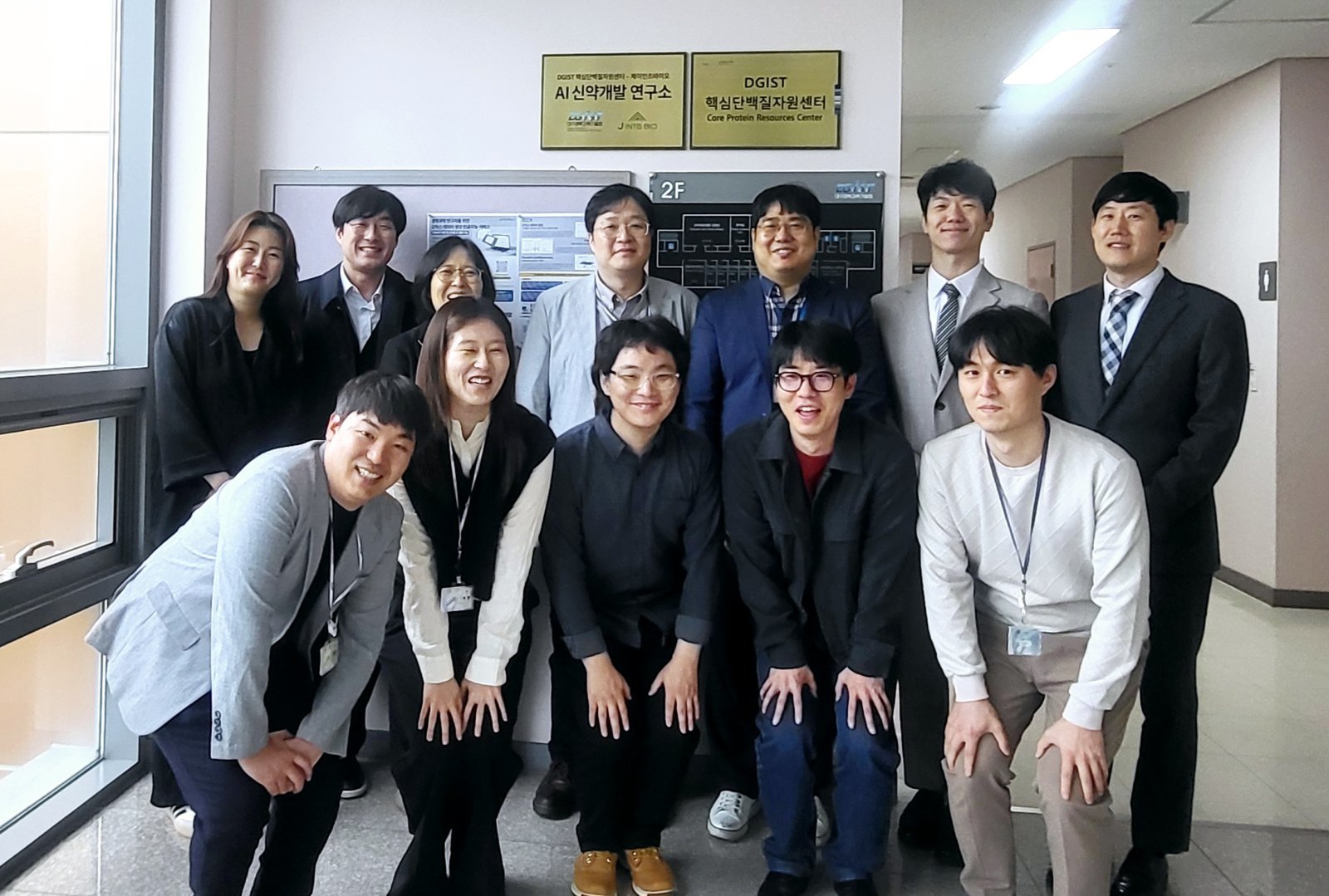
Researchers pose for a commemorative photo in front of the nameplate of the “AI New Drug Development Research Institute,” jointly established in 2024 by anticancer drug development company J-INTSBIO and the Core Protein Resources Center of the Daegu Gyeongbuk Institute of Science and Technology (DGIST). The two institutions are conducting research to discover next-generation targeted anticancer agents and new drug candidates by combining DGIST’s supercomputing infrastructure and AI platform. Provided by J-INTSBIO
Anticancer new drug developer J-INTSBIO has launched development of a new anticancer agent targeting “KRAS” mutation-positive lung cancer. KRAS is a protein that regulates cell growth, and certain mutations can cause continuous proliferation of cancer cells. The company has designed therapeutic candidate substances using its proprietary artificial intelligence (AI) new drug development platform “JIN-NOVA.” It plans to verify the efficacy of these substances and select those with superior effects for development as new drugs.
This research is part of the Ministry of SMEs and Startups’ “Scale-up TIPS Specialized Type” project. J-INTSBIO was selected for this project this year and will receive a total of KRW 3 billion in government research and development funding over three years. The company is leading the research, with DGIST and Yonsei University participating as co-research institutions. J-INTSBIO CEO Joanna Cho stated, “Based on our previous experience in targeted anticancer drug development, we aim to expand our development scope to mutation-positive lung cancer,” adding, “We plan to pursue development with the goal of obtaining Investigational New Drug (IND) approval in 2027.”
● Developing a therapy for G12D-mutant lung cancer with no existing treatmentsJ-INTSBIO is focusing on lung cancer with a “G12D” mutation in KRAS. G12D is the name of a mutation in which a specific part of the KRAS protein has changed. The company is developing a new therapy targeting cases in which this mutation appears in patients with non-small cell lung cancer, a type of lung cancer.
Even among KRAS mutations, available treatments differ by subtype. While a targeted therapy already exists for the G12C mutation, no lung cancer treatments specifically targeting the G12D mutation have yet been approved. Overseas, an oral therapeutic candidate targeting the G12D mutation has entered a global phase 2 clinical trial, but the number of drug candidates under development remains limited. J-INTSBIO aims to provide a new treatment option for patients with G12D-mutant lung cancer who currently have few therapeutic choices.
J-INTSBIO plans to carry out follow-up research to develop AI-designed candidate substances into actual drugs and submit an IND in 2027. An IND is a protocol submitted to regulatory authorities to test the efficacy and safety of new drug candidates in humans. Once approved by the relevant authorities, clinical trials can begin.
● Designing new drug candidates with AIJ-INTSBIO is using its proprietary AI platform “JIN-NOVA” in the process of discovering new drug candidates. JIN-NOVA analyzes the three-dimensional structure of the target protein on which the therapy will act and designs substances that can bind to it. It also uses computer simulations to predict whether the substance will be well absorbed in the body, how it will be metabolized, and whether it is likely to cause toxicity.
Candidate substances targeting the G12D mutation were also designed and selected through JIN-NOVA. Computer analyses indicated that these substances have a high potential to bind effectively to the target protein. The company also obtained positive predictive results regarding absorption and metabolism in the body and potential toxicity. Efficacy and safety will be verified through follow-up experiments. Patient genetic and protein data are also being utilized in AI-based drug development. A company representative said, “We plan to use multi-omics technology, which analyzes multiple types of biological data together, to examine what changes have occurred in cancer cells,” adding, “We will also use the data accumulated during the research process to improve the predictive accuracy of JIN-NOVA.”
● New drug candidate JIN-A02 in phase 1/2 clinical trials
J-INTSBIO has already been applying AI technology to the development of its existing lung cancer therapies. A representative example is the new drug candidate “JIN-A02.” This substance targets epidermal growth factor receptor (EGFR), a protein that receives cell growth signals. It is being developed for non-small cell lung cancer patients who have developed resistance to existing targeted therapies.
The research team is also using AI to search for drugs to be used in combination with JIN-A02. They analyzed changes in gene expression in cells treated with JIN-A02 and then used computer simulations to predict the responses when other drugs are combined. Based on these predictions, they narrowed down drug candidates for verification in further experiments. The results of this research were published as an abstract at the 2026 American Society of Clinical Oncology (ASCO) Annual Meeting.
JIN-A02 is currently undergoing phase 1/2 clinical trials. The company confirmed tumor-suppressing effects in cell and animal studies, and in early clinical trials observed tumor shrinkage in some patients. The related research results were published in 2026 in the international journal Clinical Cancer Research. A company representative said, “Depending on the outcomes of our new drug development programs, we plan to consider joint development and technology commercialization with domestic and overseas pharmaceutical companies.”
ⓒ dongA.com. All rights reserved. Reproduction, redistribution, or use for AI training prohibited.
Popular News