[Universities as Startup Architects] Medical Data Visualization Company ④ Visualterminology
Visualizing diagnosis, test, and surgery histories by body part
Already in practical use by medical staff at three Busan-area hospitals
Developing patient-facing services and expanding into personalized healthcare
[Joint Project by Pusan National University Holdings X Dong-A Ilbo] How do technologies born in university laboratories become businesses and advance into the global market? This series first examines the technology commercialization strategy and startup support model of Pusan National University Holdings, and then, through the stories of five deep-tech companies challenging the global market together with PNU Holdings, sheds light on how university research outcomes are translated into businesses and explores the potential of lab-based startups.
Choi Byung-kwan, CEO of Visual Terminology. Provided by Visual Terminology
“In the clinical setting, I felt there were limits to how medical information is expressed when listening to patients’ symptoms and recording them.”
When a patient visits a hospital and says, “I can feel a lump near my cheekbone,” medical staff must check exactly where the lump is located, as well as its size and shape. If this is simply recorded in the medical chart as “a lump around the cheekbone,” it becomes difficult for other medical staff later reviewing the record to know the precise location and condition of the lesion. As a result, they may have to ask the patient about the symptoms again or check additional materials.
To address this problem, Choi Byung-kwan, a professor of neurosurgery at Pusan National University Hospital and CEO of Visual Terminology, has been researching ways to effectively express and utilize medical information. He has filed several related patents while exploring technologies that can complement the limitations of spoken and written language. Concluding that commercialization would be necessary to apply his research results to actual clinical settings and services, he founded Visual Terminology in 2019 upon the recommendation of Pusan National University’s Industry-Academic Cooperation Foundation.
● Embedding medical records in a 3D human body modelA patient’s medical record accumulates various information such as diagnoses, test results, and surgical history. However, for medical staff to understand the patient’s condition, they must review multiple records one by one and check which part of the body each piece of information is related to.
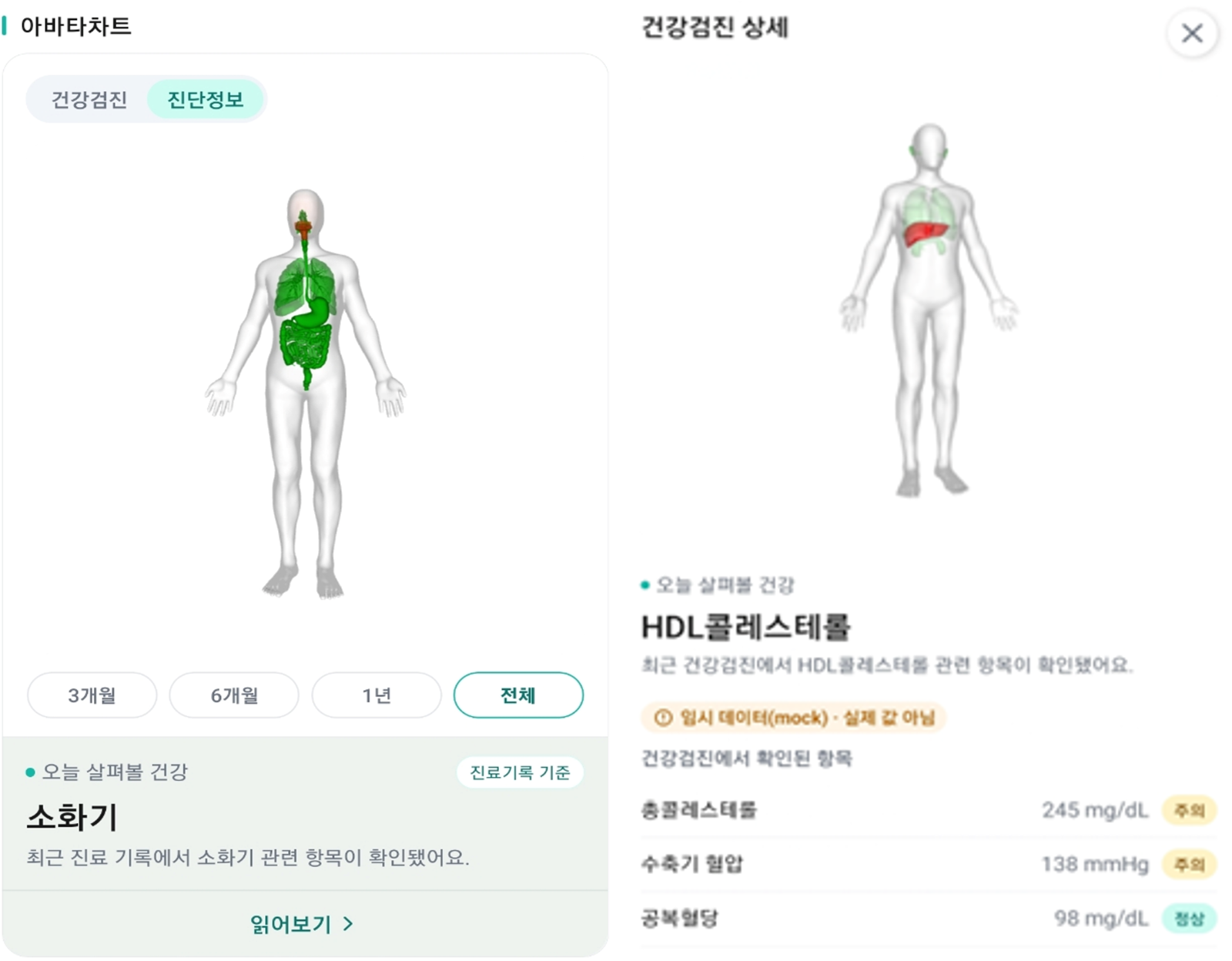
AVATAChart, developed by Visual Terminology, is a service designed to reduce such inconvenience. It links and displays a patient’s diagnoses, test results, surgical history, and other information on a 3D human body model. Instead of checking each record individually, medical staff can review relevant information by body part.
Choi focused on a 3D human body model because it can represent the body’s three-dimensional structure. Unlike flat illustrations, it allows the position of body parts and the size and shape of lesions to be expressed and compared from multiple angles. Choi said, “A 3D model is not just a drawing but a three-dimensionally expressed model in mathematical terms,” adding, “It can be used to represent in detail and to compare or analyze the position of body parts and the size and shape of lesions.”
The process of linking medical records to a 3D model was not simple. There is a large difference in difficulty between creating an individual body part and implementing the entire human body in a way that is anatomically consistent. Even minor structural errors can lead to incorrectly expressed medical information, so meticulous review was required. To this end, medical experts and 3D modeling experts worked together, and the model was repeatedly reviewed and revised with advice from faculty members in anatomy.
Currently, medical staff at three major hospitals in the Busan area are using AVATAChart to review patient information. Visual Terminology has also developed AVATAChart for general patients to view their own health information.
However, to commercialize the patient-facing service, personal medical information scattered across multiple medical institutions must be interconnected. The company expects that as environments enabling individuals to view and use their own medical information expand through government initiatives such as the “My Healthway” health information highway project, the potential use cases for patient-facing services will also grow.
AVATAChart displaying diagnostic information and health checkup results. Provided by Visual Terminology
● From PNU startup support to TIPSThe founding of Visual Terminology began with a recommendation from the Pusan National University Industry-Academic Cooperation Foundation. The foundation focused on Choi’s research track record of filing and registering more than 30 domestic patents related to medical information processing systems since 2010. It also determined that the issues Choi experienced as a clinician were common across other medical professionals and medical institutions, and that the technology to address them had strong potential for business expansion. Accordingly, it jointly pursued a startup as a subsidiary of Pusan National University Holdings and transferred a total of seven patented technologies—five domestic patents and one each from the United States and Japan—leading to the establishment of Visual Terminology.
Pusan National University Holdings laid the initial foundation for Visual Terminology’s launch, from business model (BM) design to a U-Tech guarantee and investment linkage through the Korea Technology Finance Corporation, the recruitment of a Chief Strategy Officer (CSO) and team formation, and securing startup incubation space. In doing so, it supported the full-cycle commercialization process from intellectual property (IP) discovery to technology startup.
Subsequently, it expanded the scope of support to the research and development stage through seed investment from its own early-stage fund and by linking the company to TIPS (Tech Incubator Program for Startups). Visual Terminology was selected for TIPS, a Ministry of SMEs and Startups technology startup support program, securing a total of KRW 500 million in R&D funding over two years. Based on this funding, the company is currently developing new services that leverage its medical information processing technologies.
● Expanding medical information use beyond hospitalsVisual Terminology also aims to use its technologies for analyzing and standardizing medical information in recommending health-related products. For example, it plans to recommend exercise content or assistive devices suitable for users with knee disorders. To this end, it is developing a platform that allows health product sellers to register product information and link it to related medical information such as diseases and body parts.
The company plans to supply this technology to healthcare and commerce companies in the form of solutions and APIs. Its goal is to enable individual companies to recommend products and content tailored to users’ health conditions without having to analyze medical information themselves or build their own disease classification systems.
Hwang Sung-jin, head of the R&D team at Visual Terminology, said, “Our current goal is to develop the medical information processing technologies accumulated so far into businesses that can be applied in the actual market,” adding, “Over the next two to three years, we plan to focus on advancing the technology and completing it as a product registration and recommendation solution that healthcare and commerce companies can actually use.”
ⓒ dongA.com. All rights reserved. Reproduction, redistribution, or use for AI training prohibited.
Popular News