Chairman Jang In-hwa to foster three core businesses in steel, strategic resources, and energy…KRW 29.1 trillion to be invested by 2028
Unveils electric arc furnace, lithium, cathode materials, battery recycling, and rare gas production facilities in Gwangyang…processes managed with automated equipment
Securing critical mineral supply chains and expanding LNG business…group revenue target of KRW 187 trillion by 2035
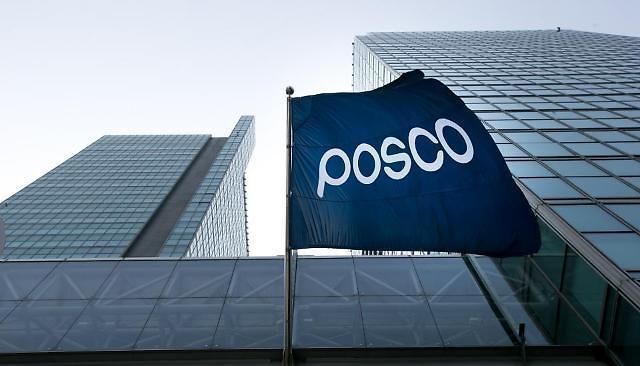
Panoramic view of POSCO headquarters. Courtesy of POSCO Holdings.
The Gwangyang works of POSCO Group, which previously focused on steel production, is being expanded into a core resource production hub encompassing lithium, secondary battery materials, rare gases, and liquefied natural gas (LNG). Key production facilities in Gwangyang, unveiled on 2 November, included not only the existing steel mill, but also a lithium refining plant, cathode material production facilities, an end-of-life battery recycling plant, and rare gas production facilities for semiconductors.
Under Chairman Chang In-hwa’s “Triple Core” strategy, POSCO Group is reinforcing its strategic resources and energy resources businesses with steel as the foundation.
On this day, POSCO Group opened the Gwangyang Steelworks and major affiliate production facilities to the press and presented the status of business implementation under the Triple Core strategy.
The Triple Core strategy, announced by Chairman Chang at the “CEO Investor Day” on 2 July, is a plan to foster steel as industrial resources, lithium/cathode material/anode material/rare earths as strategic resources, and LNG/renewable energy as energy resources. The concept is to leverage the technology and business base accumulated around steel production to expand business areas to the securing, processing, and supply of core resources.
To this end, POSCO Group will invest a total of KRW 29.1 trillion from 2026 to 2028. Of this, KRW 16.7 trillion is earmarked for growth investment, including KRW 6.7 trillion for overseas steel business, KRW 2.4 trillion for the lithium business, KRW 1.3 trillion for cathode and anode materials, and KRW 3.1 trillion for LNG and renewable energy businesses.
At the briefing session, Choi Dong-young, Head of POSCO’s Corporate Strategy Office, outlined plans to strengthen competitiveness in steel and secondary battery materials while expanding resource businesses in response to global supply chain instability and intensifying protectionism.
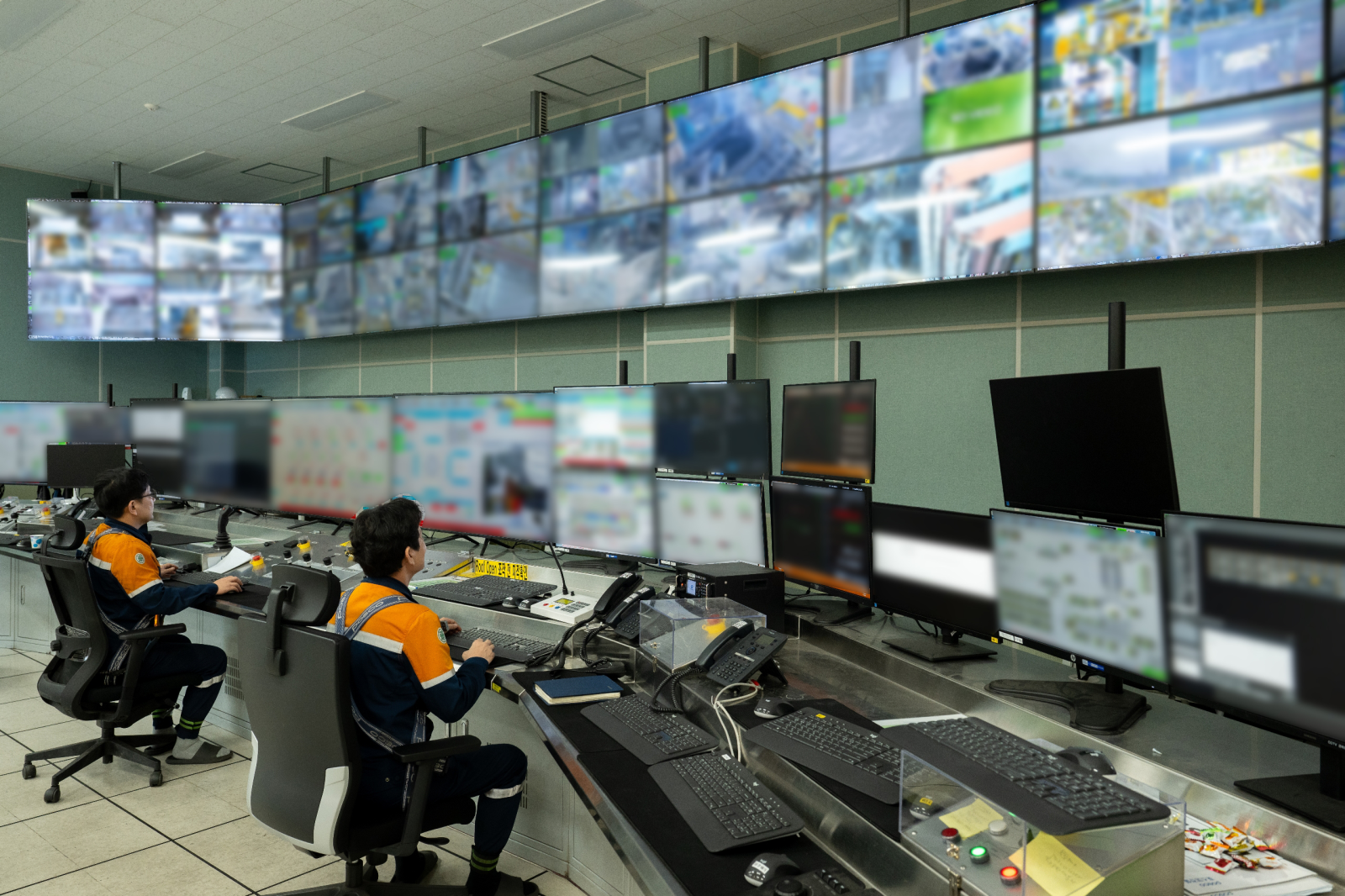
Control room of the electric arc furnace plant at Gwangyang Steelworks. Courtesy of POSCO Holdings.
● Gwangyang Steelworks covering 6.67 million pyeong…operation of low-carbon electric arc furnace and expansion of high value-added steel
As of 2019, Gwangyang Steelworks covers approximately 6.67 million pyeong, about 7.7 times the size of Yeouido. It is a large-scale integrated steelworks with an annual crude steel production capacity of about 20 million tons, operating a continuous production system from ironmaking and steelmaking to continuous casting and rolling. According to on-site explanations, about 15,000 people are normally stationed at the site, with the number of personnel increasing to around 30,000 during large-scale maintenance and construction periods.
The electric arc furnace plant visited on the day is a low-carbon steel production facility with an annual capacity of 2.5 million tons, completed on 17 June following an investment of about KRW 600 billion by POSCO.
Shin Jong-hun, Head of the Electric Arc Furnace Plant at Gwangyang Steelworks, introduced the scrap bay, which serves as a storage facility for steel scrap, the electric arc furnace control room, and the alloying technology that mixes hot metal from blast furnaces with molten steel from the electric arc furnace.
The scrap bay is divided into six bays and 12 storage sections. The electric arc furnace adopts the “Consteel” technology of Italy’s Tenova, which continuously charges and preheats steel scrap before melting it with arc heat.
The control room is equipped with a system that precisely controls electrode and arc conditions. POSCO plans to mix molten steel produced by the electric arc furnace with blast furnace hot metal to reduce carbon emissions while expanding production of high-grade steel such as automotive steel sheets.
Gwangyang Steelworks will bolster production competitiveness by focusing on steel materials for future mobility, while Pohang Steelworks will focus on steel materials for energy applications. Overseas, POSCO is pursuing a joint venture steelworks with JSW in India, with an annual capacity of 6 million tons, and is participating in an electric arc furnace steelworks project in Louisiana, USA, with Hyundai Motor Group, with an annual capacity of 2.7 million tons. POSCO Group plans to expand its overseas crude steel production capacity to around 10 million tons per year by 2031.
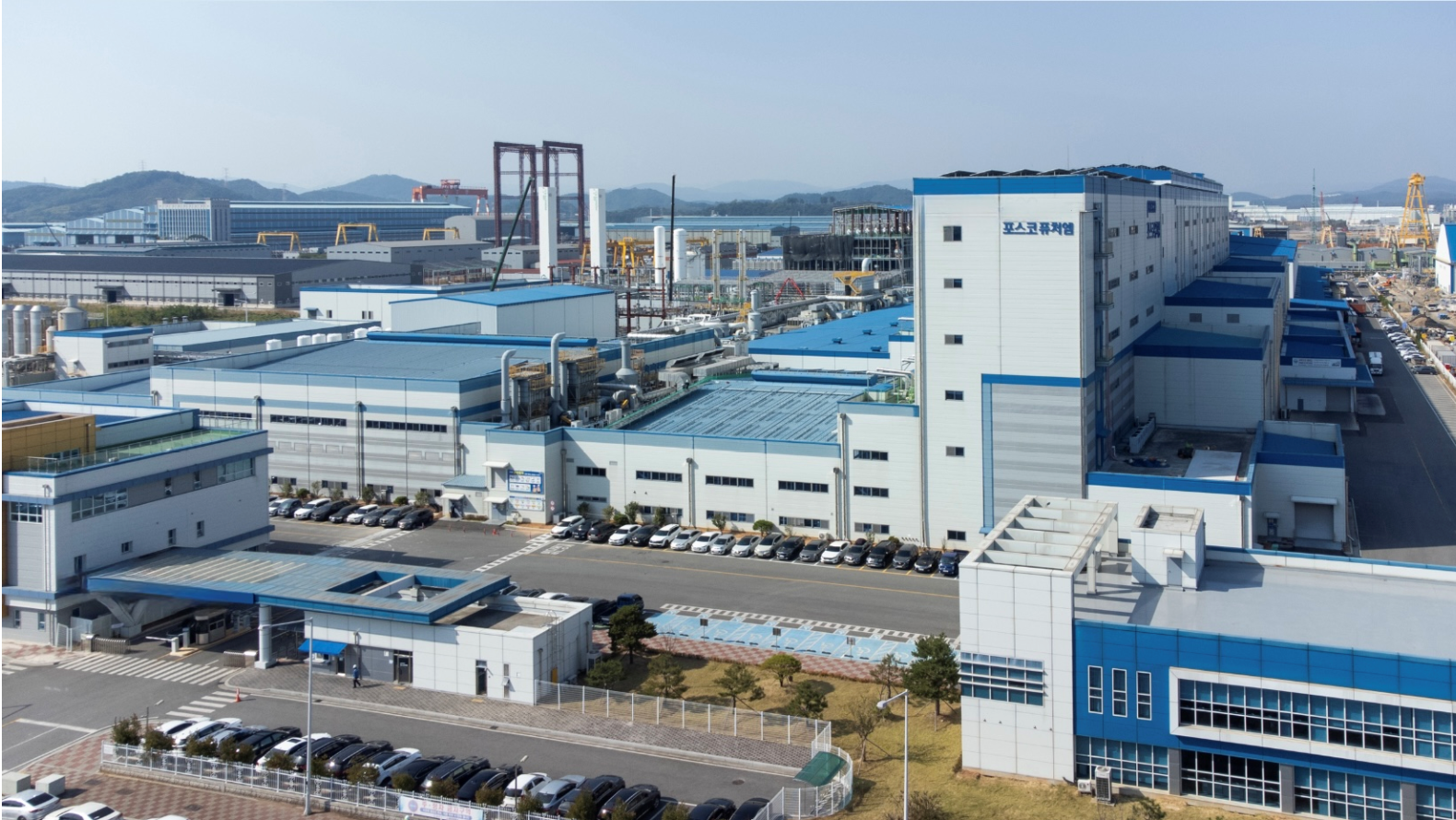
Panoramic view of the POSCO Future M Gwangyang cathode materials plant. Courtesy of POSCO Holdings.
● From Australian ore to battery materials…establishment of lithium and cathode production facilities
In the strategic resources segment, the sites visited were POSCO Pilbara Lithium Solution and the POSCO Future M Gwangyang cathode materials plant.
POSCO Pilbara Lithium Solution processes spodumene ore imported from the Pilbara region of Australia to produce lithium hydroxide, a secondary battery material. With the completion of its second plant in November 2024, it has established an annual production system of 43,000 tons.
At the plant, the ore is processed at high temperatures of around 1,000 degrees Celsius, lithium is extracted using sulfuric acid, and then refined and crystallized after removing impurities. Two production lines apply different extraction technologies. The first plant uses electrodialysis technology that employs ion-exchange membranes and electric power, while the second plant uses a chemical separation process based on sodium hydroxide. POSCO is building operational know-how by comparing productivity and cost between the two processes.
At the POSCO Future M Gwangyang cathode materials plant visited next, strict foreign particle control procedures had to be followed even before entering the production facilities. Visitors were required to wear hair covers and shoe covers and pass through an air curtain to remove external dust before entering the plant interior. Notices were posted throughout the site warning against foreign particle contamination, and related guidelines were emphasized to employees.
This level of control is necessary because a single small metallic foreign particle can lead to large-scale production losses. Plant manager Jeong Jae-yong explained that if non-magnetic metallic foreign particles such as copper (Cu) and zinc (Zn) are introduced, they can affect about 4.5 tons of cathode material, resulting in losses of at least KRW 100 million.
The Gwangyang cathode materials plant, with an annual capacity of 90,000 tons, produces cathode materials by mixing precursors with lithium, then heat-treating them in a calcination furnace, followed by pulverizing, washing, and drying. Automation equipment is applied to key processes such as raw material input and transfer and heat treatment.
In the on-site analytical facilities, the physical and particle properties of raw materials and the presence of impurities are examined, and coin cells the size of a coin are fabricated for battery performance evaluation. Some analysis rooms maintain a dry environment with a dew point of minus 73 degrees Celsius, forming a quality control system designed to block the inflow of moisture and foreign particles.
POSCO Group aims to leverage brine resources in Argentina and mines in Australia to expand its lithium production capacity to 173,000 tons per year by 2033 and enter the global top five.
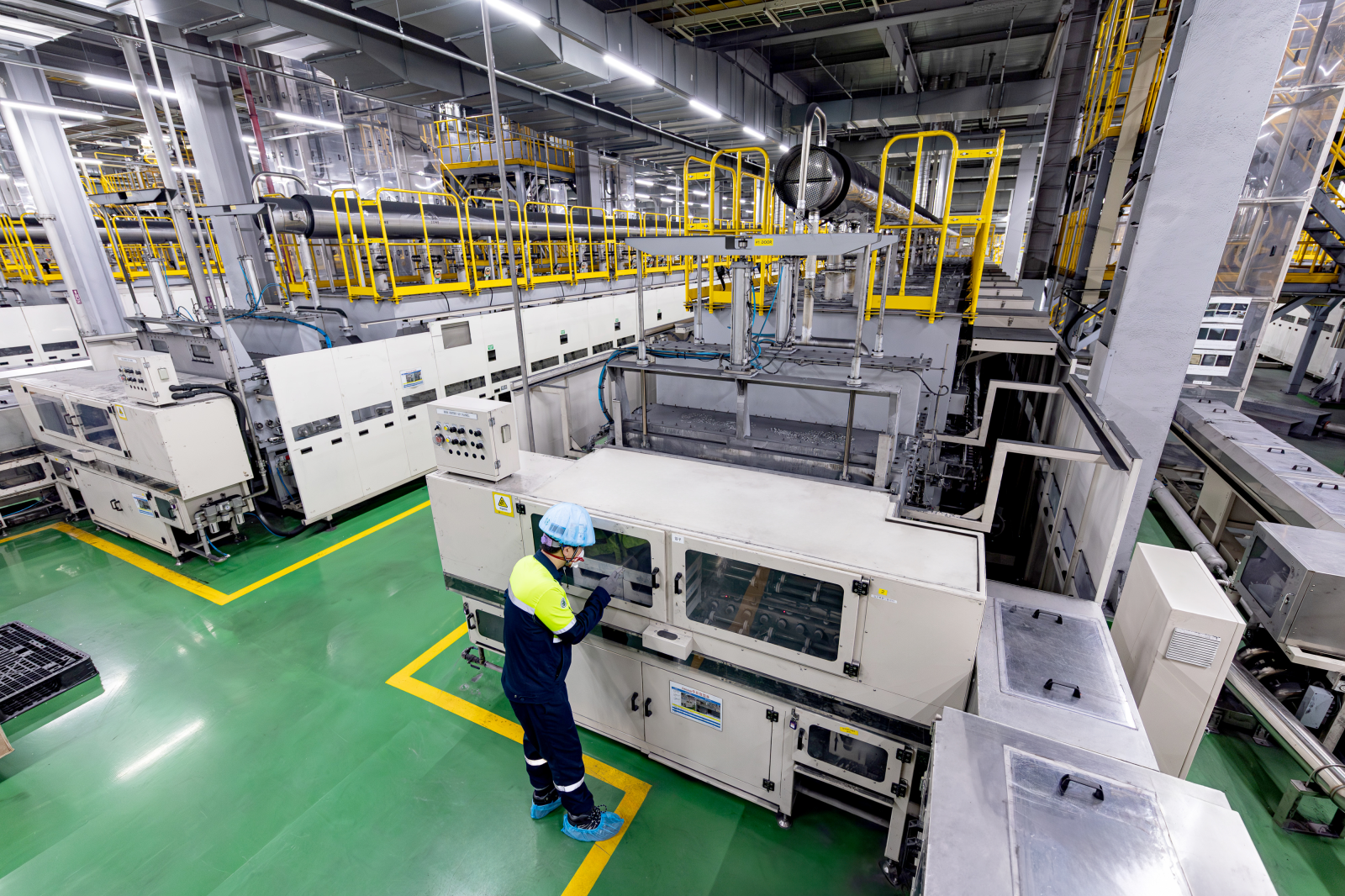
A worker inspects high-temperature heat treatment equipment used in active cathode material production at the POSCO Future M Gwangyang cathode materials plant. Courtesy of POSCO Holdings.
● Recycling end-of-life batteries and localizing rare gases…expansion of the strategic resource supply chain
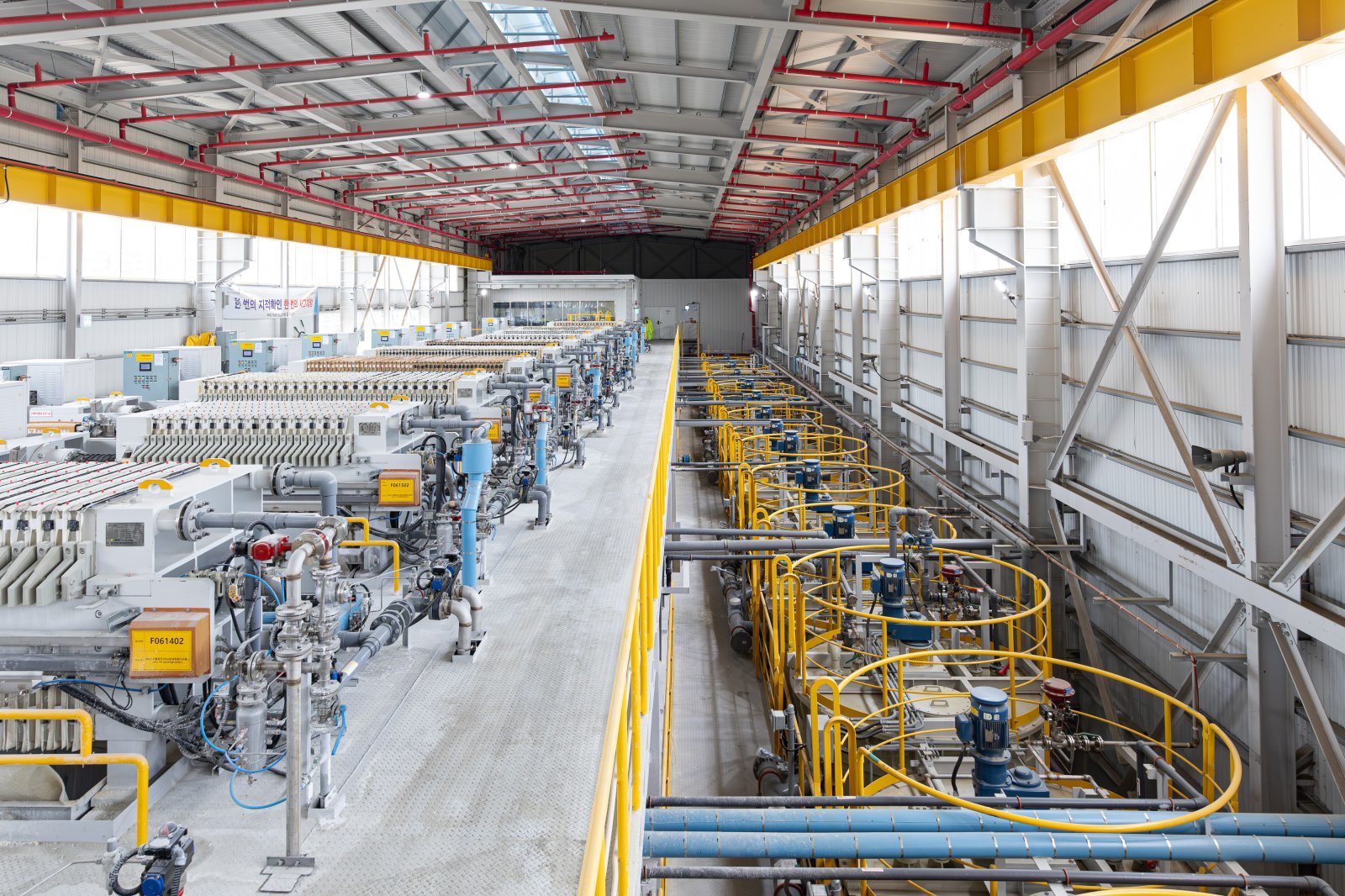
At POSCO HY Clean Metal, the processes for recovering valuable metals such as lithium, nickel, and cobalt from end-of-life batteries were examined.
Plant manager Song Kyu-young explained the production process from component analysis of black mass, a recycled raw material, through leaching, separation, refinement, and crystallization.
The plant is equipped with leaching facilities, which dissolve raw materials in acidic solutions to extract metals, and solvent extraction facilities, which separate metallic components. According to on-site explanations, the solvent extraction process consists of nine circuits and about 330 stages, through which lithium carbonate, nickel sulfate, cobalt sulfate, and manganese sulfate are produced.
POSCO Group plans to increase its battery recycling processing capacity from 12,000 tons per year in 2026 to 72,000 tons per year by 2035.
The rare gas production facility POSCO Air Solution was also unveiled on the same day. Established in 2024, POSCO Air Solution began test operations in November last year, shipped its first products in May this year, and held its plant completion ceremony in June.
The facility produces rare gases such as xenon, krypton, and neon—essential for the semiconductor and aerospace industries—by utilizing feed gas secured during the oxygen production process at the steelworks. Production capacity stands at 130,000 Nm³ per year.
Bae Sang-bok, Team Leader of Production at POSCO Air Solution, introduced processes that remove impurities from the feed gas and separate and refine high-purity gases by using differences in boiling points.
The plant is equipped with an automated control system that manages about 1,000 measurement points, while the analytical laboratory tests for the purity and quality levels required by customers.
POSCO Group plans to expand its strategic resources business beyond lithium and cathode/anode materials to include rare earths and rare gases, thereby strengthening its supply base for advanced industrial materials.
Production facilities installed in the lithium carbonate production building of POSCO HY Clean Metal. Courtesy of POSCO Holdings.
● Expansion into LNG…aim to become a “national core resource supplier”
In the energy resources segment, POSCO International’s second LNG terminal in Gwangyang will be completed on 10 November. The Gwangyang LNG Terminal, which began commercial operation in 2005 as the first privately operated LNG terminal in Korea, has expanded its storage capacity from 930,000 kL to 1.33 million kL with the completion of the first terminal in 2024 and now the second terminal. This is sufficient to store approximately 600,000 tons of LNG, which, according to POSCO International, is enough to supply heating gas for the entire population of Korea for about 40 days.
The second terminal is equipped with two 200,000 kL-class LNG storage tanks, berthing and unloading facilities for large LNG carriers, and bunkering facilities for supplying marine fuel. POSCO Group plans to expand the Gwangyang LNG Terminal’s storage capacity to 1.8 million kL by 2031.
Based on the Gwangyang LNG Terminal, POSCO Group is expanding its overseas gas field development, LNG transportation and trading, and power generation businesses. It plans to increase LNG handling volume from 1,822,000 tons in 2025 to 6,347,000 tons by 2031, and during the same period aims to achieve KRW 9 trillion in energy segment revenue and KRW 1.4 trillion in operating profit.
ⓒ dongA.com. All rights reserved. Reproduction, redistribution, or use for AI training prohibited.
Popular News