[Agriculture for All, Growing Korea Together] Three Key Policies of the Ministry of Agriculture and Food Deliver Results on the Ground
10 Counties with Basic Income Payments See 5% Population Increase
From Production Areas to Wholesale Markets to Consumers… Streamlining Distribution Across All Stages
Grape Exports Jump 54%… Ramen Up 25%, Strawberries 15%, Targeting USD 16 Billion in ‘K-Food+’ Exports This Year
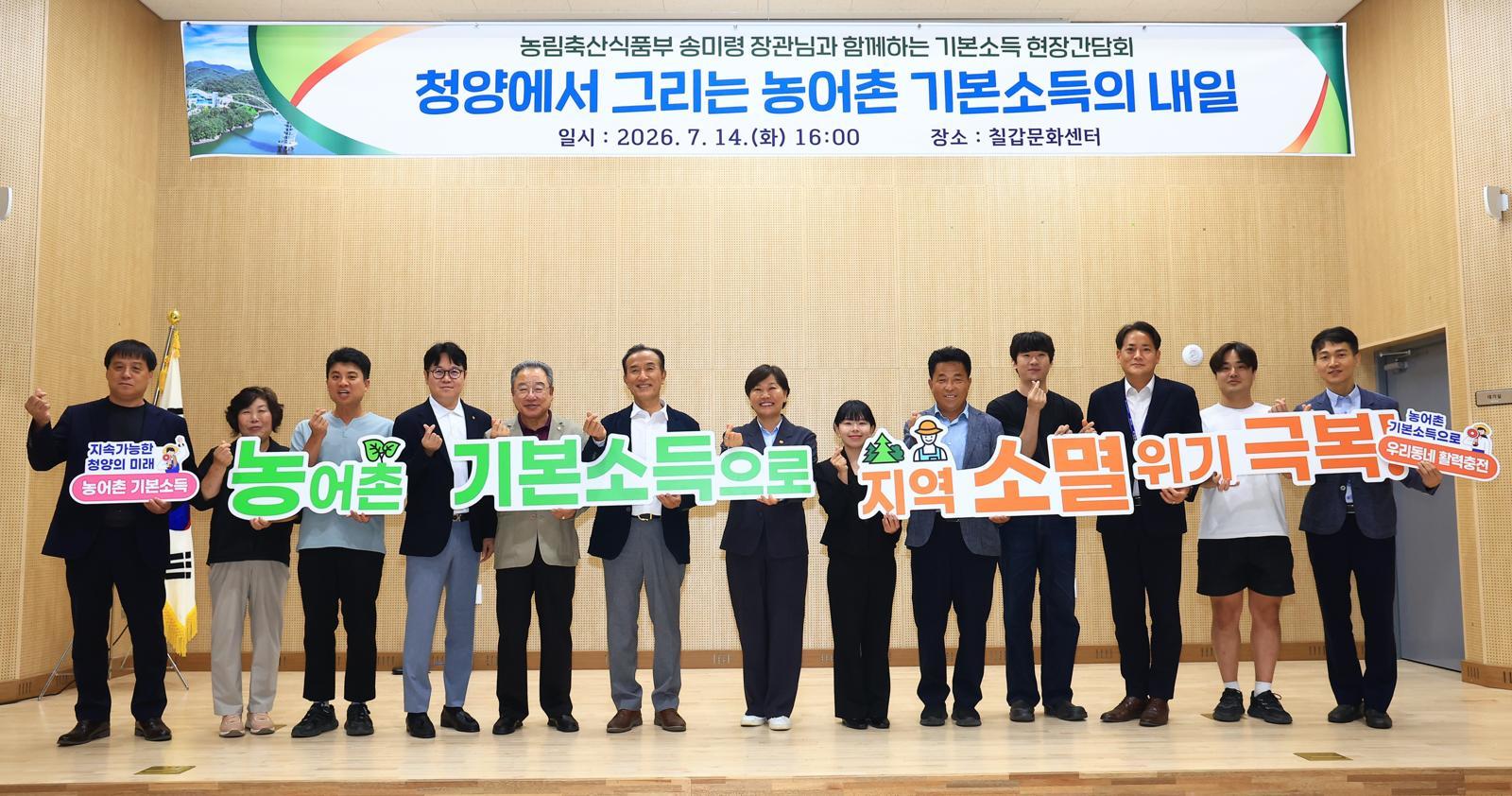
Minister of Agriculture, Food and Rural Affairs Song Mi-ryeong visits Daechi-myeon, Cheongyang-gun, Chungcheongnam-do, one of the regions implementing the pilot project for basic income in rural and fishing communities, on July 14 to inspect the progress of the project and hold an on-site meeting with local resident representatives, followed by a commemorative photo. Provided by the Ministry of Agriculture, Food and Rural Affairs.
People are returning to rural areas, the route from production sites to the table is shortening, and Korean agri-food products are expanding into global markets.
The Ministry of Agriculture, Food and Rural Affairs’ key initiatives this year—the pilot project for basic income in rural and fishing communities, improvements to the agricultural product distribution structure, and expansion of K-food exports—are delivering measurable results on the ground. In counties suffering from population decline, both residents and businesses are increasing, while production areas and wholesale markets are using artificial intelligence (AI) and online trading to reduce distribution costs. “K-Food+ (Plus) exports,” which include not only agri-food but also agricultural industries, are continuing to post record-high performance and aim to reach USD 16 billion (about KRW 21.5 trillion) this year.
KRW 150,000 per month in basic income… Rural areas see rising population and start-ups
The pilot project for basic income in rural and fishing communities aims to stabilize the income of residents in areas facing population extinction and to revitalize local economies. Residents who are registered in the relevant county and have resided there for at least 30 days receive KRW 150,000 per person each month in local gift certificates. The project will be implemented for two years from this year through 2027, starting with 10 counties where payments began first, and from August an additional 7 counties were added, bringing the total to 17 counties nationwide. In principle, the income must be used within the area of residence so that the basic income flows into local stores and service industries.
As of the end of September, the registered population in the 10 counties that started the project first was 335,044, an increase of 16,039 people (5.0%) from 319,005 in the month prior to project selection. The population aged 39 and under also rose 6.1%, from 73,844 to 78,341 over the same period. The number of affiliated merchants increased 17.3%, from 14,253 at the beginning of January this year to 16,716 in September, and 833 new businesses were launched between January and September. Businesses closely tied to residents’ daily lives account for the majority, including 393 restaurants and 246 retail stores.
On the ground, initiatives are emerging to fill gaps in everyday services. Yeoncheon-gun in Gyeonggi-do operates a mobile market truck called “Haengbokmacha” that delivers fresh food to village halls and other locations in township areas with a shortage of stores. In Beonam-myeon, Jangsu-gun, Jeollabuk-do, a young returnee to the countryside opened the area’s only hair salon, and in Cheongyang-gun, Chungcheongnam-do, the “Jumin-sim Bureomkkun” project supports seniors with grocery shopping and household repairs. In Sunchang-gun, Jeollabuk-do, a residents’ cooperative runs pop-up markets and events for sales and experiences of local agricultural specialties. Further analysis is needed to determine whether the increases in population and affiliated merchants are solely the effect of basic income, but changes are evident as the living infrastructure supporting local consumption widens.
Promoting competition among wholesale corporations and growing online wholesale markets… Trimming distribution fat inside and out
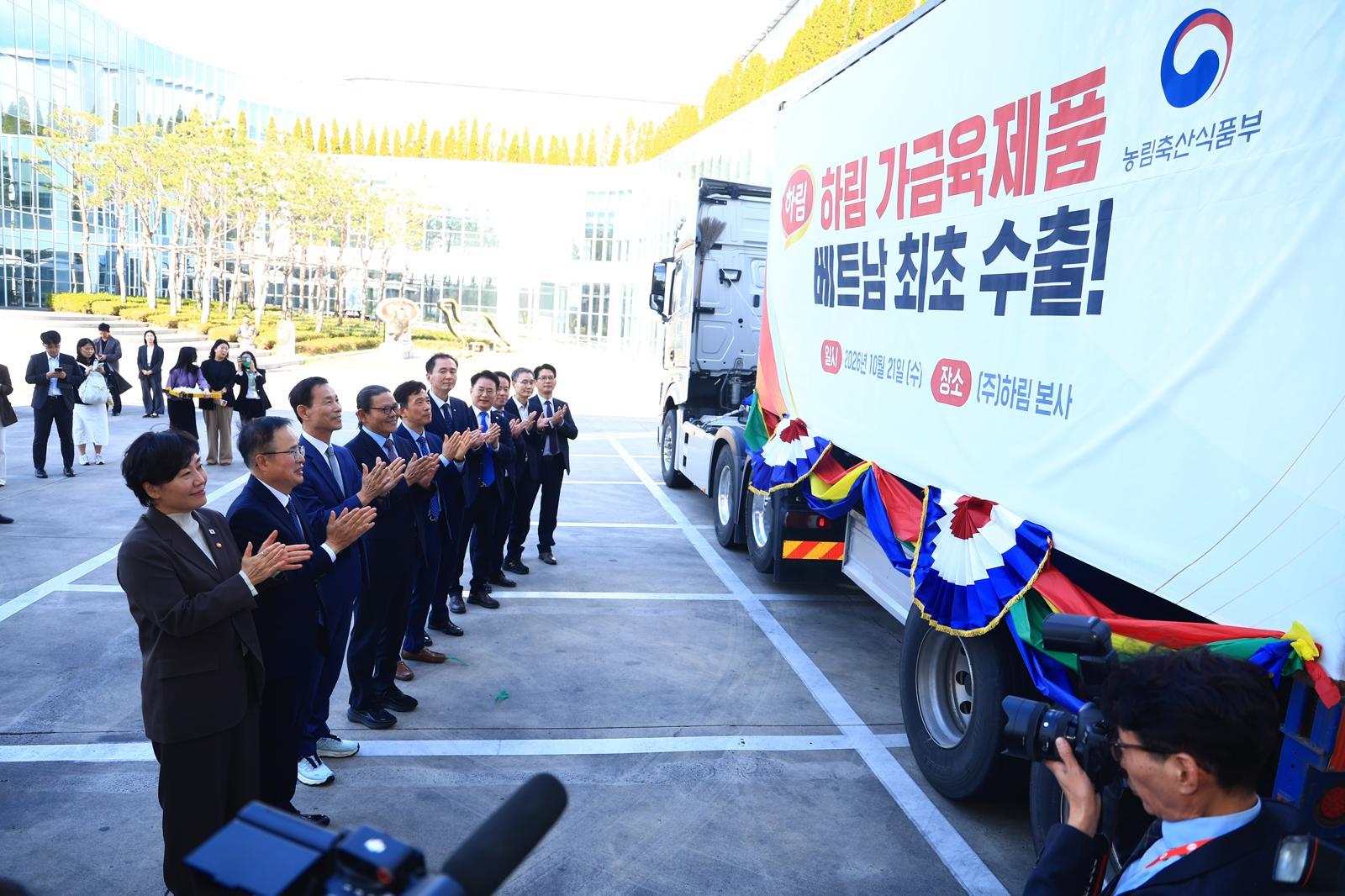
Exports of K-processed chicken products to Vietnam became possible following the conclusion of sanitary and phytosanitary (SPS) negotiations on heat-treated poultry meat, which were agreed upon on the occasion of the Korea–Vietnam summit in April 2026. On October 21, Minister Song Mi-ryeong attended the first shipment ceremony for K-processed chicken products to Vietnam held at Harim Co., Ltd. in Iksan, Jeollabuk-do, to encourage stakeholders and personally check the loading of the initial export volume.
The Ministry of Agriculture, Food and Rural Affairs is pursuing reforms at the production, wholesale, and retail stages with the goal of reducing agricultural product distribution costs by 10% by 2030. In production areas, it is expanding smart Agricultural Products Processing Centers (APCs) equipped with automation facilities to ease labor burdens and strengthen quality control. The number of smart APCs is planned to rise from 60 last year to a cumulative total of 115 this year.
A representative case is the Wolhang Nonghyup APC in Seongju-gun, Gyeongsangbuk-do. Its AI sorter takes 24 photos of each Korean melon, examines 26 external appearance items, and checks weight and sugar content to classify grades. According to Wolhang Nonghyup data, the sorting workforce was reduced from 34 to 19 people, with labor cost savings estimated at about KRW 270 million. Daily processing capacity increased 60%, from 100 tons to 160 tons. Member farms’ income also rose by up to 5%. This is a case that improves the efficiency of commercializing agricultural products while responding to labor shortages.
In wholesale markets, regulatory improvements have been made to promote competition among corporations and protect shippers. Measures now allow for cancellation of designations of underperforming wholesale corporations, public recruitment and designation of new corporations, and recommendations to adjust commission fees when operating profits are excessive. At the Garak Market in Seoul, a scheme has been introduced to compensate for the difference when auction prices fall below shipping costs, including packaging and transportation. From January to September this year, a total of KRW 1 billion was provided to 440 producers of 66 items, including Shine Muscat grapes and onions.
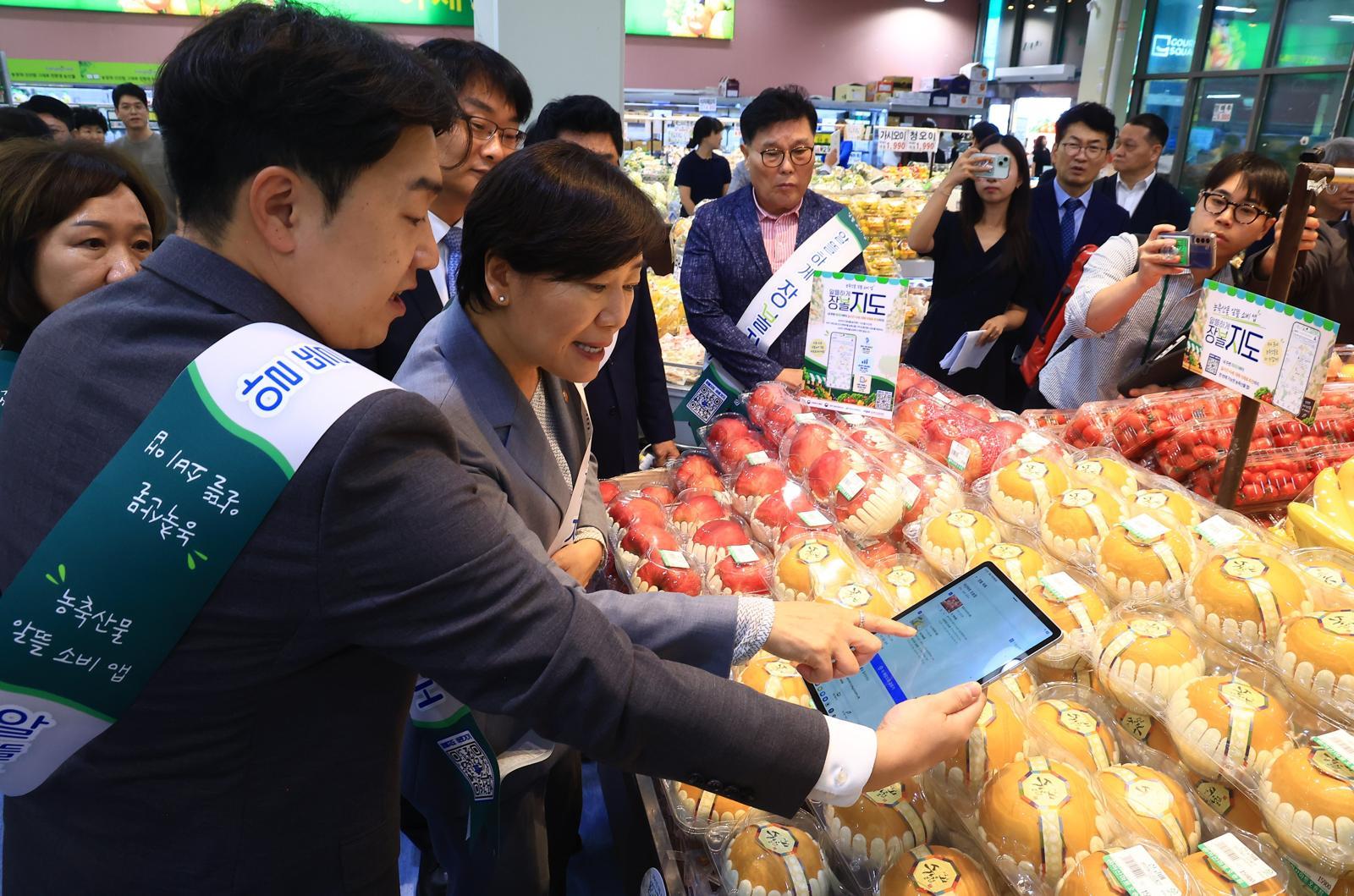
The online wholesale market is also emerging as a channel to reduce distribution costs. As of the end of October this year, transaction value rose 39.9% compared with the same period last year. In a 2025 analysis of fruit and vegetable transactions presented by the Ministry, the distribution cost ratio in the online wholesale market was 11.1 percentage points lower than that of traditional transactions, while farmers’ receipts were 5.1% higher. In September, four hub logistics centers were established in Icheon, Daegu, Gwangju and Gangneung to support joint delivery. For consumers, the “Alteulhage Jangboljido” app, launched in September, allows users to compare prices and discount information for agricultural products at nearby supermarkets and uses AI to recommend the optimal place to shop for an entire cart. It is currently being piloted in five regions, with nationwide commercialization targeted for the second half of 2027.
Grape exports targeting USD 100 million… First entry of K-processed chicken products into Vietnam
A commemorative event was held at OSCO in Cheongju to mark the pilot launch of the “Alteulhage Jangboljido” app, which provides price information on fresh agricultural and livestock products at nearby stores based on consumers’ locations. After the ceremony, a visit was made to the Asan Mart Osong branch in Cheongju to promote consumer downloads of the app and to conduct an event comparing the app’s price information with actual prices of agricultural and livestock products to verify information accuracy.
In the January–September period this year, exports of agricultural, forestry, livestock and food products amounted to USD 8.1319 billion, up 4.6% year-on-year. Exports of ramen reached USD 1.4122 billion, an increase of 25.5%; grapes USD 56.3 million, up 54.6%; and strawberries USD 61 million, up 15.4%. Exports of rice-processed foods totaled USD 220.9 million, up 5.0%, and sauces USD 321.3 million, up 3.3%.
The Ministry of Agriculture, Food and Rural Affairs is working to achieve USD 100 million in grape exports, which would be the first time a single fresh agricultural product attains that level. Under the “GRAPE Strategy,” announced in Sangju, Gyeongsangbuk-do in October, 12,000 tons, or 93% of the target volume, has been pre-secured, and the number of quarantine orchards for exports to the United States has been expanded from 31 to 41.
Producers and exporters have also signed a “win-win standard contract” that clarifies settlement terms and quality standards. Support for cold-chain distribution and logistics costs will be strengthened, and quarantine will be offered on weekends and holidays to support exports during the peak season from October to December. The plan is to target major retail chains in the United States and expand sales channels to the premium gift market in Taiwan and emerging ASEAN markets.
New export achievements are also emerging in the livestock sector. Following the conclusion of SPS negotiations on heat-treated poultry meat on the occasion of the Korea–Vietnam summit in April, the Ministry of Agriculture, Food and Rural Affairs and the Ministry of Food and Drug Safety held the first shipment ceremony for K-processed chicken products to Vietnam at Harim in Iksan, Jeollabuk-do on October 21. This was the result of cooperation between companies and producer farms, following the conclusion of intergovernmental negotiations, to complete local product registration, secure distribution networks, and stabilize the supply of raw meat.
Harim plans to first export about 2 tons of processed chicken products this year and expand exports to a total of more than 70 tons, worth KRW 700 million, by next year. Exports of processed chicken products are diversifying beyond traditional samgyetang (ginseng chicken soup) to include nuggets and sweet-and-spicy fried chicken, among others. As of August this year, exports of processed chicken products stood at KRW 24.8 billion, a 39.5% increase from the same period last year. Leveraging entry into Vietnam, the Ministry plans to support the expansion of processing facilities and local marketing while also pursuing export negotiations for other livestock products, such as Hanwoo (Korean beef) and heat-treated pork.
The Ministry has set this year’s export target for “K-Food+”—which includes agricultural industries such as agricultural machinery and smart farms in addition to agri-food—at USD 16 billion. To this end, it is implementing export expansion strategies across five key areas: fostering strategic items, targeting core and emerging markets, promoting through global distribution networks, providing customized support for companies, and responding to non-tariff barriers.
In the United States, the strategy is to broaden contact points with general consumers through major local retail chains, while in China, online sales will be expanded. In Europe, ASEAN and elsewhere, the Ministry supports promotions tailored to regional consumption characteristics and the development of new sales channels.
The key tasks are to extend the overseas popularity of processed foods to exports of fresh agricultural products and livestock products, and to translate quarantine negotiations and logistics and distribution support into tangible export performance. The Ministry plans to resolve on-the-ground challenges faced by export companies and support their entry into overseas markets through public–private cooperation.
ⓒ dongA.com. All rights reserved. Reproduction, redistribution, or use for AI training prohibited.
Popular News