HTWO Guangzhou signs business agreement with French company Building a supply chain spanning production, charging, and operation “We will contribute to China’s hydrogen mobility industry”
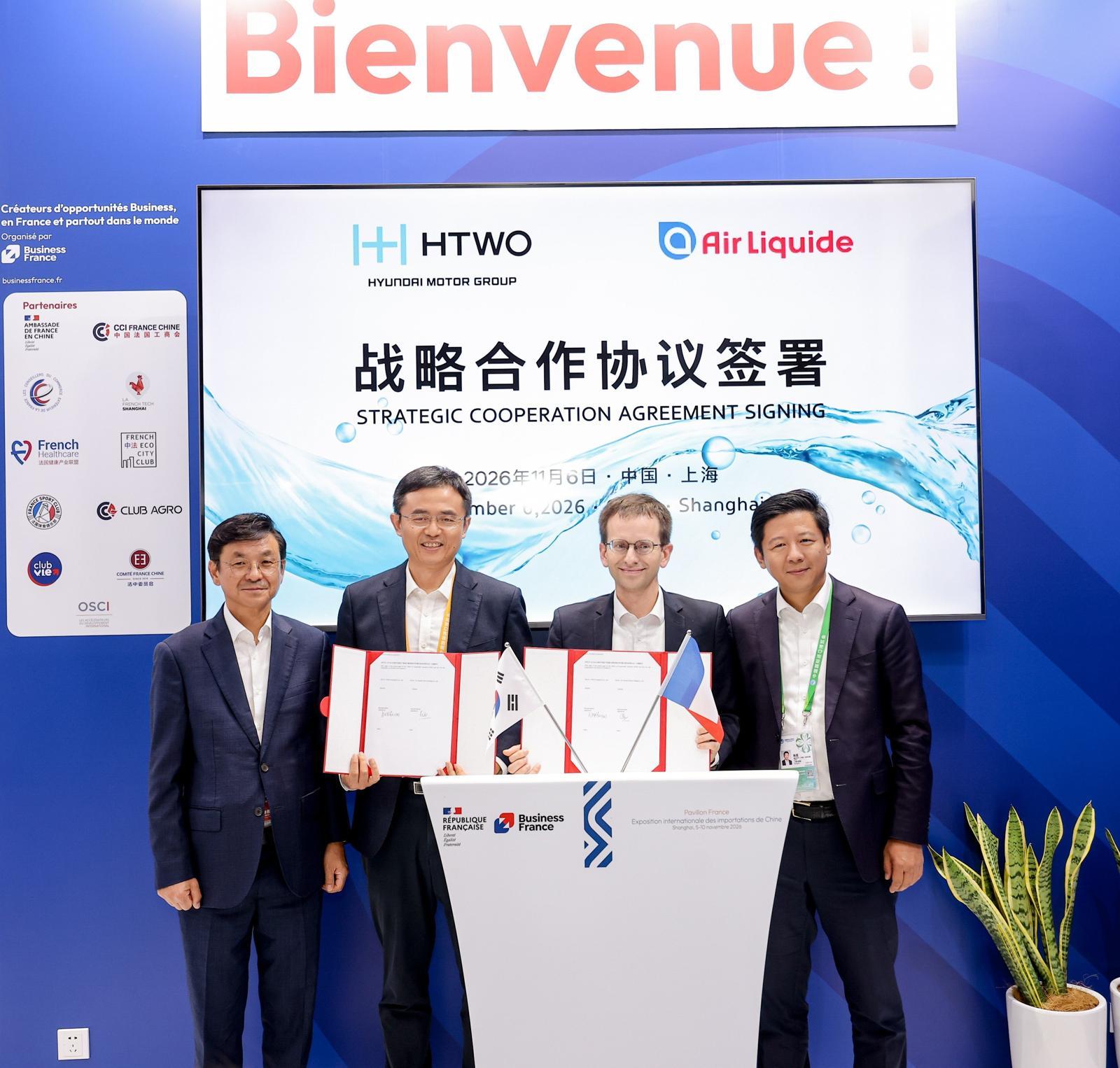
(From left) Choi Doo-ha, Executive Vice President and Head of Commercial Hydrogen for the China Region at Hyundai Motor Company and General Manager of HTWO Guangzhou, Sohn Heung-gi, Director at HTWO Guangzhou, Clement Lix, Vice President of Air Liquide China, and Chen Xing, Deputy General Manager of Air Liquide China. Provided by Hyundai Motor Group
Hyundai Motor Group is partnering with an energy company in China to develop a hydrogen commercial vehicle business model tailored to the local market. Having been expanding its hydrogen electric vehicle business in its home market, Hyundai Motor Group is now accelerating its efforts in China as well.
HTWO Guangzhou announced on the 9th that it signed a memorandum of understanding (MOU) for cooperation in the hydrogen mobility sector with the Chinese subsidiary of French energy company Air Liquide at the China International Import Expo held in Shanghai, China, on the 6th (local time).
HTWO Guangzhou is Hyundai Motor Group’s production hub for hydrogen fuel cell systems in China. This system, the core power source of hydrogen electric vehicles, functions as a generator that produces the electricity required for driving by using hydrogen and oxygen from the air.
Under the agreement, the two companies will establish a supply chain that covers everything from hydrogen supply and refueling to the operation of hydrogen commercial vehicles. HTWO Guangzhou will be responsible for locally customized research and development, production, and sales of hydrogen fuel cell systems. Air Liquide China will be in charge of the overall infrastructure, including hydrogen production, storage, transportation, and the installation and operation of refueling stations.
The two companies also agreed to jointly identify pilot models for hydrogen commercial vehicles, focusing on logistics transport routes. Their goal is to develop business models optimized for the Chinese market that minimize costs. Commercial vehicles run longer hours and distances while carrying heavier loads than passenger cars, and China has a vast territory. As a result, the key challenge is to develop technology that is both highly durable and cost-competitive. Choi Doo-ha, General Manager of HTWO Guangzhou, said, “Through this cooperation, we will contribute to the development of China’s hydrogen mobility industry.”
Hyundai Motor Group is also pushing ahead with a “hydrogen vehicle drive” in the domestic market as it responds to the future eco-friendly vehicle market. Kia recently decided to begin production of a hydrogen-powered model of the Carnival, its first mass-produced hydrogen vehicle, from 2029.
Choi Won-young
AI-translated with ChatGPT. Provided as is; original Korean text prevails.
ⓒ dongA.com. All rights reserved. Reproduction, redistribution, or use for AI training prohibited.