[In the Era of Climate Crisis: Securing Water Resources for the Future] Part 2: Seawater Desalination
Salt removed through 14,000 reverse osmosis membranes… supplied to four petrochemical companies in the Daesan industrial complex
Forty times cleaner than ordinary industrial water… but uses ten times the power of a typical water treatment plant
On the 5th, at the seawater desalination facility in the Daesan Coastal Industrial Zone in Seosan, South Chungcheong Province, opening the raw water storage tank filled with seawater revealed a strong sea scent mixed with saltiness. This seawater, drawn from the West Sea, is reborn as “pure-grade” water (water from which almost all salts and ions have been removed) after processes that remove suspended solids and salt. This water is then sent to the nearby Daesan Industrial Complex and used as industrial water.
Seawater desalination is a technology that removes dissolved salts and other substances from seawater to produce fresh water. In water-scarce Middle Eastern countries such as Saudi Arabia and Israel, a significant portion of domestic water is supplied through seawater desalination, making it a widely used method. In Korea, however, it did not receive much attention until recently, when recurring extreme droughts began to bring it back into the spotlight. Seawater is virtually limitless and does not dry up even without rainfall, enabling a stable water supply during droughts. It is being evaluated as a kind of “water insurance” for water-scarce coastal regions or industrial complexes.
● Seawater turned into “pure-grade” industrial water
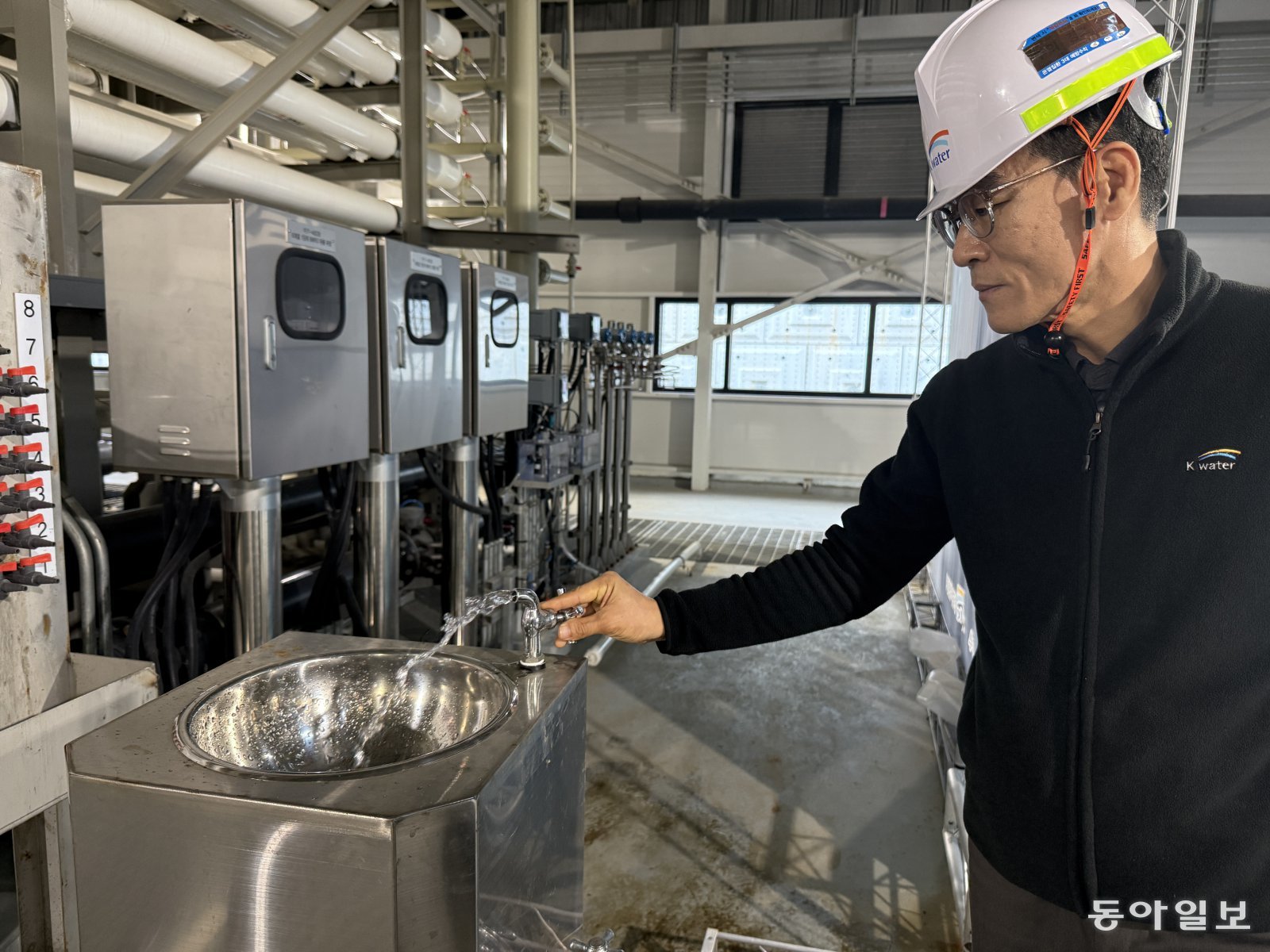
On the 5th, an employee of Korea Water Resources Corporation checks purified water at the seawater desalination facility in the Daesan Coastal Industrial Zone in Seosan, South Chungcheong Province. This facility filters about 224,000 t of seawater a day to produce about 100,000 t of fresh water. Seosan = Reporter Jeon Chae-eun chan2@donga.com
There are currently only three large-scale seawater desalination facilities completed in Korea. The first desalination facility, with a capacity to supply 45,000 t of domestic water per day, was built in 2014 in Gijang-gun, Busan. However, due to residents’ opposition over concerns that radioactive materials could be mixed in because of the nearby Kori Nuclear Power Plant, located about 11 km away, it has never supplied tap water. In the same year, POSCO built a facility with a capacity of 30,000 t per day in Gwangyang, Jeollanam-do, to supply water for its steel mill.
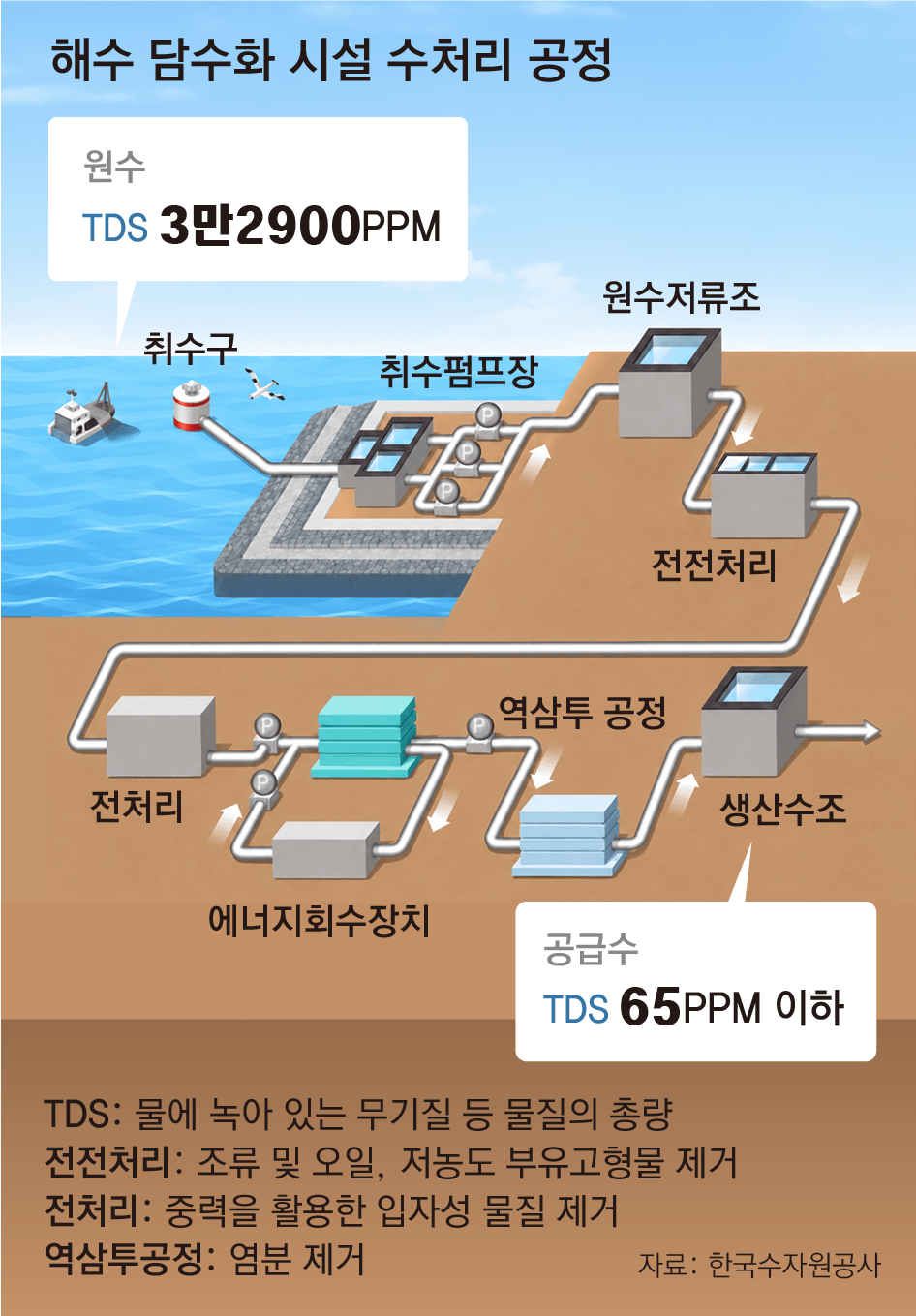
This was followed in June this year by the completion of Korea Water Resources Corporation’s seawater desalination facility in Seosan. Seawater drawn in at the intake tower in the Daesan Coastal Industrial Zone is conveyed to the facility through a 4.8 km pipeline. In the first stage of the process, fine air bubbles are injected to float contaminants lighter than water, such as oil or algae, to the surface, where they are removed. Remaining particles are then filtered out in filter beds layered with anthracite and sand.
In the reverse osmosis process, which is the core of seawater desalination technology, the seawater passes through about 14,000 reverse osmosis membranes, each about 1 m in length. When high pressure is applied to seawater, the salts are filtered out and only water molecules remain; this is called reverse osmosis. In this process, pressure 50–60 times atmospheric pressure is applied to the seawater, a force sufficient to propel water up to a height of 600 m.
The Seosan seawater desalination facility draws in about 224,000 t of seawater per day and produces 100,000 t of fresh water. The remainder is discharged back into the sea as concentrated brine with double the original salinity. The water produced is supplied as industrial water to four petrochemical companies in the Daesan Coastal Industrial Complex, including HD Hyundai Oilbank and LG Chem. In terms of domestic water, 100,000 t of industrial water is equivalent to the amount that about 300,000 people could use in a day.
The final product has a total dissolved solids (TDS – the total amount of substances such as minerals dissolved in the water) level of 1.6 ppm, making it about 40 times cleaner than the industrial water quality standard of 65 ppm. The TDS of seawater is about 32,000 ppm. Noh Dae-jin, deputy head of the Daesan Seawater Desalination Center at Korea Water Resources Corporation, stated, “We are developing technology to further filter this pure-grade water into ultra-pure water,” adding, “Once development is complete, by adding post-treatment processes, seawater desalination facilities will be able to produce industrial water suitable for use in semiconductor industrial complexes.”
● “If electricity is supplied directly from power plants, price competitiveness is possible” Technical limitations were also identified during operation. The West Sea has a tidal range of nearly 10 m, so the intake volume constantly changes even when the same pumps are operating. Because the seabed is mudflat, running additional pumps suddenly makes the water turbid, requiring a complete reset of the chemical dosing conditions needed for purification. Corrosion of equipment is also accelerated by salinity, shortening the service life of some components that are not designed specifically for seawater use.
The biggest obstacle is cost. While general water treatment plants consume 0.3–0.4 kWh of electricity to produce 1 t of water, the Seosan seawater desalination facility requires about 10 times that amount. This is because producing the high pressures used in the reverse osmosis process consumes a large amount of electricity. As a result, water produced at seawater desalination facilities is about 1.5 times more expensive than ordinary industrial water. For this reason, although local governments considering expansion of seawater desalination facilities are making frequent inquiries, few cases have led to actual implementation. Gangneung City in Gangwon Province, which was mentioned as an alternative during last year’s extreme drought, is also not taking proactive action due to the cost burden.
Recently, however, hydrogen production complexes have emerged as new demand centers, prompting Uljin-gun in North Gyeongsang Province and Yeonggwang-gun in Jeollanam-do to review seawater desalination facilities. Producing hydrogen by electrolysis of water requires clean water and massive amounts of electricity, and both Uljin and Yeonggwang are located near nuclear power plants.
Korea Water Resources Corporation believes that purchasing electricity directly from power plants could significantly reduce power costs and plans to consult with relevant agencies so that institutional improvements can be applied. Jang Seok-gi, head of the Industrial Water Department at Korea Water Resources Corporation, said, “Many local governments are hesitating because of the cost, and the key issue is electricity prices,” adding, “If electricity could be supplied directly from power plants, price competitiveness could be secured as well.”
ⓒ dongA.com. All rights reserved. Reproduction, redistribution, or use for AI training prohibited.
Popular News