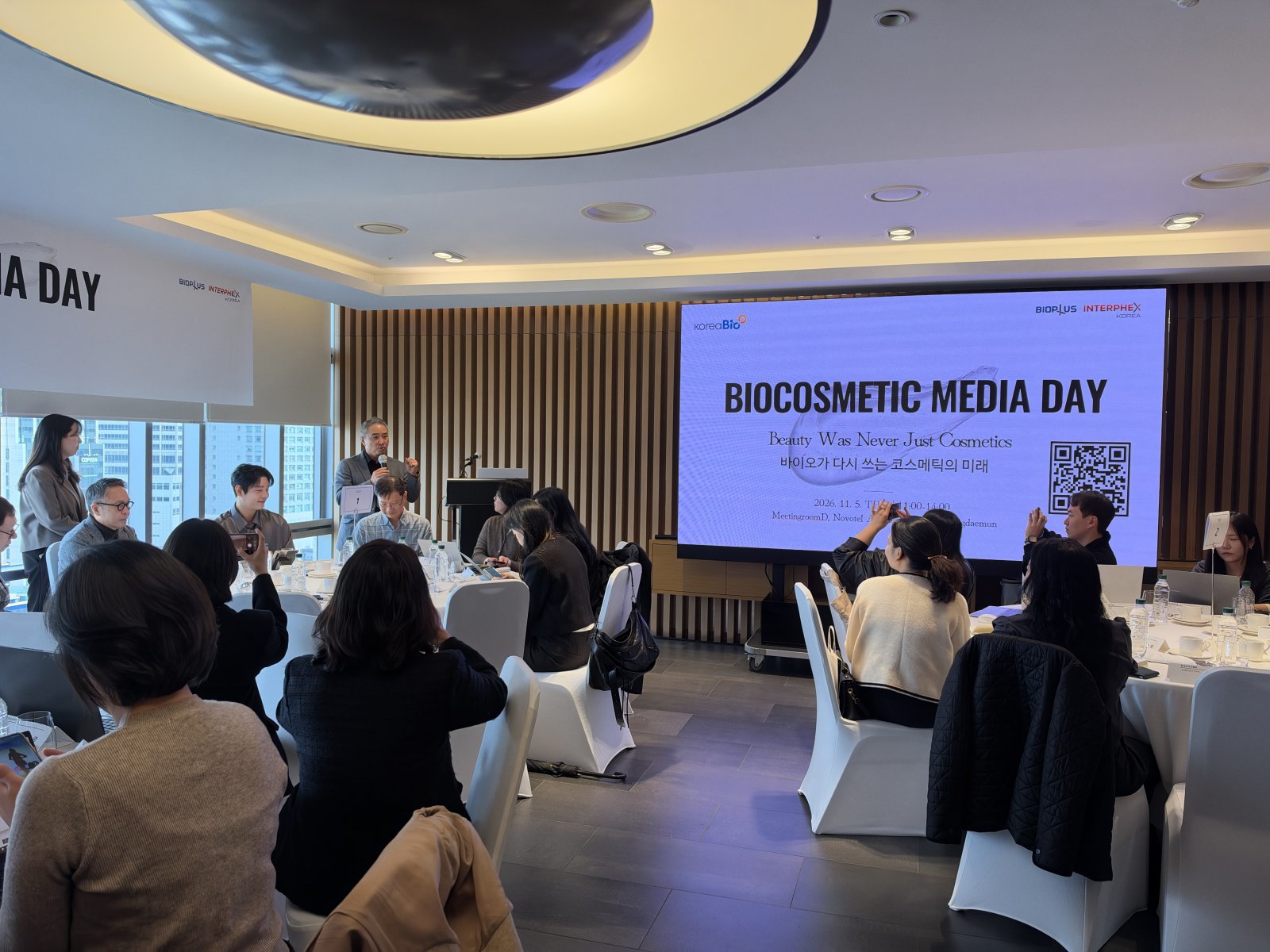
Lee Seung-kyu, Vice Chairman of the Korea Biotechnology Industry Organization, speaks at the “2026 Biocosmetic Media Day” held at Novotel Ambassador Seoul Dongdaemun in Jung-gu, Seoul, on the 5th. Photo provided by Korea Biotechnology Industry Organization
From centella-derived ingredients used in the wound treatment Madecassol to epidermal growth factor (EGF) that has been utilized in the development of treatments for diabetic foot ulcers, pharmaceutical and biotech companies are expanding their research technologies into the cosmetics market. However, the fact that a technology has been used in pharmaceutical research does not guarantee skin improvement effects in cosmetics. The key is to prove efficacy on actual skin and develop products that consumers will choose.
At the “2026 Biocosmetic Media Day” held on the 5th at Novotel Ambassador Seoul Dongdaemun in Jung-gu, Seoul, representatives from biotech and pharmaceutical companies, the cosmetics industry, and the investment sector shared commercialization cases of research technologies and strategies for entering the market. As moves to extend ingredients and technologies used in new drug development into the skin care field were introduced, the importance of verifying product efficacy and strengthening distribution and marketing capabilities was also highlighted.
● Madecassol’s centella and a diabetic foot treatment’s EGF…expanding into cosmeticsDongkook Pharmaceutical has expanded its beauty business by applying centella-derived ingredients, which it has used in the wound treatment Madecassol, to cosmetics. Its flagship brand is Centellian24. According to materials introduced by the company on the day, Centellian24’s cumulative sales from April 2015 to December 2024 exceeded KRW 1 trillion.
Even when the same ingredient is used, pharmaceuticals and cosmetics differ in product purpose and conditions of use. In the process of applying TECA, a standardized extract derived from centella, to cosmetics, Dongkook Pharmaceutical emphasized its technology for stably formulating the ingredient. The company explained that the challenge lay in resolving the difficulty of applying the ingredient in high concentrations due to its poor water solubility.
The cosmetic brand Easydew, which utilizes Daewoong Pharmaceutical’s research technology, was also presented as a case. Daewoong Pharmaceutical has been studying EGF in the course of developing treatments for diabetic foot ulcers. Based on this research, Easydew has expanded its product portfolio to include blemish ampoules, cushions, and post-procedure skin care products.
EGF is a protein involved in cell growth and proliferation. However, the mechanism of action confirmed in therapeutic development cannot be assumed to lead to the same level of efficacy in cosmetics. Efficacy and safety must be verified separately in line with the usage conditions and skin delivery methods of cosmetics.
● Applying new drug development technologies to skin care…biotech firms seek market entryBiotech companies engaged in new drug research are also broadening the scope of their technologies. Separate from the new drug business, which requires long development periods and substantial costs, they are seeking new business opportunities by applying technologies accumulated during research to the skin care field.
NovoMetaPharma presented a strategy to extend its peptide platform, used in new drug development, into the skin booster segment. The company explained that it is exploring applications in the skin field based on research results related to anti-inflammatory and anti-fibrotic effects and improvement of mitochondrial function.
The company is also pursuing global marketing for a skin booster that combines peptides with polynucleotides (PN). However, it is necessary to distinguish between the related research results and the actual efficacy of finished products on the human body when conducting evaluations.
Novacell Technology presented a case in which it expanded its technology from atopic dermatitis drug candidates to skin care products. It is an approach that broadens the scope of applications into the skin care field based on a peptide platform that promotes the resolution of inflammation.
The cases of the two companies show that research assets accumulated during the new drug development process are not necessarily used only for pharmaceutical development. However, in order to commercialize them as skin care products, it is necessary to review not only the potential mechanisms of the ingredients but also the actual efficacy and safety in finished products, as well as the regulatory classification of the products in which they are applied.
●
“Cell experiments alone are not enough”…need to prove efficacy on actual skinWhen applying biotechnology to cosmetics, ensuring that ingredients act effectively on actual skin is as important as securing new ingredients.
Park Won-seok, Executive Director at Amorepacific, presented clear targeting aligned with consumers’ skin concerns and mechanism of action, scientific evidence, skin delivery and formulation stability, safety, and differentiated efficacy compared with existing technologies as criteria for evaluating biotechnology.
He particularly emphasized the need to verify whether research results confirmed at the cellular level translate into effects on actual human skin. Even if promising results are obtained in the laboratory, it is difficult to achieve the expected effects if, when applied to cosmetics, the ingredient is not sufficiently delivered to the skin or formulation stability is not maintained.
Methods for verifying efficacy are also becoming more sophisticated. Park introduced an approach that supports efficacy by quantitatively analyzing biomarkers such as proteins within the skin, in addition to visible changes such as wrinkles and firmness.
Amorepacific cited Sulwhasoo’s ginseng research as a case of applying such technologies. The company is seeking to enhance product efficacy not merely by using ginseng extract, but by converting or concentrating specific components and applying technologies that deliver them to the skin.
As future research directions, he pointed to strengthening skin resilience, skin longevity (the long-term maintenance of skin health), and research using artificial intelligence (AI) and bioinformatics.
● For good ingredients to become successful cosmetics…distribution, marketing, and regulation are also keyFor biotech companies with technological capabilities to succeed in the cosmetics market, it is also necessary to turn their technologies into products that consumers can understand and choose.
Jung Su-min, Manager at IMM Investment, noted that biotech companies tend to focus on technological strengths such as the excellence of their ingredients and skin delivery, but that in the cosmetics market, product concepts that can be communicated to consumers, marketing, and suitable distribution channels are also important.
He suggested that instead of trying to secure all of these capabilities in-house, biotech companies should consider partnering with cosmetics companies that are strong in marketing and distribution. As fast-growing cosmetics companies are showing interest in differentiating products through new ingredients, there is potential for collaboration between the two sides, he explained.
Regulation is also a key variable for overseas market entry. Jung recounted a case in which introducing a new peptide ingredient to a global cosmetics company became difficult because collaboration hinged on whether the ingredient could be used in China, the main target market, and how long it would take to obtain regulatory approval there.
No matter how excellent an ingredient is, if it cannot be used as a cosmetic raw material in the target country, product launches may be hindered. This is why the suitability of raw materials, product classification, and the evidence supporting efficacy claims in labeling and advertising must be reviewed from the development stage.
For technologies originating from new drug research to gain competitiveness in the cosmetics market, research achievements alone are insufficient. Efficacy must be verified on actual skin, stable products must be developed, and their value must be communicated so that consumers understand it. How well biotech companies’ research capabilities are linked with cosmetics companies’ product development and distribution capabilities is likely to determine the success or failure of commercialization.
ⓒ dongA.com. All rights reserved. Reproduction, redistribution, or use for AI training prohibited.
Popular News