Finest offers automation solutions to companies without finance teams
Targeting the 80–90% of firms without finance departments… Integrating key data with client consent
A single engine from closing the books to analysis, cutting financial management costs by 70% at 33 client companies
A 1993-born Wharton graduate’s challenge… Expanding next year into a VC-matching investment platform
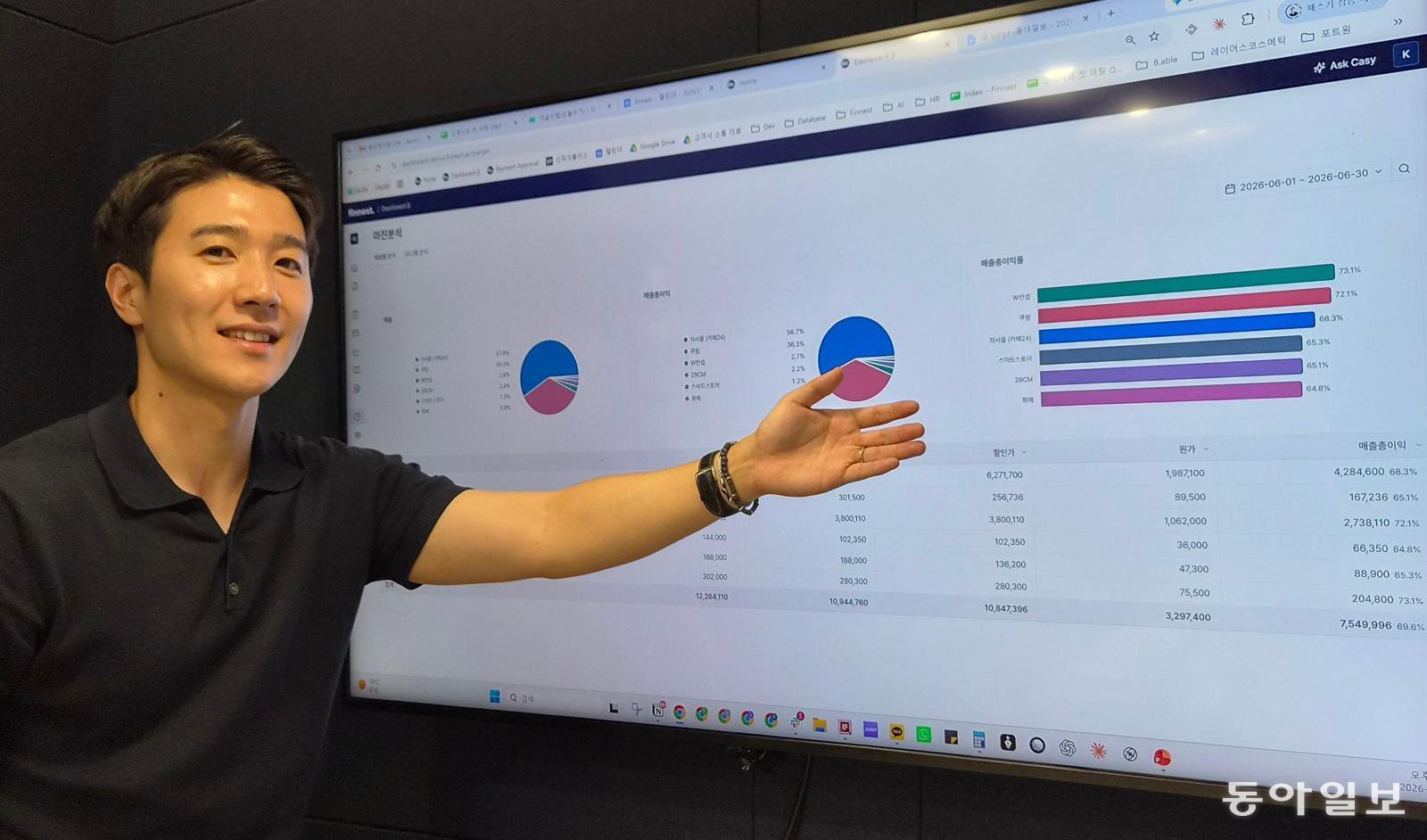
CEO Lim Ji-seop of Finest explains the automation methods of the company’s financial management service and the financial information it provides at the company’s office in Gangnam-gu, Seoul, in late September. He said, “I find it rewarding to provide real-time financial figures that help with management decisions.” Photo by reporter Heo Jin-seok, jameshur@donga.com
There are not a few company heads who run their business based on guesswork, thinking, “We sold about 100 units of our product today, so we must have this much left.” Whether the company is in the black or in the red only becomes clear around the time of the following year’s tax filing. Corporate card statements arrive the following month. To find out how much was sold through which channel and which business is generating profit, employees have to wrestle with Excel for days.
Maintaining an in-house finance team is a heavy burden. With at least two to three staff members plus four major social insurances and employee benefits, monthly costs easily exceed KRW 10 million. Furthermore, standard financial statements are prepared for corporate tax filing, so there are limitations in using them directly for management decision-making.
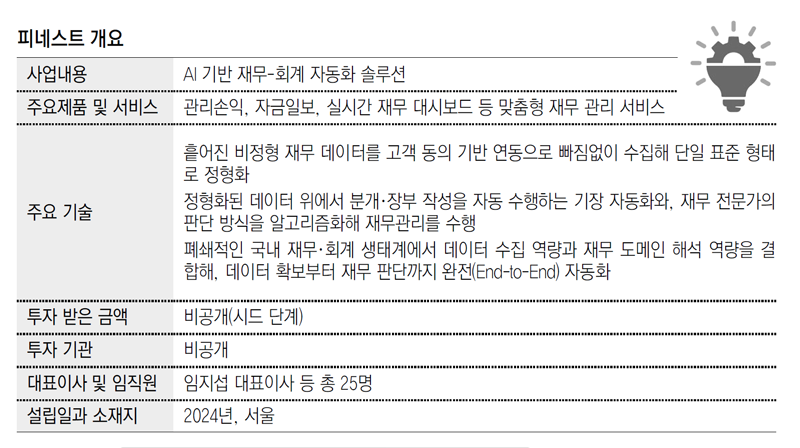
There is a startup that aims to bridge this gap with artificial intelligence (AI) and automation. Finest gathers scattered data ranging from bank transaction records to marketplace settlements and inventory costs, then performs bookkeeping, closing, and even produces analytical reports.
Met in late September at Finest’s office in Gangnam-gu, Seoul, 33-year-old CEO Lim Ji-seop described the company as “a place that builds an autonomous management solution that relieves startups and small and medium-sized enterprises of the burden of financial and management control, so they can focus on the real business problems they need to solve.” According to Finest, 80–90% of the approximately 500,000 startups and small and medium-sized enterprises in Korea do not have an internal finance and accounting team.
● ‘External automated finance team’ for companies without finance departments
Lim said, “There are so many excellent startups and small and medium-sized enterprises in Korea, but I have repeatedly seen management unable to focus on the issues they truly need to resolve because of the inconvenience of financial management.” He pointed to three main issues. Many CEOs do not know how much profit their company is actually making; financial statements prepared by tax accountants are produced only once a year or once a month, so they lack real-time relevance; and responding to financial data requests from investors and shareholders requires significant time and effort.
Why has this not been automated until now? Lim said, “In the United States, corporate cards and payroll tools are connected via application programming interfaces (APIs) to accounting enterprise resource planning (ERP) systems, but in Korea, most of these connection channels are blocked.”
Finest has gone beyond traditional bookkeeping agents, which stop at producing tax-filing ledgers, and beyond automation software, which only provides tools, by integrating data collection, classification, journal entry creation, closing, analysis, tax filing support, and payment execution assistance into a single engine. Lim said, “Unlike tools that stop at scraping bank or card statements, we collect source data such as inventory, logistics, and marketplaces, complete the classification and closing process, and take responsibility for the accuracy of the output.”
● Integrating data and turning scattered ledgers into a relational DB
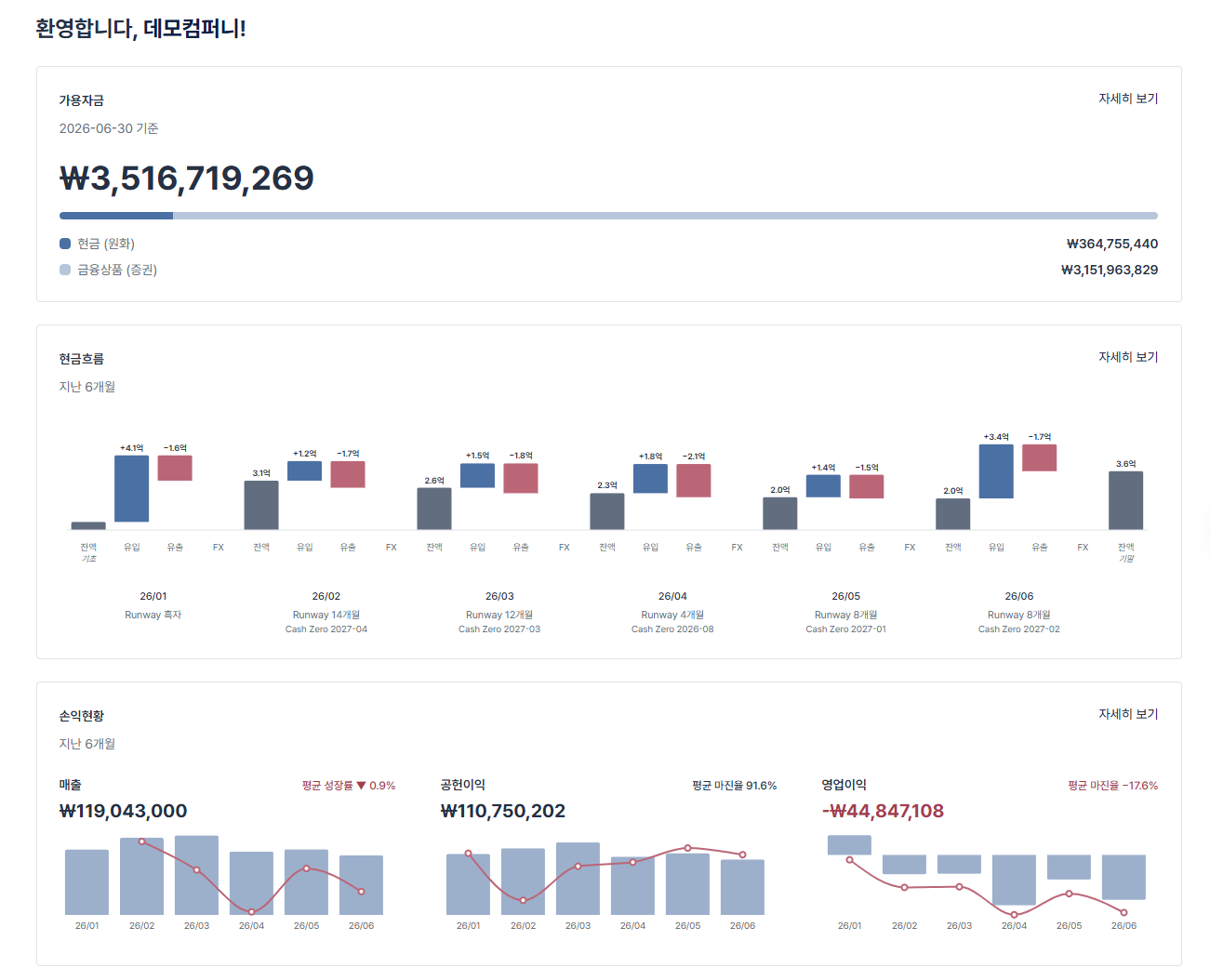
A hypothetical case of a dashboard provided by Finest. It displays all financial information in real time. Courtesy of Finest
The starting point of the core technology is securing data. Lim said, “We collect data by integrating it with the consent of client companies. Only when this is in place can bookkeeping, filing support, and analysis automation become possible.” Integration has been completed for bank transaction records, tax invoices, and most corporate cards, and many major marketplaces and payment gateways (PGs) have also been connected.
The differentiating factor lies in the next stage. Order and settlement data from sales channels, stock keeping units (SKUs) of finished products in logistics, and inventory costs are all managed under different code systems. These must be linked under the same identifier to calculate profit by channel and by product. Lim said, “One of our technological strengths is building a relational database that links these three into one,” adding, “It was originally all done manually by people.”
The classification process has also been automated. Transactions are categorized according to company-specific rules, with high-confidence transactions processed automatically and only low-confidence ones checked with the client. Lim said, “About 20% of the work requires judgment, and the remaining 80% consists of very similar transactions.”
The outputs are a dashboard providing a one-glance view of management profit and loss, daily cash reports, and financial statements, along with analytical reports issued twice a month. The service fee starts at KRW 1.5 million per month. The reports include not just figures but also reasons. Lim said, “If IT expenses increased by KRW 10 million from the previous month, for example, we explain that it was due to higher Microsoft costs, based on the transaction details.” A “financial agent” is also built into the dashboard. Lim said, “General-purpose AI does not have our company’s information. The agent we developed only answers based on the ledger we have completed.”
Results have begun to show. Lim said that the financial management costs of client companies fell by an average of around 70%. According to the company profile, one content and media client reduced its monthly financial management cost from KRW 15 million to KRW 4 million.
● A stable financier’s challenge to ‘support from behind’
Lim majored in finance and accounting at the Wharton School and worked in the investment banking division at Credit Suisse and the private equity division at Morgan Stanley before serving as chief financial officer (CFO) at startup Mathpresso.
The turning point came during investment due diligence. Lim said, “When reviewing multiple companies at the same time, there were far too many whose books were not properly organized.” Even companies with annual revenue of KRW 10–20 billion had five people in the finance and accounting team, yet they spent all their time collecting and processing data. He said, “In this day and age, it made no sense to me that so many people were manually collecting and processing data.”
The roots of Finest lie with co-founder and chief operating officer (COO) Kim Min. Having worked on finance teams at various startups, Kim started the business based on Excel and then identified points that could be automated one by one. Finest is the former financial technology startup BurnyRate. Chief technology officer (CTO) Yang Won-seok and Lim, who had worked with COO Kim at Mathpresso, later joined. The current development is handled by a five-member tech team that includes database engineers and cloud specialists.
Lim said, “I had no plans to start a business, but the urgency of the problem, the timing of AI making it solvable, the experience I built in investment and as a CFO, and the presence of a team of practical experts all came together at once.” He added, “Of course it was unsettling, but I was convinced this is what I could do best. For me, supporting the birth of good companies from behind felt like a bigger challenge.”
● Targeting 400,000 companies without finance teams
Finest currently has around 33 client companies, ranging from consumer brands to physical AI robot startups. Around 20 of its 25 employees form virtual finance teams with client companies to provide support. The focus now is on enhancing the completeness of integration with marketplaces and PGs, after which the company plans to move on to payroll and tax filing support and to automating financial closing.
Next year, once the number of client companies exceeds 100, Finest plans to build an investment platform on which venture capital (VC) firms can view financial information and company profiles collected with client consent. For overseas expansion, the company is considering entry into the United States and Japan, starting with integrated management of clients that have U.S. entities.
As a risk factor, Lim cited operational efficiency rather than competition. He said, “Demand has been validated. The issue is hiring and developing people so we can serve tens of thousands of clients, and making full use of our technology so we can reach critical mass quickly without bottlenecks. It is a battle with ourselves.”
Lim said, “Among the 500,000 companies in Korea, we want to provide our service to as many as possible of the 400,000 that do not have finance teams, so that good companies do not collapse simply because they lack proper financial management. Our goal is to become the kind of infrastructure company that any business must use if it is running a company.”
ⓒ dongA.com. All rights reserved. Reproduction, redistribution, or use for AI training prohibited.
Popular News