[Universities as Architects of Startups]③ 2D–3D Integrated LiDAR Developer VisionPark
Pusan National University Holdings’ seed investment and TIPS drive 2D–3D integrated sensor development
Customer contracts and on-site validation in progress
Mass production slated for full-scale rollout in 2027, with certification underway
[Busan National University Holdings X Dong-A Ilbo Joint Project] How do technologies born in university laboratories become businesses and advance into the global market? In this series, the focus is first on the technology commercialization strategy and startup support model of Busan National University Holdings. It then sheds light on how university research achievements develop into businesses and the potential of lab-based startups through the stories of five deep-tech companies that are taking on the global market together with Busan National University Holdings.
“There was a case where more than half of the motor-type LiDAR units used in a factory broke down. Since they were foreign-made products, it took time to receive replacement parts, and on-site we realized that if a single sensor stopped, the entire production line could come to a halt.”
Lee Gwi-yeon, CEO of industrial LiDAR startup VisionPark, gave this explanation of his startup’s inception in an interview with this newspaper on the 3rd. Lee spent more than 10 years at Jung Sang Lidar and Sungwoo Smart Lab developing firmware and control systems for industrial LiDAR, gaining first-hand experience in factories and logistics sites.
LiDAR (Light Detection And Ranging) is a sensor that emits a laser and calculates the time it takes for the light to be reflected back from an object to determine the distance and spatial relationship with surrounding objects. It is used in autonomous vehicles to detect nearby vehicles, pedestrians, and road structures, and in robot vacuum cleaners to identify the position of walls and furniture to map the interior of a home.
The LiDAR market is already dominated by U.S. and Chinese companies. Among these, Lee focused on industrial LiDAR used in factories and logistics centers. In Korean manufacturing sites, dependence on foreign products is high, so when a sensor breaks down, securing parts and performing repairs often takes a long time. At the same time, Korea has a large manufacturing base and automation facilities are rapidly increasing. Lee believed that if products could be quickly modified according to on-site requirements and maintenance could be provided promptly, domestically produced products would be competitive. This was the background to the founding of VisionPark in October 2024.
Lee Gwi-yeon, CEO of VisionPark. Provided by VisionPark
● Inconveniences witnessed on the factory floorLee identified three major problems with industrial LiDAR he observed on site. The first was durability and maintenance. Products that rotate mirrors or optical components with a motor can suffer wear of the rotating parts if exposed to vibration and shock over a long period. In the case of foreign-made products, it could also take a long time to procure parts and complete repairs after a breakdown, imposing a significant burden on production sites.
The second issue was the need to install multiple sensors together. 2D LiDAR is mainly used to detect obstacles, while 3D LiDAR is used to perceive the surrounding space in three dimensions. Because their functions differ, it was common to install multiple units together, for example, mounting two to three 2D LiDAR units on the overhead transport (OHT) systems of semiconductor fabs, or placing four 2D LiDAR units and two 3D LiDAR units on unmanned forklifts. As the number of sensors increased, installation space and wiring became more complex, and the points requiring maintenance also multiplied.
The third problem was that data formats and communication methods differed from manufacturer to manufacturer. To change products, it was sometimes necessary to modify the control software of existing equipment or reconfigure the interconnection between sensors. Once a certain product started being used, it was difficult to switch to another one easily, even if the price was high or parts procurement was slow.
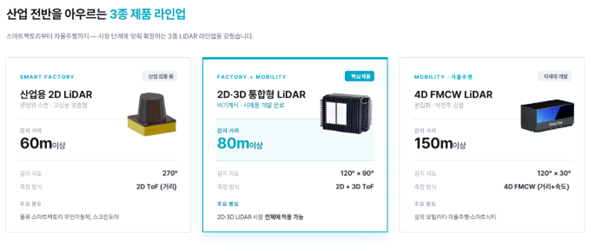
● Eliminating rotating parts and integrating sensors… “Being a latecomer made it possible”VisionPark focused on reducing to a single unit the LiDAR systems that previously had to be installed separately in multiple units. It designed a single sensor to handle both obstacle detection, previously done by 2D LiDAR, and spatial perception, handled by 3D LiDAR.
The company also addressed durability issues. Most existing industrial LiDAR systems use motors to rotate mirrors or optical components. VisionPark applied a semiconductor-based, non-mechanical beam steering technology to control the direction of the laser beam without mechanical rotation. This was intended to simplify the structure by eliminating rotating parts and reduce the likelihood of failures due to wear.
Signal-processing functions were also embedded inside the sensor. Using an FPGA (Field Programmable Gate Array), the sensor internally performs distance calculations, detection-area determinations, and signal corrections. This allows the sensor to process information in real time without relying on external equipment.
Installation, wiring, and output conditions were matched to those of existing 2D scanners so that products could be replaced without major changes to existing equipment. Lee cited their status as a market latecomer as the background that made such an integrated product possible. Existing global players have long sold 2D and 3D products separately, so they had little incentive to combine the two functions into one. VisionPark, by contrast, was able to design its products from the outset on the premise of integration. “Precisely because we are a latecomer, we were able to approach the design differently from the very beginning,” Lee said.
Products under development at VisionPark. Provided by VisionPark
● Initial investment of KRW 300 million and TIPS KRW 500 million… Turning technology into productsIn its early days, VisionPark lacked development funding to commercialize its integrated 2D/3D LiDAR as a product. Capital was required to secure personnel and equipment, and even after a prototype was built, performance had to be repeatedly adjusted to meet customer requirements.
Busan National University Holdings made a seed investment of about KRW 300 million in VisionPark. As a TIPS operator, it also took on the task of recommending the company for the program. VisionPark was selected for TIPS in 2025 and secured KRW 500 million in government research and development funding. “Based on the initial investment and TIPS funding, we were able to focus on developing our core technologies,” Lee said.
Busan National University Holdings also participated in the commercialization process. It worked with VisionPark to review commercialization strategies and assisted with investor relations and responses to government project calls to attract investment. It also provided support for utilizing Busan National University’s research infrastructure and connected the company with investors and end-user companies.
“For an early-stage startup that only had technology, Busan National University Holdings was both the first investor and a partner in the commercialization process,” Lee said. “We were able to concentrate on R&D and lay the foundation for turning customer validation into revenue.”
● Targeting KRW 10 billion in annual sales within three years… Aiming to become the standard sensor for industrial sites
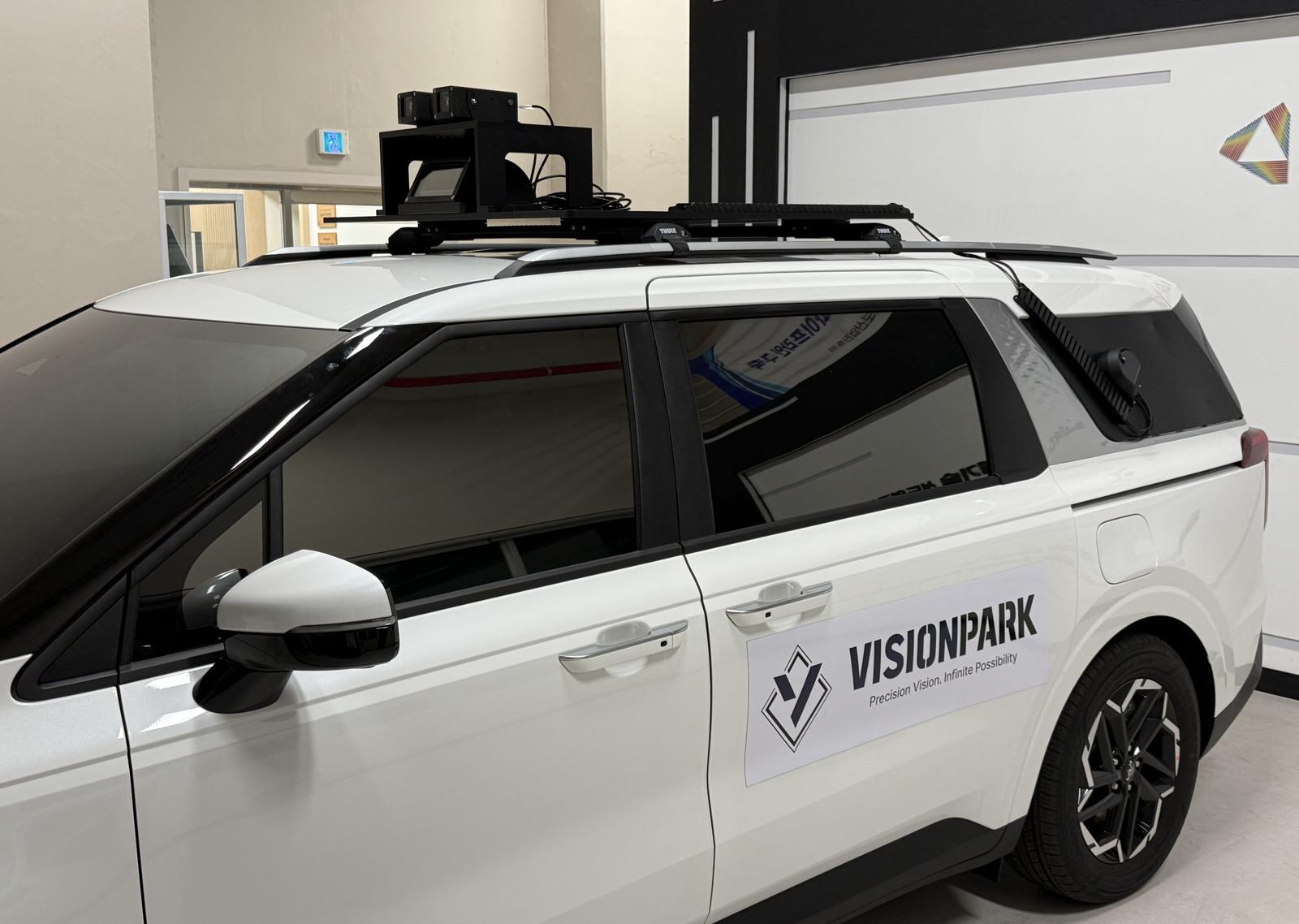
A vehicle equipped with 4D FMCW LiDAR. Provided by VisionPark
VisionPark’s flagship integrated 2D/3D LiDAR completed prototype development in January 2026. The company is currently in the stage of installing products at customer sites, incorporating their requirements, and refining performance. Development is proceeding in four stages—product design, on-site validation, debugging, and mass-production design—with the company now in the third stage, customer-site validation.
The prototypes have been applied this year to first-tier automotive suppliers, logistics centers, and vision inspection equipment. Sample sales have begun, and revenue is now being generated. For robotics companies, VisionPark is conducting product demonstrations and technical validation (OPC), then modifying products to match each customer’s equipment environment and requirements before reapplying them on site. Based on this, VisionPark expects sales of around KRW 1.5 billion this year.
The company plans to begin initial mass production of the integrated 2D/3D LiDAR in 2027. It will establish assembly and verification lines to meet initial demand, and as production volume increases, it intends to collaborate with external manufacturing partners or expand its own production lines. It is also pursuing certifications required for entry into domestic and overseas markets, including international industrial safety standards.
Starting with smart factories, VisionPark aims to expand its application range to unmanned vehicles and robots in logistics centers, ports, shipyards, and construction sites, targeting annual sales of KRW 10 billion within three years. Its fundraising roadmap envisions a pre-Series A round in 2027 followed by a Series A round in 2028.
“We want to create a domestically produced sensor that becomes the standard in Korean manufacturing sites,” Lee said. “Ultimately, our goal is to reduce blind spots in sensing and build industrial sites where people do not get hurt.”
ⓒ dongA.com. All rights reserved. Reproduction, redistribution, or use for AI training prohibited.
Popular News