Jointly developed by UNIST and POSTECH research teams Breaks down when heated to 50°C under light Could cut recycling costs if commercialized
ⓒNEWSIS
A technology has been developed that decomposes discarded PET bottles using light and heat and converts them into raw materials for new PET bottles and various chemical products. As this technology decomposes waste PET bottles at lower temperatures than existing processes and allows easy separation of the resulting raw materials, it is expected to reduce recycling costs.
Ulsan National Institute of Science and Technology (UNIST) announced on the 4th that a research team led by Professor Ryu Jeongki of the Department of Energy and Chemical Engineering, in collaboration with a team led by Professor Park Soo-jin at Pohang University of Science and Technology (POSTECH), has developed a technology to obtain two types of chemical feedstocks from waste PET. When PET bottles are chemically decomposed, raw materials for new plastics can be obtained. However, conventional processes often require high temperatures and pressure, as well as organic solvents. Additional costs are also incurred to separate and purify the produced substances, which are mixed in solution.
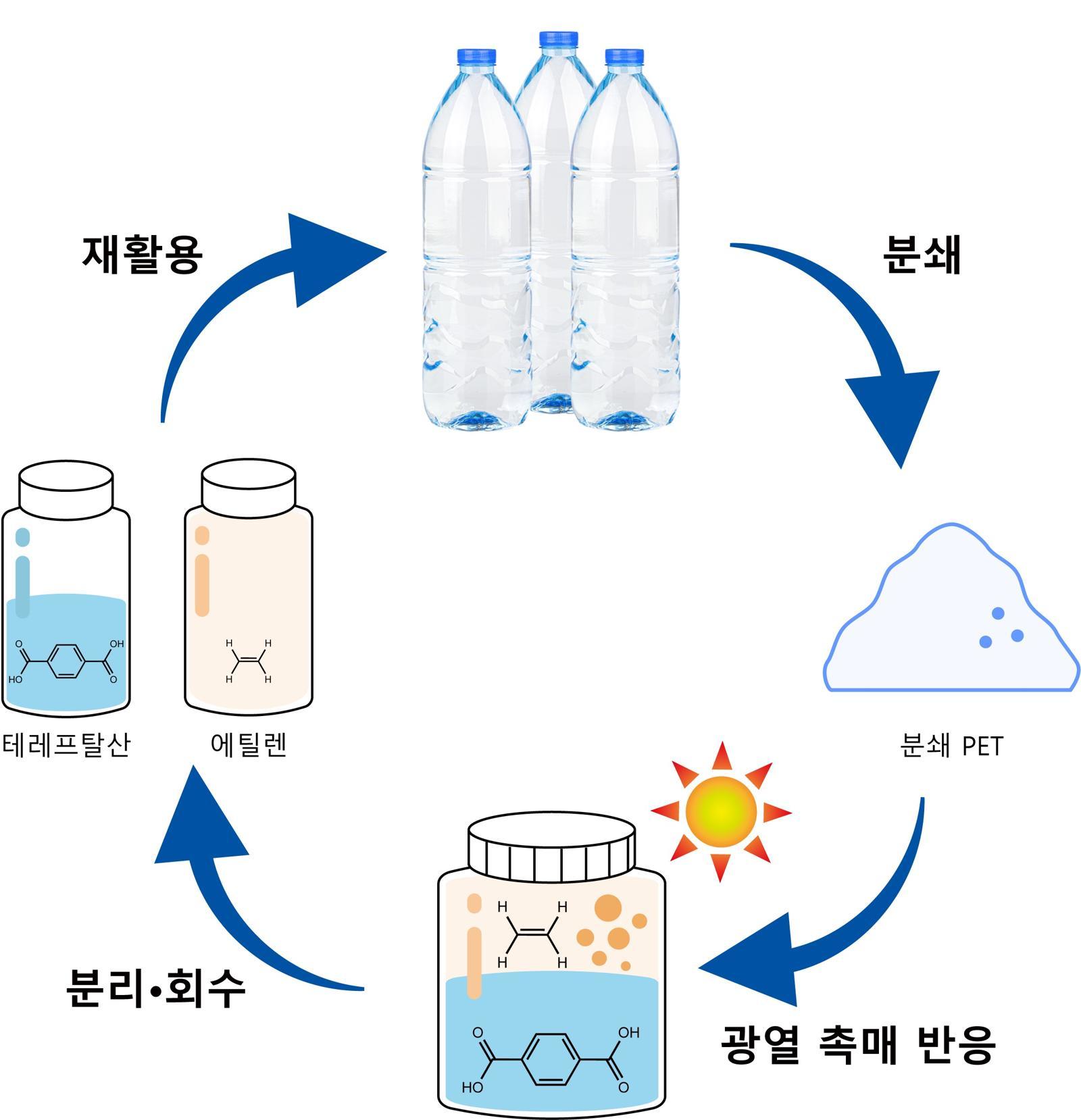
Conceptual diagram of resource circulation of waste plastics using a photothermal catalytic reaction. (Provided by UNIST. Redistribution and DB prohibited)/News1
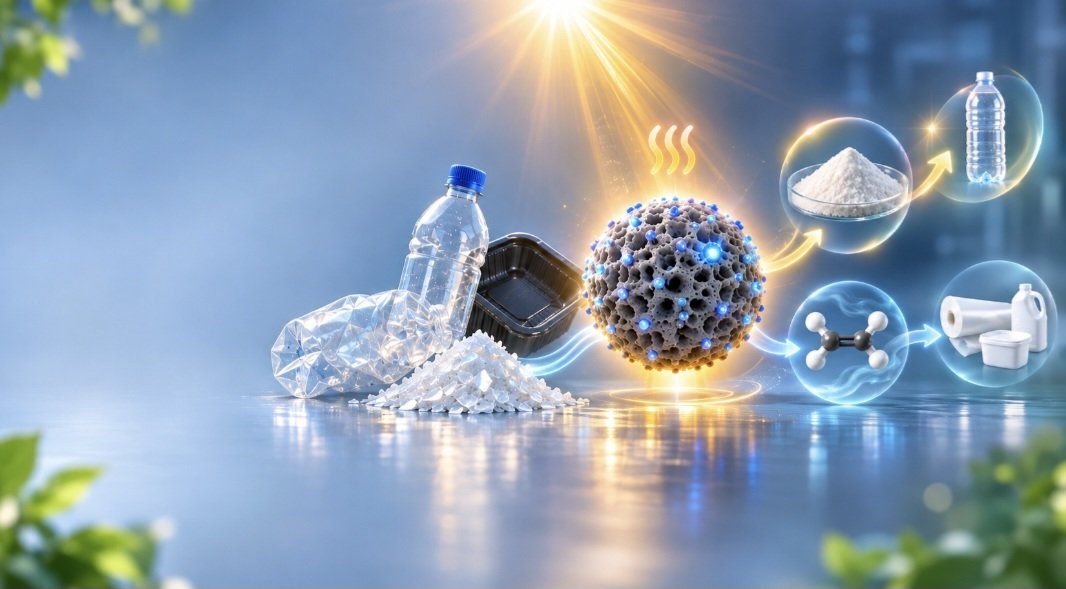
To solve these problems, the research team used a combination of light, heat, and a special catalyst. Waste PET is pulverized, placed together with the catalyst in a diluted sulfuric acid solution, and then heated to 50 degrees Celsius while being exposed to artificial light similar to sunlight.
In this process, PET is decomposed into terephthalic acid and ethylene. Terephthalic acid is a raw material used to manufacture PET bottles again, and ethylene is a basic feedstock for a wide range of chemical products. In particular, because terephthalic acid can be filtered out as a solid and ethylene can be collected as a gas, the process of separating the two substances becomes significantly simpler.
Experimental results showed that 73.2% of the PET powder was converted into other substances within 24 hours. The yields of terephthalic acid and ethylene were 69.4% and 39.1%, respectively. In experiments using actually discarded transparent PET bottles and black food containers, the yields of terephthalic acid were 91.4% and 90.8%, respectively.
Yield refers to the actual amount produced relative to the theoretically obtainable amount. Additional verification is required before commercialization. Impurities and hydrogen gas mixed with the produced substances must be removed, and economic viability must be secured in large-scale processing as well.
Professor Ryu stated, “Commercialization of existing chemical recycling has been slow because process costs are high,” adding, “This technology will help reduce costs by simplifying the production and recovery of feedstocks.” The research findings were published in the September 30 issue of the international journal Chemical Engineering Journal.
Choi Chang-hwan
AI-translated with ChatGPT. Provided as is; original Korean text prevails.
ⓒ dongA.com. All rights reserved. Reproduction, redistribution, or use for AI training prohibited.